India’s economy has started the financial year 2026-27 on a stronger footing than many expected, with real GDP Growth of 7.8% in the April-June quarter. The number has reinforced the country’s position as one of the fastest-growing major economies and provided fresh evidence of resilience despite a difficult global Environment.
But a strong quarter is not the same thing as a successful 20-year development strategy.
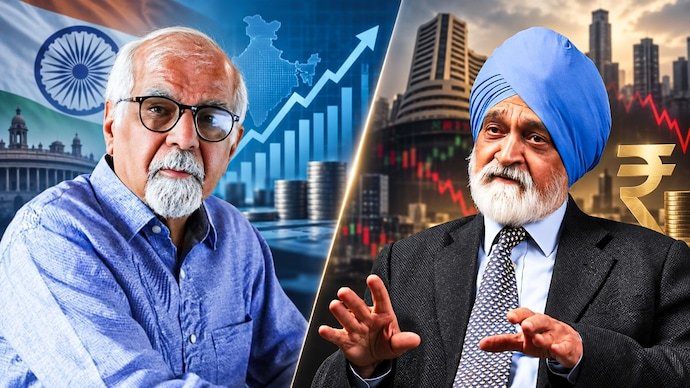
That is the central message from two prominent Indian economists, Surjit Bhalla and Montek Singh Ahluwalia, who have argued that the pace of growth needed to achieve India’s Viksit Bharat 2047 ambition must be substantially higher and, more importantly, sustained for many years.
Their assessment does not amount to a rejection of the latest GDP data. Both economists, along with economist Neelkanth Mishra, have rejected suggestions that the latest growth figures are simply a product of political manipulation. Their concern is what happens after a good quarter: whether India can maintain high growth, create enough productive employment, raise per-capita incomes and broaden the benefits of expansion.
For India’s development ambitions, that distinction could be more important than the headline 7.8% number itself.
What is Viksit Bharat 2047?
Viksit Bharat 2047 is the Indian government’s long-term ambition of transforming India into a developed country by the centenary of Independence in 2047.
The objective goes beyond increasing the size of the economy. It encompasses higher per-capita income, improved living standards, stronger Infrastructure, better human capital and wider access to economic opportunities.
That means the success of the vision cannot be judged solely by whether India occasionally records growth rates above 7%.
A country can expand rapidly without every household experiencing the same improvement in living standards. Similarly, GDP can grow strongly while employment creation remains weak in some sections of the economy.
This is why Bhalla and Ahluwalia are focusing on the longer-term growth trajectory rather than treating the latest quarter as proof that India is already on track for developed-country status.
7.8% growth is encouraging, but the timeline changes the calculation
India’s 7.8% GDP growth in the first quarter of 2026-27 is a strong result by the standards of major economies. It indicates that domestic economic activity remains resilient and that growth has not collapsed despite global uncertainty.
But becoming a developed economy by 2047 involves increasing national output and, crucially, income per person over two decades.
That requires sustained compounding.
A growth rate of 7% or 8% maintained for a long period can dramatically increase the size of an economy. But the starting point also matters. India has a much lower per-capita income than advanced economies, meaning the country needs both rapid aggregate growth and strong population-wide increases in productivity and incomes.
That is the reason a good quarter cannot settle the Viksit Bharat debate.
Surjit Bhalla says India needs sustained double-digit growth
Surjit Bhalla, who has served as India’s Executive Director at the International Monetary Fund, remains sceptical about the 2047 target under the current growth trajectory.
He has argued that India would need sustained double-digit growth to have a realistic chance of reaching the levels of income associated with developed economies.
Bhalla’s argument has an important qualification: he is not saying the latest GDP number is necessarily wrong.
In fact, his assessment has evolved on some aspects of the economy. He has pointed to an increase in the investment-to-GDP ratio to around 34% as a positive development.
That improvement matters because sustained investment is one of the foundations of long-term productivity growth. More capital can increase productive capacity, improve infrastructure and allow businesses to adopt better technology.
But Bhalla believes the improvement is not enough to alter the broader challenge facing the 2047 target.
Why dollar income matters for the developed-country goal
One of Bhalla’s central arguments is that developed-country status must ultimately be considered in terms of per-capita income measured in dollar terms.
India can record impressive growth in domestic-currency terms while remaining far below the income levels of advanced economies.
The gap becomes clearer when India is compared with large economies that have already reached high-income levels.
According to World Bank data cited in the discussion, India’s per-capita GDP was around $2,695 in 2024, compared with roughly $13,303 in china, $53,246 in the United Kingdom and $84,534 in the United States.
Closing a gap of that scale within two decades requires much more than a handful of years with above-average GDP growth.
It requires rapid productivity gains, a strong investment cycle, rising wages and greater participation in high-value economic activity across the population.
Ahluwalia agrees that India is not yet on the required track
Montek Singh Ahluwalia, the former deputy chairman of the Planning Commission, has taken a somewhat more cautious tone than Bhalla but reaches a similar broad conclusion.
His assessment is that India is performing better than some pessimistic forecasts had suggested, but the current growth rate should not be mistaken for proof that the country is already on the trajectory required for Viksit Bharat.
Ahluwalia’s message is essentially that 7.8% is good news, but it is not a development strategy.
A country seeking to transform its economic structure over two decades needs consistent reforms that increase productivity and expand opportunities rather than relying on periodic bursts of growth.
That means India must ask not only how fast GDP is expanding, but also where that expansion is occurring and who is benefiting from it.
The K-shaped growth problem
One of Ahluwalia’s most important warnings concerns the possibility of a K-shaped economy.
A K-shaped recovery describes a situation in which different parts of an economy move in sharply different directions or grow at very different speeds.
In India’s case, the concern is that highly productive formal-sector companies, technology-driven industries and asset-owning households may experience rapid gains while smaller businesses, informal workers and lower-income households see much slower improvement.
Ahluwalia has argued that the existence of strong aggregate GDP growth does not automatically disprove this phenomenon.
That distinction is vital for the Viksit Bharat goal. A developed economy requires broad-based gains in productivity and living standards, not simply a high national growth rate concentrated in a limited number of sectors.
Why GDP alone cannot measure development
GDP is one of the most important indicators of economic performance, but it does not capture every aspect of development.
A rising GDP tells us that the economy is producing more goods and services. It does not by itself reveal whether wages are rising quickly enough, whether jobs are being created for young workers, whether regional disparities are narrowing or whether small businesses are sharing in the expansion.
That is why economists often distinguish between economic growth and economic development.
Growth provides the resources needed for development, but the quality of that growth determines how effectively those resources improve living standards.
For India, this distinction becomes increasingly important as the country approaches the midpoint of the Viksit Bharat timeline.
The jobs problem behind India’s growth story
Employment is one of the biggest challenges associated with turning high GDP growth into widespread prosperity.
India has a very large working-age population, which creates both an opportunity and a policy challenge. If millions of young people enter productive employment, the country can benefit from what economists describe as a demographic dividend.
If employment creation does not keep pace with the expansion of the labour force, the same demographic structure can create economic and social pressure.
Ahluwalia has particularly highlighted the difficulty of creating enough jobs for educated young Indians.
The issue is not simply the number of jobs. It is also the type of jobs being created and whether they match the qualifications and expectations of the workforce.
AI and data centres may not solve India’s employment challenge
One emerging concern is that some of the industries expected to drive future growth may be highly capital-intensive.
Artificial intelligence infrastructure, data centres and advanced technology businesses can generate significant economic output, but they do not necessarily employ workers on the same scale as labour-intensive manufacturing or large consumer industries.
That creates a potential mismatch for India.
The country needs productivity-enhancing technology to become richer, but it also needs sectors capable of absorbing millions of workers into productive employment.
A development strategy focused heavily on capital-intensive industries could therefore produce impressive GDP numbers without solving the employment challenge at the scale required.
Surjit Bhalla disagrees that India simply has no jobs
Bhalla offers a different interpretation of India’s employment problem.
He has rejected the simple argument that India does not have enough jobs and has pointed instead to the mismatch between the Education system and the type of employment available.
According to Bhalla, salaried employment has grown strongly over the past decade, but the supply of educated workers has expanded faster than the number of jobs requiring graduate-level qualifications.
That means the problem may be less about the complete absence of economic opportunities and more about the structure of those opportunities.
Many young Indians aspire to professional or salaried positions, while the economy continues to generate large numbers of jobs across informal, self-employed and lower-productivity activities.
For Viksit Bharat, the challenge is to narrow this mismatch by creating more productive, better-paying employment.
India followed an unusual route to economic development
Another major issue raised in the broader discussion is that India has not followed the same development path as several successful Asian economies.
Economist Rohit Lamba, an assistant professor of economics at Pennsylvania State University, has argued that India’s growth model has departed from the conventional sequence followed by economies such as China and South Korea.
The traditional development pattern often involves moving workers from low-productivity agriculture into labour-intensive manufacturing before gradually transitioning toward higher-value services and technology.
China and South Korea were able to compress large portions of that transition over several decades.
India, by contrast, moved relatively quickly from an agriculture-heavy economy toward services without manufacturing becoming the dominant source of either economic output or employment.
Why manufacturing remains important
India’s unusual development path does not mean manufacturing is irrelevant.
Manufacturing can play an important role in increasing productivity, creating jobs for workers with different skill levels, supporting exports and connecting domestic firms to global supply chains.
But the debate is about how manufacturing fits into India’s current development stage.
Lamba’s argument is essentially that India should not assume that it can mechanically reproduce China’s earlier growth model after the Global Economy has already changed.
Instead, policymakers need to identify areas where India can build competitive advantages while ensuring that growth produces jobs and raises incomes beyond a narrow group of high-productivity sectors.
India’s per-capita income gap remains enormous
The difference in per-capita income between India and richer economies explains why the Viksit Bharat deadline presents such a demanding target.
India’s per-capita GDP of around $2,695 in 2024 was only a fraction of the levels recorded in advanced economies.
China’s figure was roughly $13,303, while the United Kingdom stood near $53,246 and the United States around $84,534.
These comparisons should not be treated as a simple ranking of economic performance because countries differ in population, prices, exchange rates and economic structures. But they illustrate the scale of the income gap India needs to narrow.
That gap is precisely why sustained compounding is so important.
A single quarter cannot establish a 2047 trajectory
Ahluwalia has cautioned against drawing sweeping conclusions from one strong quarter.
The 7.8% result is significant, but quarterly growth rates can be influenced by base effects, seasonal patterns, sector-specific changes and temporary shifts in investment or consumption.
What matters for a 2047 target is the average rate of productivity and income growth sustained over many years.
A strong quarter can demonstrate resilience. It cannot prove that the same pace will continue for 20 years.
That is why the economists’ concerns remain relevant even after a better-than-expected GDP report.
The GDP debate is not the main issue anymore
The latest GDP series has generated political arguments over methodology, revisions and the reliability of the growth estimates.
But Bhalla, Ahluwalia and Neelkanth Mishra have broadly rejected the idea that India’s growth data has simply been manufactured for political purposes.
The more useful question, in their view, is what happens after the number is accepted.
If India is genuinely growing at close to 8%, can that rate be sustained? Can investment rise further? Can productivity improve? Can enough high-quality jobs be generated? Can exports become more competitive? Can the gains reach smaller firms and lower-income households?
Those questions matter far more to the 2047 goal than a political argument over a single quarterly figure.
India needs greater openness to global trade
Both Bhalla and Ahluwalia have argued that greater integration with the global economy should be an important part of India’s growth strategy.
Ahluwalia has advocated a more open trade regime, including lower tariffs on imported inputs and deeper participation in international trade agreements.
His argument is that Indian companies should be exposed to enough global competition to become more efficient and competitive rather than relying excessively on protection.
Trade openness can also provide access to cheaper inputs, technology and larger foreign markets.
For a country seeking to increase manufacturing and exports, this could be particularly important because successful integration into global supply chains often depends on importing sophisticated components and intermediate goods as efficiently as possible.
Why lower input tariffs could matter
Tariffs are often justified as a tool for protecting domestic producers, but high duties on imported inputs can increase the cost of production for Indian companies.
A manufacturer that pays more for machinery, components or raw materials may become less competitive internationally.
That creates a difficult policy trade-off.
Protection can help emerging domestic industries build capacity, but excessive protection can also reduce competitive pressure and raise costs.
Ahluwalia’s argument is that India needs greater confidence in its ability to compete and should therefore move toward a more open economic model.
Trade agreements could expand India’s growth opportunities
Ahluwalia has pointed to India’s trade agreements with the United Kingdom and European Union as important opportunities while also arguing that India should consider deeper integration with other major trading blocs.
Greater access to international markets could help Indian manufacturers and service providers increase exports, attract investment and participate more deeply in global production networks.
But trade agreements work best when domestic businesses are capable of competing in the markets they open.
That brings the discussion back to productivity, logistics, skills, infrastructure and regulatory efficiency.
Trade policy cannot substitute for domestic reform; it has to work alongside it.
India needs to move from broad reform promises to specific reforms
One of Ahluwalia’s strongest recommendations is that India should move beyond general statements about reform and focus on specific changes.
Long-term development depends on the details of policy implementation: how easy it is to start and expand a business, how quickly infrastructure projects are completed, how predictable regulations are, how efficiently courts resolve commercial disputes and how effectively workers acquire new skills.
Calling for reform is easy. Identifying the reforms that have the largest measurable impact and implementing them consistently is much harder.
That implementation challenge could become one of the decisive factors in whether India can move from high growth to developed-economy status.
Medium-sized businesses could be critical
Large corporations often have the resources to navigate complex regulations, invest in technology and access international capital.
Smaller enterprises, however, can struggle to scale when compliance costs are high or access to finance is limited.
Ahluwalia has argued that medium-sized firms deserve particular attention in India’s development strategy.
A stronger mid-sized business ecosystem could help bridge the gap between informal micro-enterprises and large corporations while creating more productive employment.
It could also improve competition and give India’s manufacturing and services sectors a broader base of internationally competitive companies.
Investment is improving, but capital alone is not enough
Bhalla’s reference to an investment-to-GDP ratio of around 34% points to one of the more encouraging aspects of the current economic picture.
Investment is essential to long-term growth because new factories, infrastructure, machinery, technology and business capacity increase the economy’s productive potential.
But high investment does not automatically guarantee high productivity.
The quality of investment matters, as does how efficiently capital is allocated.
India therefore needs an environment in which businesses invest not only because of short-term incentives but because they expect rising demand, reliable infrastructure, predictable policy and access to large domestic and international markets.
Foreign investment remains part of the equation
Another issue raised by Bhalla is India’s relationship with foreign investment.
Foreign direct investment can bring capital, technology, managerial expertise and access to international supply chains. At the same time, domestic investment and entrepreneurship remain essential because no country can build a large economy through foreign capital alone.
The broader objective should therefore be to create conditions in which both Indian and international investors see long-term value in expanding capacity within the country.
That requires policy stability as much as financial incentives.
What India needs to sustain high growth until 2047
Reaching the Viksit Bharat goal will require India to sustain high growth over a period measured in decades rather than quarters.
That means maintaining investment while increasing productivity, improving human capital and expanding the number of people engaged in productive employment.
India will also need stronger infrastructure, competitive businesses, efficient logistics, higher labour productivity and greater participation in international trade.
None of these changes can be achieved through a single budget, government programme or election cycle.
The challenge is to create a policy framework that remains effective as the economy becomes larger and more complex.
Human capital may determine whether the target is achievable
A richer India needs a more productive workforce.
That requires improvements in education, vocational training, healthcare and the ability of workers to adapt to technological change.
The mismatch identified by Bhalla between the number of educated workers and suitable graduate-level jobs shows that education policy and economic policy cannot be treated separately.
If India’s education system produces qualifications without corresponding improvements in employability and productivity, the country risks expanding frustration rather than income.
The Viksit Bharat vision therefore needs to include not only more years of education but better alignment between skills, industry demand and economic opportunities.
The informal economy cannot be left behind
Broad-based development also requires productivity improvements among smaller businesses and informal workers.
India’s economy remains diverse, with modern corporations operating alongside millions of small enterprises and self-employed workers.
A high-growth path that benefits only large formal companies could widen the gap between different sections of the economy.
Policies that improve access to formal credit, technology, infrastructure and markets can help smaller firms become more productive and gradually scale up.
That is directly connected to Ahluwalia’s concern about the K-shaped nature of growth.
Can India sustain 8% growth?
Maintaining growth close to 8% for many years would itself represent a significant economic achievement.
Doing so requires avoiding repeated slowdowns caused by weak private investment, external shocks, financial stress, inadequate demand or policy uncertainty.
It also requires productivity growth strong enough to prevent the economy from becoming increasingly dependent on simply adding more capital and workers.
India’s current growth rate therefore deserves recognition, but the real test is persistence.
If the economy can maintain high growth while steadily improving productivity and employment, the Viksit Bharat target becomes more credible. If growth remains volatile or concentrated in a narrow part of the economy, the distance to developed-country income levels could remain substantial.
What the economists agree on and where they differ
Bhalla and Ahluwalia do not agree on every aspect of India’s economic performance.
Bhalla places greater emphasis on the need for very high, potentially double-digit growth and argues that India’s income gap requires an unusually rapid trajectory.
Ahluwalia is more cautious about specifying a single growth rate and places greater emphasis on the quality and distribution of growth, including the K-shaped economy and the employment challenge.
But their broad conclusion is remarkably similar: 7.8% growth in one quarter is encouraging, not sufficient.
The country needs a sustained growth strategy supported by structural reforms and a wider distribution of economic gains.
The difference between “good growth” and “enough growth”
This distinction is at the centre of the Viksit Bharat debate.
India’s latest GDP growth is clearly good news. It suggests stronger-than-expected economic momentum and provides greater confidence about near-term resilience.
But “good growth” and “enough growth” are not the same thing.
For India to reach developed-country income levels within a fixed period, the growth rate must be high enough to compound rapidly while also improving productivity and per-capita earnings.
That is a much more demanding standard than simply outperforming other large economies in a given quarter.
Key challenges for Viksit Bharat 2047
| Challenge | Why it matters |
|---|---|
| Sustained high growth | A few strong quarters cannot deliver the long-term income gains required by 2047 |
| Per-capita income | India remains far below advanced economies in income per person |
| Quality jobs | Growth must create productive employment for India’s large young workforce |
| Education-job mismatch | More educated workers need access to jobs that match their skills and qualifications |
| K-shaped growth | Economic gains need to spread beyond highly productive formal-sector businesses and households |
| Manufacturing | A stronger industrial base could support exports, productivity and employment |
| Trade openness | Lower barriers and deeper global integration can improve competitiveness and access to markets |
| Investment | High-quality capital formation is necessary to expand productive capacity |
| Medium-sized firms | Helping firms scale can broaden employment and strengthen the competitive base |
| Human capital | Skills, education and health are essential for raising long-term productivity |
What would make the 2047 target more realistic?
The economists’ comments point toward a strategy built around several complementary priorities rather than one headline policy.
India needs continued infrastructure investment, stronger private-sector capital formation, better education and skills, more productive employment and a more competitive trade environment.
It also needs policy implementation to become more predictable for businesses of different sizes.
The country cannot rely solely on large corporations or technology-intensive industries. It needs a broad economic base that includes manufacturing, services, agriculture-linked value chains and small and medium-sized enterprises.
That breadth is important because developed economies typically have multiple sources of productivity and employment rather than one dominant growth engine.
Why 2047 should be viewed as a long-term economic programme
The biggest risk to the Viksit Bharat vision would be treating it as a slogan rather than a multi-decade economic programme.
A long-term target requires milestones that can be measured regularly: productivity growth, investment, exports, real wages, employment rates, educational outcomes and per-capita income.
Tracking those indicators can provide a more meaningful assessment of progress than focusing exclusively on quarterly GDP numbers.
It also allows policymakers to identify weaknesses early rather than waiting until the end of the period to discover that growth was insufficient or uneven.
The real test is whether growth reaches ordinary households
Ultimately, the success of Viksit Bharat will be judged by living standards rather than by GDP statistics alone.
If economic expansion produces substantially higher household incomes, better jobs, stronger public services and improved access to opportunity, India will move closer to the goal of becoming a developed economy.
If growth remains concentrated among a relatively narrow part of the population, the country could become much richer without fully achieving the broad-based transformation implied by the term “Viksit Bharat.”
That is the significance of Ahluwalia’s warning about the K-shaped economy and Bhalla’s emphasis on per-capita income.
India’s 7.8% GDP growth is a beginning, not the destination
India’s 7.8% GDP growth in the first quarter of 2026-27 is an encouraging signal. It suggests that the economy remains resilient and capable of expanding rapidly even amid global uncertainty.
But Surjit Bhalla and Montek Singh Ahluwalia are asking a harder question than whether the latest number is good.
They are asking whether India can sustain the pace of expansion necessary to close a huge per-capita income gap before 2047 while creating enough productive jobs and ensuring that growth is shared across the economy.
Bhalla’s argument is that sustained double-digit growth may be required. Ahluwalia places greater emphasis on the quality and distribution of growth, employment, openness and concrete reforms. Their approaches differ, but the underlying message is similar.
India needs more than a strong GDP number. It needs two decades of consistently strong productivity and income growth.
That will require investment, competitive businesses, stronger human capital, better jobs, deeper global integration and reforms that move from broad promises to measurable changes.
The latest GDP figure therefore should be seen as evidence of what India can achieve in the short term, not proof that the Viksit Bharat 2047 destination is already within reach. The real challenge is sustaining that momentum long enough and spreading its benefits widely enough to fundamentally change India’s economic position by the time the country marks 100 years of Independence.
For breaking news and live news updates, like us on Facebook or follow us on Twitter and Instagram. Read more on Latest Business on thefoxdaily.com.






COMMENTS 0