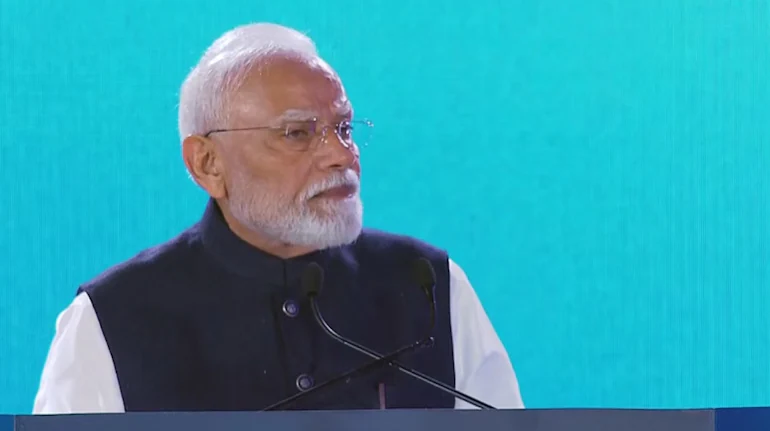
Prime Minister Narendra Modi on Thursday said India’s agricultural sector recorded average annual growth of more than 4 per cent over the past decade, describing it as the first such sustained performance since Independence. Addressing the Kisan Tak Bharat Agriculture Conference organised by the India Today Group, he linked the sector’s growth with poverty reduction in rural areas and called for a shift towards technology-driven, diversified and sustainable farming.
Modi also highlighted the Centre’s support for farmers amid rising international fuel and fertiliser costs. He said the government absorbed Rs 43 per litre of a diesel price increase that would otherwise have been passed on to consumers and farmers, while limiting the domestic increase to Rs 7 per litre. According to the Prime Minister, the decision was costing the government approximately Rs 14,000 crore every month.
Beyond growth figures and input costs, the address focused on crop diversification, solar-powered agriculture, natural farming, farmer-producer organisations and the need to turn farmers into agricultural entrepreneurs. Modi argued that India’s ambition of becoming a developed nation, or Viksit Bharat, depends on making agriculture more productive and strengthening farmers’ ability to earn from multiple sources.
Indian Agriculture Records More Than 4% Annual Growth
Modi described the past decade as a significant period for Indian agriculture, saying the sector had achieved an average annual growth rate exceeding 4 per cent for the first time since Independence.
He presented the performance as an important indicator of the connection between agricultural development and the country’s wider economic progress. Agriculture remains a major source of employment and livelihood in India, particularly in rural communities, where the income of farming households is influenced by crop yields, market prices, weather conditions and the cost of agricultural inputs.
The Prime Minister said the growth in agriculture had coincided with a substantial reduction in poverty. Referring to a recent World Bank report on poverty, he claimed that approximately 50 crore people had moved out of poverty over a period of 12 to 13 years, with the fastest decline taking place in villages.
He said small farmers and agricultural labourers had also benefited from the improvement in rural economic conditions. However, the relationship between agricultural growth and poverty reduction is influenced by several factors, including employment opportunities, rural infrastructure, access to markets, public welfare programmes and non-farm income.
Modi argued that these achievements deserved greater attention in discussions about India’s development. He also criticised what he described as an excessive focus on political narratives at the expense of economic and social progress.
Why Agriculture Is Central to the Viksit Bharat Vision
Describing agriculture as one of the seven streams of national strength highlighted from the Red Fort, Modi said India’s development ambitions could not be achieved without improving the farming sector.
He described agriculture as more than an economic activity, calling it part of India’s culture, tradition and social life. According to him, a developed country needs a farming system that is technologically advanced, economically sustainable and capable of providing farmers with reliable sources of income.
The Prime Minister stressed that simply increasing foodgrain production would not be sufficient. Agricultural markets, consumer preferences, weather patterns and technology are changing, requiring farmers to adapt their production methods and business decisions.
He said previous governments had focused heavily on filling foodgrain warehouses, but argued that the country now needed to move beyond a narrow emphasis on wheat, rice and sugarcane. Farmers, he said, should develop new skills and explore crops and agricultural activities that respond to changing market demand.
The broader challenge is to ensure that diversification does not expose farmers to new financial risks. Moving away from established crops requires access to suitable seeds, reliable buyers, storage facilities, processing infrastructure, insurance and information about market prices. Without these arrangements, farmers may struggle to secure stable returns from alternative crops.
Centre Absorbed Rs 43 of Diesel Price Increase, Says Modi
One of the major announcements in Modi’s address concerned the government’s response to rising international crude oil prices. He said crude prices had climbed from around $70 to $122 per barrel within a matter of weeks, increasing pressure on domestic fuel costs.
According to the Prime Minister, the resulting pressure required a diesel price adjustment of approximately Rs 50 per litre. However, the Centre decided not to pass the entire increase on to citizens and farmers.
Modi said the domestic price was raised by only Rs 7 per litre, with the government absorbing the remaining Rs 43. He added that the decision was resulting in a monthly financial burden of approximately Rs 14,000 crore on the government.
The Prime Minister also compared India’s response with developments in neighbouring countries, claiming diesel prices there had increased by 40 to 50 per cent.
Diesel is an important input for Indian agriculture. Farmers depend on it to operate tractors, harvesters, irrigation pumps and other machinery. It is also used extensively in transporting agricultural produce from farms to markets, warehouses, processing facilities and wholesale distribution centres.
Consequently, a sharp increase in diesel prices can affect farming costs beyond the immediate expense of operating machinery. Higher transportation charges can raise the cost of moving fertilisers, seeds and harvested crops, while increasing the price pressure faced by agricultural supply chains.
By absorbing part of the increase, the government aimed to limit the immediate impact of international fuel price volatility on domestic consumers and agricultural activity. However, the Prime Minister’s figures describe the government’s stated assessment of the intervention; the actual impact on individual farmers depends on fuel consumption, local prices and the extent to which transport and input costs are passed through.
Rs 16 Lakh Crore Spent on Fertiliser Support in 12 Years
Modi also highlighted government spending on fertiliser subsidies, saying the Centre had spent approximately Rs 16 lakh crore on fertiliser support over the previous 12 years.
He described the amount as larger than the annual budgets of many countries and presented it as evidence of the government’s effort to protect farmers from rising international input costs.
Referring to di-ammonium phosphate (DAP), the Prime Minister said a 50-kg bag that costs approximately Rs 5,000 in the international market was being made available to Indian farmers at Rs 1,300 despite geopolitical tensions and higher global prices.
Fertilisers are essential for maintaining soil nutrient levels and supporting crop productivity. Their prices, however, can be affected by international energy costs, raw material availability, shipping expenses and currency movements.
Subsidies help reduce the amount farmers pay when purchasing fertilisers, limiting the immediate impact of global price increases. At the same time, the long-term challenge is to ensure that fertiliser use remains balanced and does not contribute to declining soil health or excessive dependence on chemical inputs.
India’s Agricultural Exports Cross Rs 4 Lakh Crore Annually
Highlighting India’s position in global agriculture, Modi said the country exports agricultural produce worth more than Rs 4 lakh crore every year.
He also cited India’s production strength across several agricultural and allied sectors, including milk, pulses, jute, rice, wheat, cotton, fruits, vegetables, fish and millets. The Prime Minister used these achievements to underline the scale and diversity of India’s agricultural economy.
India’s agricultural export performance is important because overseas markets can provide additional demand for domestic produce. Export opportunities can also encourage improvements in processing, packaging, quality control and supply-chain infrastructure.
However, access to international markets depends on factors such as product standards, food safety requirements, logistics, price competitiveness and changing trade policies. Small farmers may not be able to access export markets independently, making cooperatives, farmer-producer organisations and agricultural businesses important intermediaries.
Milk, Egg and Fish Production Record Major Growth
Modi highlighted the expansion of India’s allied agricultural sectors, particularly dairy, poultry, fisheries and horticulture. He said milk production had increased by approximately 70 per cent over the past decade, while egg production had risen by around 90 per cent.
Fish production, according to the Prime Minister, had more than doubled during the same period. These sectors provide opportunities for farmers to diversify their earnings rather than relying exclusively on traditional field crops.
Dairy can provide households with regular income through milk sales, while poultry offers opportunities in egg and meat production. Fisheries can generate additional employment through aquaculture, processing, storage and transportation.
The expansion of these activities also creates demand for veterinary services, animal feed, cold-chain facilities and food-processing businesses. Their contribution to rural livelihoods therefore extends beyond the farmers directly involved in production.
Modi also cited the growth of honey production, which he said had increased from approximately 80,000 tonnes to 1.5 lakh tonnes. Honey production can provide an additional income stream through beekeeping while also supporting pollination in agricultural and horticultural areas.
Horticulture output has also expanded, rising from approximately 280 million tonnes to more than 350 million tonnes, according to the Prime Minister. Fruits, vegetables and other horticultural products can offer higher-value opportunities, although they often require better storage, transportation and access to markets because many are perishable.
Modi Urges Farmers to Diversify Beyond Wheat, Rice and Sugarcane
A central theme of the address was the need for crop diversification. Modi urged farmers not to depend exclusively on wheat, rice and sugarcane, arguing that changing consumer preferences and market conditions require a broader agricultural strategy.
He said different agricultural developments and production revolutions should be connected under a common vision so that farmers can earn from multiple sources.
Crop diversification can help reduce dependence on a limited number of crops and create opportunities in pulses, oilseeds, millets, fruits, vegetables and other products. It can also support more efficient use of land and water when farmers select crops suited to local soil and climate conditions.
For example, millets and certain pulses can be suitable alternatives in regions where water availability is limited. Horticulture can provide higher-value opportunities in areas with access to irrigation, storage and nearby markets. However, the right choice depends on local conditions rather than a single national formula.
Farmers also need reliable market information before changing their cropping patterns. A crop that offers attractive prices in one season may become less profitable when production rises or demand weakens. Processing facilities, procurement systems and long-term buyer arrangements can help reduce these uncertainties.
Modi’s emphasis on diversification therefore reflects a wider shift in agricultural policy discussions: from increasing the volume of foodgrain production towards improving farm incomes, productivity and market opportunities.
12 Lakh Solar Pumps Provided Under PM-KUSUM
The Prime Minister also highlighted the role of solar energy in reducing agricultural electricity costs. He said approximately 12 lakh solar pumps had been provided under the Pradhan Mantri Kisan Urja Suraksha evam Utthaan Mahabhiyan, commonly known as PM-KUSUM.
The scheme aims to expand the use of solar energy in agriculture by supporting solar-powered irrigation pumps and other decentralised renewable-energy installations. Its broader objective is to reduce dependence on conventional electricity and diesel-powered irrigation while creating additional income opportunities for farmers.
Solar pumps can help farmers manage irrigation expenses, particularly in locations where electricity supply is unreliable or diesel-powered pumps are expensive to operate. Depending on the scheme component and local arrangements, farmers may also be able to generate and sell surplus electricity through eligible installations.
Modi encouraged farmers to explore the income opportunities associated with solar plants on agricultural land. He also asked farm equipment manufacturers and start-ups to focus on developing solar-powered machinery.
Such equipment could help reduce fuel consumption in agricultural operations, although affordability, maintenance, availability of spare parts and suitability for different farming conditions will influence adoption.
Soil Testing Laboratories and Krishi Vigyan Kendras Expand
Modi said India had expanded its agricultural support infrastructure through soil testing laboratories and Krishi Vigyan Kendras (KVKs).
According to the Prime Minister, the number of soil testing laboratories had increased to more than 8,400 from only a handful in 2014. The country now has more than 7,500 Krishi Vigyan Kendras, which provide agricultural information, training and technical support to farmers.
Soil testing helps farmers understand the nutrient composition and condition of their land. The information can guide fertiliser application, reduce unnecessary input use and support crop choices suited to local soil characteristics.
Krishi Vigyan Kendras play a different but complementary role. They connect agricultural research with farming practices through demonstrations, training programmes and the dissemination of information about improved seeds, cultivation techniques, pest management and modern equipment.
The effectiveness of these institutions depends not only on their numbers but also on whether farmers can access timely advice and practical support. Regular soil testing and locally relevant training can help improve productivity when recommendations are implemented appropriately.
10,000 Farmer Producer Organisations to Support Small Farmers
The Prime Minister called for farmers to become agricultural entrepreneurs rather than remaining limited to their traditional role as food producers. He highlighted the development of a network of 10,000 Farmer Producer Organisations, or FPOs, as an important step towards this objective.
FPOs bring farmers together to conduct activities such as purchasing agricultural inputs, aggregating produce, accessing markets and negotiating with buyers. By operating collectively, small farmers can potentially gain advantages that would be difficult to secure individually.
Collective organisation can also make it easier to access food-processing technology, storage facilities, transportation and professional services. These capabilities can help farmers capture a greater share of the value generated after harvesting.
Modi said the government was connecting FPOs with food-processing technology to strengthen their commercial potential. Processing can help reduce post-harvest losses and create products with longer shelf lives or higher market value.
However, the success of an FPO depends on professional management, access to working capital, reliable buyers and the ability to maintain consistent quality. Building a large network is an important step, but ensuring that individual organisations become financially sustainable remains equally important.
Modi Calls for Natural Farming and Reduced Chemical Use
Modi concluded his address with a warning about excessive chemical use in agriculture and urged farmers to adopt more sustainable cultivation practices.
He argued that the continued use of chemicals was damaging the soil and called for greater awareness of the long-term consequences of farming practices that undermine natural resources.
The Prime Minister said the government had strengthened its support for natural farming and described it as an approach that farmers could adopt more easily. He distinguished natural farming from organic farming and suggested that livestock-based inputs could play an important role.
Modi also claimed that manure from one cow could be sufficient for 30 acres of land. This should be understood as a statement made during the address rather than a universal agricultural recommendation. The amount of manure required depends on soil conditions, crop type, nutrient needs, manure quality and the farming system being followed.
Natural farming generally focuses on reducing or avoiding synthetic chemical inputs and using locally available biological resources and ecological processes. Its adoption requires appropriate training, suitable techniques and careful management to maintain yields and soil fertility.
Farmers considering a transition also need to account for possible changes in productivity, labour requirements, input availability and market access. Support through agricultural extension services and reliable demonstrations can help them assess whether particular practices are suitable for their land.
Why Agricultural Modernisation Matters for Rural Incomes
The Prime Minister’s address brought together several issues shaping the future of Indian agriculture: productivity, input costs, technology, diversification, exports and environmental sustainability.
The reported growth of more than 4 per cent annually provides an indication of the sector’s performance over the past decade. But agricultural progress cannot be measured through production figures alone. Farmers’ earnings, the stability of rural employment, access to markets and the cost of cultivation are equally important measures of development.
Higher production does not automatically translate into higher incomes if prices fall, storage is inadequate or transportation costs rise. Similarly, new technologies can improve efficiency but may remain inaccessible to small farmers if equipment and financing are too expensive.
Solar pumps, soil testing facilities, agricultural research centres and FPOs can address some of these challenges. Their impact will depend on effective implementation and whether the benefits reach farmers across different regions and landholding sizes.
Crop diversification and natural farming also require practical support. Farmers need access to suitable seeds, technical guidance, processing facilities and dependable buyers before they can confidently change established practices.
Modi’s message at the Kisan Tak Bharat Agriculture Conference was that agriculture must become more adaptable, technology-driven and income-oriented to support the Viksit Bharat ambition. His appeal to equipment manufacturers and start-ups to develop solar-powered machinery added an emphasis on innovation and private-sector participation.
The broader challenge will be converting these priorities into measurable improvements in farm profitability, rural livelihoods and the long-term sustainability of India’s agricultural resources.
For breaking news and live news updates, like us on Facebook or follow us on Twitter and Instagram. Read more on Latest India on thefoxdaily.com.






COMMENTS 0