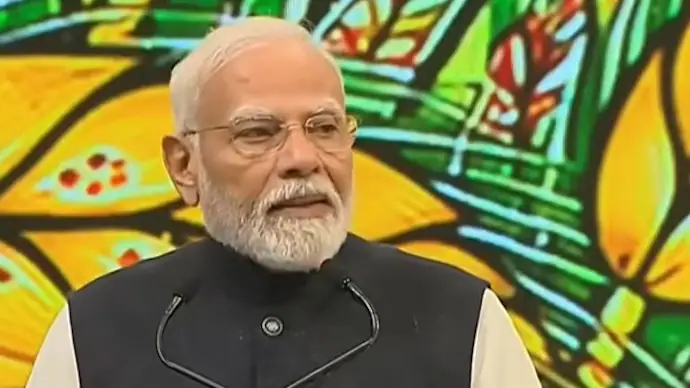
Prime Minister Narendra Modi has urged Indian farmers to move beyond traditional crops such as wheat, rice and sugarcane, calling for greater crop diversification and investment in allied agricultural activities to improve farm incomes. Addressing the India Today Group’s Kisan Tak Bharat Agriculture Conference 2026 in New Delhi on Thursday, November 12, he said India’s agricultural sector must adapt to changing markets, consumer preferences, weather conditions and technological developments.
Modi emphasised that producing more foodgrains alone would not be enough to secure farmers’ prosperity. He called for a broader approach that creates multiple income sources through dairy farming, fisheries, beekeeping, horticulture and other agricultural activities.
Speaking at Bharat Mandapam, the Prime Minister said earlier agricultural policies had placed considerable emphasis on maintaining adequate foodgrain stocks, but the next phase of development should focus more directly on improving farmers’ earnings and expanding opportunities beyond conventional crop cultivation.
He also highlighted India’s position in global agricultural production, pointing to growth in milk, pulses, jute, rice, millets, fruits, vegetables and fisheries. According to Modi, the expansion of different agricultural sectors demonstrates the potential of Indian farmers and the importance of diversifying rural income sources.
PM Modi Says Farmers Should Move Beyond Traditional Crops
Addressing farmers, policymakers and agricultural experts at the conference, Modi urged cultivators not to remain overly dependent on wheat, rice and sugarcane. He said agricultural practices must evolve in response to changing economic and environmental conditions.
The Prime Minister argued that farming decisions should take into account market demand, consumer preferences, available technology and changing weather patterns. Depending heavily on a limited number of crops can leave farmers exposed to fluctuations in prices, production costs and climatic conditions.
He stressed that farmers need opportunities to explore other crops and agricultural activities that can generate additional earnings. Diversification can include shifting part of the cultivated area towards pulses, millets, fruits, vegetables and other suitable crops, while expanding activities such as dairy farming, fisheries and beekeeping.
“Filling foodgrain warehouses is not enough.”
The remark reflected the Prime Minister’s argument that agricultural policy should look beyond national foodgrain availability and focus on the financial well-being of farming households. Maintaining food security remains important, but farmers also need access to profitable markets and opportunities to increase the value of what they produce.
For farmers, diversification is not simply a matter of replacing one crop with another. Decisions depend on local soil conditions, water availability, weather, access to seeds, processing facilities and the possibility of securing buyers. Reliable market access and suitable infrastructure are therefore important for making diversification financially sustainable.
India’s Agricultural Exports Cross Rs 4 Lakh Crore Annually
Modi said India had taken steps over the past decade to adapt its agricultural sector to changing conditions. He highlighted the country’s agricultural exports, which he said were now worth more than Rs 4 lakh crore annually.
According to the Prime Minister, export earnings are contributing to farmers’ incomes and creating opportunities for Indian agricultural products in international markets. A stronger export-oriented agricultural sector can also encourage investment in food processing, storage, transportation and quality control.
However, increasing exports does not automatically guarantee higher earnings for every farmer. The benefits depend on how agricultural supply chains operate, whether producers can meet international quality requirements and how much of the final market value reaches cultivators.
Improving access to processing facilities, cold storage and organised markets can help farmers reduce post-harvest losses and sell products more effectively. These facilities are particularly relevant for perishable products such as fruits, vegetables, dairy and fish.
India’s Position in Global Agricultural Production
During his address, Modi highlighted India’s standing among the world’s leading agricultural producers. He said the country was the largest producer of milk, pulses and jute, and had also become the world’s largest producer of rice and millets.
He added that India ranked second globally in wheat production, as well as in cotton, fruits, vegetables and fish production.
“These are not just figures. They show the immense potential of India’s farmers.”
The Prime Minister used these production figures to underline the contribution of Indian farmers to the country’s agricultural economy. He also connected the country’s position across multiple sectors with the need to create more opportunities for producers.
India’s agricultural strength extends beyond foodgrains. Dairy, horticulture, fisheries and other allied activities contribute to rural livelihoods and provide opportunities for households that may not have sufficient land to depend exclusively on crop cultivation.
Expanding these sectors can help farmers build more diversified income streams, although success depends on investment, suitable infrastructure, technical support and stable demand.
Green, White, Blue and Sweet Revolutions: PM Modi Highlights Agricultural Progress
Modi referred to several agricultural revolutions that have shaped India’s production capacity and expanded opportunities for farmers. He said these developments demonstrated how different parts of the agricultural economy could contribute to rural prosperity.
Green Revolution Helped India Achieve Foodgrain Self-Sufficiency
The Prime Minister said the Green Revolution played a major role in helping India move towards self-sufficiency in foodgrain production. Improvements in agricultural practices and production capacity helped strengthen the country’s ability to meet domestic food requirements.
Wheat and rice have remained central to India’s food security system. However, Modi’s appeal for diversification suggests that future agricultural development should also create greater space for crops and activities that offer farmers additional income opportunities.
The challenge is to balance foodgrain production with the need to improve farm profitability, conserve natural resources and respond to changing consumption patterns.
White Revolution Expanded India’s Dairy Sector
Highlighting the White Revolution, Modi said India had become the world’s largest milk producer. He also cited growth in dairy production over the past decade.
According to the Prime Minister, India’s milk production increased by nearly 70% during the period. Dairy farming provides an additional source of income for many rural households and can complement crop cultivation.
Unlike seasonal crop income, dairy activities can provide more regular earnings when farmers have access to animals, veterinary services, feed, collection centres and reliable buyers. The sector also supports employment in processing, transportation and distribution.
Blue Revolution Boosted Fisheries Production
Modi said India’s fish production had more than doubled over the past decade under the Blue Revolution. He highlighted fisheries as another important source of income and an area with potential for further agricultural diversification.
Fisheries can create opportunities for people involved in inland aquaculture, coastal fishing, fish processing and distribution. The sector also supports allied businesses, including feed production, equipment supply and cold-chain services.
For farmers looking to diversify, fisheries may offer an alternative where water resources, technical knowledge and market access make the activity viable.
Sweet Revolution Creates Opportunities Through Beekeeping
The Prime Minister also referred to the Sweet Revolution, which has encouraged the growth of beekeeping and honey production. He said India’s honey production had increased from approximately 80,000 tonnes to 1.5 lakh tonnes.
Beekeeping can provide an additional income source for rural households and complement certain agricultural activities. Honey production also creates opportunities in processing, packaging and marketing.
Expanding the sector requires access to suitable equipment, training, quality standards and markets. The growth highlighted by Modi illustrates how allied activities can contribute to agricultural earnings beyond traditional crop production.
Horticulture Production Rises Beyond 350 Million Tonnes
Modi also highlighted the expansion of India’s horticulture sector. He said horticultural production had increased from 280 million tonnes to more than 350 million tonnes.
Horticulture includes fruits, vegetables, flowers and other crops that can provide alternatives to conventional foodgrain cultivation. These products can offer farmers opportunities to serve changing consumer demand and supply markets with higher-value agricultural produce.
However, horticulture often requires specialised cultivation practices, careful handling and better storage facilities. Fruits and vegetables are particularly vulnerable to losses when transportation and cold-chain infrastructure are inadequate.
Improving these facilities can help farmers preserve product quality, access distant markets and reduce the amount of produce wasted after harvesting.
Allied Agricultural Activities Can Create Multiple Income Sources
A central message in Modi’s address was that farmers should not depend on a single crop or source of income. He argued that combining different agricultural activities could create a more diversified economic base for rural households.
“When we connect all these revolutions with a broader vision, multiple sources of income are created for the country’s farmers. This is essential for the future of agriculture.”
The approach involves connecting crop cultivation with activities such as dairy farming, fisheries, beekeeping and horticulture. Depending on local conditions, farmers may be able to combine two or more activities to reduce their dependence on income from a single harvest.
For example, dairy farming can provide an additional source of earnings alongside crop cultivation, while beekeeping can complement suitable agricultural and horticultural activities. Fisheries can offer another option in areas with appropriate water resources and infrastructure.
Such combinations can help spread financial risks. If one crop faces poor prices or adverse weather, income from other activities may provide some support. However, diversification also requires investment, skills and access to buyers, making local planning and institutional support important.
Why Crop Diversification Matters for Indian Agriculture
Crop diversification has implications beyond individual farm incomes. It can influence water use, soil management, food availability and the resilience of agricultural production.
Farmers who depend heavily on a small number of crops may face greater exposure to price fluctuations, weather-related losses and rising cultivation costs. Introducing other suitable crops can help reduce some of these risks, particularly when farmers have access to reliable markets.
Diversification can also create opportunities for pulses and millets, which have an important place in India’s food system. Expanding the production of different crops can support a broader agricultural economy rather than concentrating resources on a limited range of commodities.
Nevertheless, farmers cannot be expected to change cultivation patterns without practical support. Assured market access, procurement arrangements, storage facilities, processing units, crop insurance and agricultural extension services can influence whether a new crop becomes financially attractive.
Water availability is another important consideration. Crop choices need to reflect local conditions rather than follow a uniform national approach. A crop that is commercially attractive in one region may not be suitable for another because of differences in rainfall, soil, irrigation and market demand.
Kisan Tak Bharat Agriculture Conference 2026 Brings Together Over 2,000 Farmers
Modi delivered his address at the two-day Kisan Tak Bharat Agriculture Conference 2026, organised by the India Today Group at Bharat Mandapam in New Delhi. The conference was held under the theme ‘Smart Kisan, Viksit Bharat’.
The event brought together more than 2,000 farmers, policymakers, industry representatives and global agricultural experts to discuss the future of Indian agriculture.
Discussions at the conference focused on agricultural modernisation, technology, sustainability, productivity and ways to improve farmers’ earnings. The gathering also provided a platform for farmers and experts to exchange ideas about changing agricultural practices and emerging opportunities.
The conference’s broader focus was on connecting farmers with policy discussions, scientific knowledge and industry developments that could shape the next phase of agricultural growth.
PM Modi’s Message: Agricultural Growth Must Translate Into Farmer Prosperity
The Prime Minister’s appeal for crop diversification reflects a wider shift in the discussion around Indian agriculture: moving beyond production targets towards improving the economic position of farming households.
India’s achievements in foodgrain production, dairy, fisheries, horticulture and honey demonstrate the scale of its agricultural sector. Modi argued that connecting these different areas could create more opportunities for farmers and strengthen rural incomes.
For diversification to succeed, however, farmers will need more than encouragement. Access to suitable seeds, technology, affordable credit, processing facilities, storage and dependable markets will be essential to make alternative crops and allied activities commercially sustainable.
The message from the Kisan Tak Bharat Agriculture Conference was that the future of Indian farming should not depend exclusively on wheat, rice and sugarcane. A wider mix of crops and agricultural enterprises, supported by infrastructure and market access, could help farmers build multiple income sources while making the sector more adaptable to changing economic and environmental conditions.
For breaking news and live news updates, like us on Facebook or follow us on Twitter and Instagram. Read more on Latest India on thefoxdaily.com.






COMMENTS 0