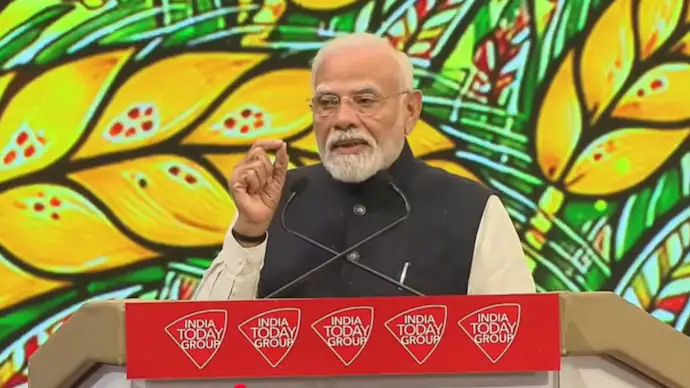
Prime Minister Narendra Modi has called for a technology-driven transformation of Indian agriculture, saying that the country’s ambition to become a developed nation depends on empowering farmers and making farming more productive, sustainable and financially rewarding. Addressing the India Today Group’s Kisan Tak Bharat Agriculture Conference, he highlighted the potential of drones, artificial intelligence, solar energy and modern farm machinery to reshape the sector.
Modi also stressed the importance of crop diversification, value addition and improved market access. Alongside technological modernisation, he urged farmers to reduce their dependence on chemical inputs and adopt natural farming practices to protect soil health and the environment.
His address connected agricultural development with the broader vision of Viksit Bharat, or a developed India. He cited agricultural growth, exports and poverty reduction while describing the role of farmers in the country’s economic progress. The Prime Minister also spoke about the contribution of women using drones in agriculture and the potential for farmers to earn additional income through solar power.
Technology at the Centre of India’s Agricultural Transformation
One of the key themes of Modi’s address was the need to bring advanced technology into everyday farming. He argued that modern tools should not remain limited to large farms or urban businesses and that rural communities must also benefit from technological progress.
He pointed to the Namo Drone Didi initiative as an example of how women can use technology to provide agricultural services. Under the initiative, women operate drones for activities such as spraying fertilisers and pesticides. Modi said the scope of drone applications in farming was being expanded.
Artificial intelligence and engineering also featured in his vision. AI-based tools can potentially help farmers make more informed decisions about crops, weather, irrigation and farm management. Meanwhile, agricultural scientists, engineers and young innovators are developing machinery intended to reduce cultivation costs and make sowing and harvesting easier.
The emphasis on technology comes as Indian agriculture faces challenges including fragmented landholdings, unpredictable weather, rising input costs and pressure to improve productivity. Digital tools and precision farming could help address some of these issues, although their benefits will depend on affordability, training, connectivity and access for small and marginal farmers.
Solar Power Can Turn Farmers Into Energy Producers
Modi also highlighted solar energy as an opportunity to reduce agricultural costs and create additional sources of income. Referring to the PM-KUSUM scheme, he said solar-powered irrigation and farm-based solar installations could help farmers reduce electricity expenses while generating revenue by supplying electricity.
He described the shift from food producers to energy producers as another revolution in rural India. The idea is to make greater use of solar power on agricultural land, allowing farmers to participate in the renewable energy sector alongside traditional cultivation.
However, the financial benefits of solar installations can vary depending on the cost of equipment, access to financing, local electricity arrangements and the availability of grid connections. Expanding solar-powered agriculture will therefore require infrastructure and implementation support alongside Government Schemes.
Natural Farming and the Need to Protect Soil Health
Environmental sustainability was another important part of the Prime Minister’s message. Modi urged farmers to reconsider excessive chemical use, warning that agricultural practices that damage the soil could threaten the long-term health of the land on which farming depends.
His appeal for natural farming reflected a broader concern about maintaining soil quality and protecting natural resources. Healthy soil is essential for agricultural productivity, while excessive or poorly managed use of fertilisers and pesticides can create environmental risks.
Moving towards more sustainable practices, however, requires careful planning. Farmers need reliable guidance, suitable alternatives, access to organic inputs and market opportunities that make the transition economically viable. Crop diversification and value addition can also help reduce dependence on a narrow range of crops and improve the resilience of farm incomes.
Modi Highlights Agricultural Growth and Exports
During the address, Modi referred to India’s agricultural growth over the past decade and said the sector had maintained an average growth rate above 4 per cent. He described this as a significant development in the country’s post-Independence agricultural record.
He also cited India’s agricultural exports, saying the country now exports farm products worth more than Rs 4 lakh crore annually. According to the Prime Minister, these exports contribute to farmers’ incomes and demonstrate the growing reach of Indian agricultural products in international markets.
Higher export earnings can create opportunities for farmers, food processors and other businesses connected to agriculture. However, the extent to which export growth translates into better farm-gate prices depends on supply chains, procurement arrangements, quality standards, storage facilities and the share of the final export value received by producers.
Modi also referred to a World Bank study on poverty, saying it estimated that 50 crore people in India had moved out of poverty over a period of 12 to 13 years. He said poverty had declined rapidly in rural areas and linked this progress partly to the changing economic circumstances of small farmers and agricultural labourers.
Top Quotes From PM Modi’s Kisan Tak Bharat Agriculture Conference Address
The Prime Minister’s remarks covered agricultural modernisation, rural poverty, solar power, drones, engineering, fuel prices and environmental protection. Here are the key quotes from his address:
1. On Agriculture and the Vision of a Developed India
“Building a developed India is simply impossible without developing agriculture, making farming smarter and empowering farmers. That is why initiatives focused on farmers and agriculture become so important.”
Modi placed farmers and agricultural development at the centre of the Viksit Bharat vision. His remarks underlined the importance of improving farm productivity and making agriculture a stronger contributor to the national economy.
2. On Poverty Reduction in Rural India
“A recent World Bank study on poverty, which is being discussed across the world, says that 50 crore poor people in India have defeated poverty in just 12-13 years. It also points out that poverty has declined rapidly in villages. This means a large number of small farmers and agricultural labourers have overcome poverty.”
The Prime Minister cited the reported decline in poverty to highlight changes in rural livelihoods. He connected the improvement to the economic progress of small farmers and agricultural workers. The figure and the methodology behind the poverty estimate remain important context when assessing the claim.
3. On India’s Agricultural Growth
“During the past decade, India’s agricultural growth rate has remained above 4 per cent. This is the first decade since Independence in which such an average growth rate has been achieved. During this very period, a large number of poor people in villages have also defeated poverty.”
Modi pointed to agricultural growth as an important measure of the sector’s progress. Sustaining that growth will require improvements in productivity, irrigation, infrastructure, research and farmers’ access to markets.
4. On Agricultural Exports
“In the past decade, the country has taken steps to match the pace of these changes and the results are before us. Today, India exports agricultural products worth more than Rs 4 lakh crore every year. This money is increasing the income of our farmers.”
The Prime Minister highlighted the value of agricultural exports as evidence of India’s expanding presence in global markets. Export opportunities can benefit producers, although stronger storage, processing and supply-chain networks are important to ensure that farmers share in the gains.
5. On Solar Power and Farmers Becoming Energy Producers
“Another revolution is the solar power revolution. This has turned the country’s annadatas, or food providers, into urjadatas, or energy providers. Under the PM-Kusum scheme, around 12,000 solar pumps have been provided so far. This is reducing farmers’ electricity bills, while farmers are also earning money by installing solar plants on their fields and generating electricity.”
Modi described solar energy as a way to diversify rural incomes. Solar pumps can reduce dependence on conventional electricity and diesel-powered irrigation, while larger solar installations may allow farmers to earn from electricity generation.
6. On the Namo Drone Didi Initiative
“People with an outdated mindset often believe that sophisticated technology cannot be used in our villages. The Namo Drone Didis have proved them wrong. These women are using drones to spray fertilisers and pesticides and the scope of their use is now being expanded.”
The Prime Minister used the example of women drone operators to illustrate how technology can create new roles in rural economies. The initiative also points to the potential for women-led groups to provide specialised services to farmers in their communities.
7. On Engineering and Modern Farm Machinery
“India is expanding the role of engineering in agriculture. Our agricultural scientists, engineers and young people are developing equipment and machines that reduce farming costs. Some of these machines are making sowing and harvesting easier.”
Modi stressed the contribution of research and innovation to reducing the physical and financial burden of farming. Affordable machinery suited to different farm sizes could help improve efficiency, particularly where labour availability and cultivation costs are major concerns.
8. On Diesel Prices During the West Asia Conflict
“When the crisis of war in West Asia was intensifying, there was a situation in which diesel prices needed to be increased by at least Rs 50 per litre. But the government decided that the entire burden would not be passed on to citizens and farmers. We increased diesel prices by only Rs 7 per litre, even though an increase of Rs 50 was required. The government absorbed the remaining Rs 43 per litre.”
The Prime Minister referred to the impact of the West Asia conflict on fuel costs and said the government had absorbed part of the pressure rather than passing the full burden on to consumers. His statement presented fuel-price management as a measure to limit the impact of external developments on farmers and households.
9. On the Constitution and Political Opposition
“These days, some people take the Constitution out of their pockets. They think that the country’s Constitution and democracy are in their pockets. Even without being in government, they have a different kind of intoxication with power.”
Modi also made a political remark during his address, criticising unnamed opponents over their claims and conduct regarding the Constitution and democracy. The comment was separate from his discussion of agricultural technology and rural development.
10. On Chemical Use and Protecting Mother Earth
“Farmers are connected to two things: annadata and Mother Earth. I want to ask my farmer brothers and sisters: Are we protecting our Mother Earth? We must ask ourselves this question with our hands on our hearts. The way we are destroying Mother Earth through the use of chemicals, we are killing our own mother before our eyes. We are her children.”
The Prime Minister’s closing appeal focused on environmental responsibility and the long-term health of agricultural land. He urged farmers to reflect on the effects of chemical use and consider practices that protect soil and natural resources.
Why Technology-Led Farming Matters for India
Agriculture remains central to rural livelihoods and food security in India. Modernising the sector involves more than introducing new machines or digital platforms. Farmers also need access to reliable information, affordable credit, irrigation, storage, transport, processing facilities and markets where they can receive fair prices.
Drones can help with selected farm operations, while AI-based services may support decisions about weather, crop health and resource use. Solar power can reduce some energy costs, and modern machinery can improve the efficiency of sowing and harvesting. These technologies could make farming more productive, but their impact will depend on whether small and marginal farmers can access and use them effectively.
Crop diversification and value addition are equally important. Moving beyond a limited number of crops can help farmers respond to changing demand and environmental conditions. Processing and better storage can reduce post-harvest losses and allow producers to sell products at more favourable times.
Modi’s address at the Kisan Tak Bharat Agriculture Conference brought these priorities together under the broader goal of building a smarter and more resilient agricultural sector. His central message was that India’s development ambitions depend on farmers having the technology, resources and market opportunities needed to improve their livelihoods while protecting the land they cultivate.
For breaking news and live news updates, like us on Facebook or follow us on Twitter and Instagram. Read more on Latest India on thefoxdaily.com.





COMMENTS 0