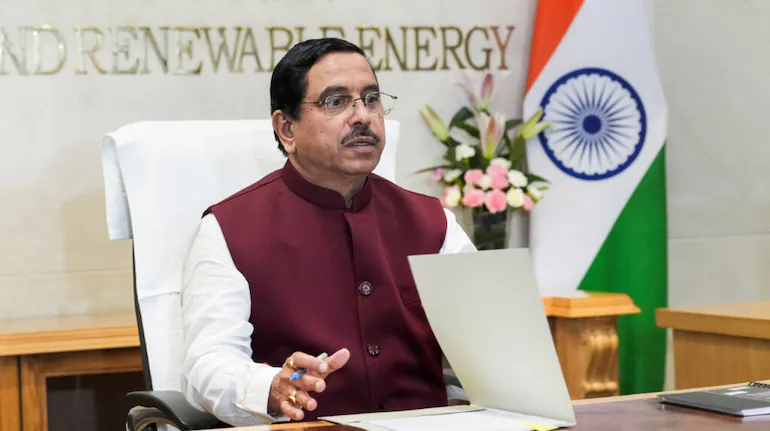
India has attracted investment interest of nearly $400 billion across the Renewable Energy sector at the Bharat Renewable Energy (BRE) Summit 2026, almost twice the estimated $220 billion required to finance the country’s green energy transition by 2030. Union Minister for New and Renewable Energy Pralhad Joshi shared the figures in an interview with Moneycontrol on Wednesday.
Key Highlights
- India received nearly $400 billion in renewable energy investment interest at the BRE Summit 2026.
- The estimated investment requirement for India’s green energy transition between FY27 and FY30 stands at $220 billion.
- The government is expanding energy storage and transmission infrastructure to reduce renewable energy curtailment.
- India plans to add another 300 GW of non-fossil fuel capacity between 2030 and 2035-36.
- Domestic solar cell manufacturing capacity is expected to increase from 47 GW to 70 GW by December 2026.
India Receives $400 Billion in Renewable Energy Investment Interest
According to Pralhad Joshi, the investment interest at the BRE Summit included participation from both domestic and international investors. However, the government was yet to finalise company-wise details and the nature of investments discussed during a CEO roundtable at the event.
Joshi said the proposed investment interest was almost double India’s estimated requirement of $220 billion for its green energy transition between FY27 and FY30. Even if some proposals do not materialise, he expressed confidence that the country would be able to meet its funding requirements.
The estimated $220 billion investment requirement covers renewable energy expansion, transmission infrastructure, energy storage, green hydrogen and domestic manufacturing. The minister attributed investor interest to the scale of development and investment opportunities across India’s renewable energy sector.
Energy Storage and Transmission to Reduce Renewable Energy Curtailment
The government is focusing on expanding energy storage and transmission infrastructure to manage fluctuations in solar and wind power generation. These investments are also expected to help reduce renewable energy curtailment as more clean energy capacity is connected to the electricity grid.
The Union Cabinet approved a Rs 14,500-crore viability gap funding (VGF) scheme to support the development of 92 GWh of grid-scale energy storage capacity by FY31.
Joshi highlighted the importance of storage infrastructure in managing variations in renewable energy generation. He also referred to plans involving approximately 60 GW of pumped storage and 30 GW of battery storage, alongside a separate Ministry of New and Renewable Energy-supported programme involving around Rs 6,000 crore in viability gap funding.
The government is also considering decentralised battery storage at household and substation levels. Such systems could help distribution companies (discoms) reduce their dependence on expensive electricity purchases during peak demand hours.
India Plans Additional 300 GW of Non-Fossil Fuel Capacity by 2035-36
India is planning to add another 300 GW of non-fossil fuel capacity between 2030 and 2035-36, over and above its existing target of achieving 500 GW by 2030, Joshi told Moneycontrol.
The government subsequently aims to move towards a longer-term target of approximately 1,800 GW by 2047. Joshi said technological developments over the coming decade would also influence the country’s energy transition.
The proposed capacity expansion reflects India’s longer-term focus on increasing non-fossil fuel electricity generation and strengthening its energy infrastructure.
Solar Cell Manufacturing Capacity Expected to Reach 70 GW
India’s domestic solar cell manufacturing capacity is expected to increase from approximately 47 GW to 70 GW by December 2026, based on commitments made by manufacturers, Joshi said.
The minister also said the government would decide within two weeks, after consulting industry stakeholders, whether to extend the deadline for solar projects to source cells from manufacturers included in the Approved List of Models and Manufacturers (ALMM).
The ALMM identifies government-approved solar module and cell manufacturers whose products must be used in projects covered by domestic sourcing requirements. The government had previously extended the relevant deadline until December 31 from June after manufacturers raised concerns about shortages of domestically produced solar cells.
PM Surya Ghar Scheme Target Remains on Track
Joshi expressed confidence that the government would achieve its target of installing rooftop solar systems in one crore households by March 2027 under the PM Surya Ghar Muft Bijli Yojana.
He said the government would assess the possibility of increasing the target in January or February. However, any additional commitment would require further consultations and approval from the Prime Minister.
Indian Solar Exporters Explore Alternative Markets Amid US Tariffs
Addressing the impact of US tariffs on Indian solar module exports, Joshi said domestic companies were exploring alternative international markets.
The development highlights the importance of diversifying export destinations while strengthening domestic solar manufacturing capacity. Expanding production and exploring new markets could help Indian manufacturers manage external trade challenges.
What India’s Renewable Energy Investment Push Means
The nearly $400 billion investment interest reported at the BRE Summit 2026 highlights the scale of investor attention towards India’s renewable energy sector. However, investment interest should not be confused with committed or realised investment.
India’s ability to meet its clean energy ambitions will depend on converting proposed investments into actual funding, expanding storage and transmission infrastructure, and strengthening domestic manufacturing.
With plans for additional non-fossil fuel capacity, higher solar cell production and greater energy storage, the government is focusing on addressing several infrastructure and financing requirements of the country’s long-term energy transition.
For breaking news and live news updates, like us on Facebook or follow us on Twitter and Instagram. Read more on Latest Business on thefoxdaily.com.






COMMENTS 0