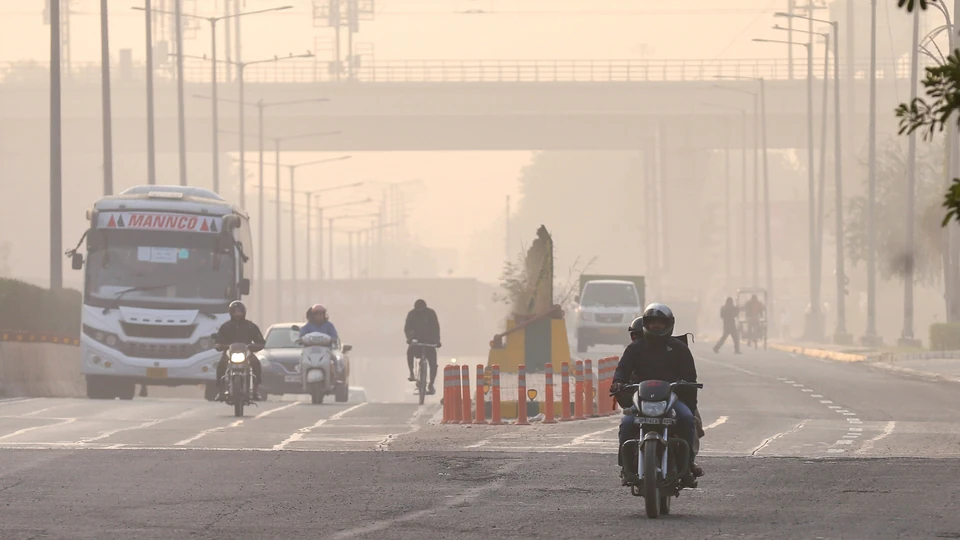
Delhi Chief Minister Rekha Gupta has announced a Winter Action Plan to tackle Air Pollution in the national capital, with a series of measures scheduled to take effect from November 1, 2026. The restrictions and initiatives are aimed at reducing vehicular emissions, easing traffic congestion, improving compliance with pollution-control rules and strengthening monitoring of construction activities during the winter months.
The plan will remain in force until February 28, 2027, with measures including a 50% work-from-home mandate for government and private offices, doubled parking charges at authorised parking facilities, staggered government office timings and restrictions on the entry of certain vehicles registered outside Delhi. The government is also focusing on cleaner public transport, electric buses, carpooling and technology-based monitoring of construction sites.
One of the key measures concerns vehicles registered outside Delhi that do not meet BS-VI emission standards. Such vehicles will be barred from entering the national capital from November 1, 2026, to January 31, 2027, under the announced plan.
Meanwhile, the ‘No PUC, No Fuel’ rule, which requires vehicles to have a valid Pollution Under Control certificate to obtain fuel, has already been in force in Delhi since October 1. The winter action plan adds further measures intended to discourage private vehicle use and reduce pollution during a period when air quality in the capital often deteriorates.
Delhi Winter Pollution Action Plan 2026: Full List of Measures
Here is a breakdown of the major measures announced by the Delhi government, their implementation timelines and how they are intended to help tackle winter pollution.
1. Restrictions on non-BS-VI vehicles registered outside Delhi
Under the Winter Action Plan, vehicles registered outside Delhi that do not comply with BS-VI emission standards will be prohibited from entering the national capital from November 1, 2026, to January 31, 2027.
The restriction targets vehicles that do not meet the specified emission standards and is intended to limit pollution from incoming traffic during the winter period. Vehicles travelling into Delhi from neighbouring states and other parts of the country will need to fall within the permitted emission category to avoid the announced restriction.
The measure is particularly relevant to the Delhi-National Capital Region (NCR), where daily travel between neighbouring cities and the national capital contributes to substantial road traffic. Restricting the entry of specified vehicles is one of the steps the government is taking to address vehicular emissions during the winter months.
The restriction is scheduled to remain in effect until January 31, 2027, while other elements of the winter plan, including office and parking measures, will continue until February 28, 2027.
2. Parking charges doubled from November 1
The Delhi government has announced that parking charges at authorised parking facilities will be doubled from November 1, 2026, to February 28, 2027. The measure is intended to discourage the use of private vehicles and encourage commuters to consider alternatives such as public transport and carpooling.
Higher parking fees can increase the cost of driving into busy areas, particularly for people who use their cars for regular office commutes. By making private vehicle use more expensive during the winter pollution-control period, the government aims to reduce unnecessary journeys and ease traffic congestion.
However, the increase will not apply to parking facilities owned and managed by the Delhi Metro Rail Corporation (DMRC). These facilities are excluded from the announced hike.
The distinction is important for commuters who use Metro services for part of their journey and leave their vehicles at Metro-managed parking facilities. The exemption means the doubled charges will apply to other authorised parking facilities covered by the order, rather than DMRC-owned and managed sites.
3. Staggered office timings to reduce traffic congestion
To reduce congestion during peak commuting hours, the Delhi government has announced different working hours for offices under the Municipal Corporation of Delhi (MCD) and the Government of the National Capital Territory of Delhi (GNCTD).
Under the revised schedule:
- MCD offices: 8:30 am to 5 pm.
- GNCTD offices: 10 am to 6:30 pm.
The revised office timings will remain in effect from November 1, 2026, to February 28, 2027.
The staggered schedule is designed to spread commuter traffic across different time slots instead of having employees from multiple government departments travel at the same time. Reducing pressure on roads during peak hours could help limit traffic congestion and the emissions associated with vehicles moving through crowded streets.
Although the measure does not directly reduce the number of vehicles owned by commuters, changing when employees travel may help manage traffic flows. Its effectiveness will depend on how commuters respond and whether the revised timings lead to a meaningful reduction in congestion.
4. 50% work-from-home mandate for government and private offices
One of the most significant measures in the winter plan is the direction for government and private offices in Delhi to ensure that 50% of their workforce works from home during the specified period.
The arrangement will run from November 1, 2026, to February 28, 2027. Under the announced measure, half of the workforce is expected to work remotely, while the remaining half attends the workplace.
The objective is to reduce the number of daily office commuters on Delhi’s roads. Fewer people travelling to and from workplaces could mean fewer private vehicles on the road, helping to ease congestion and reduce transport-related emissions.
The work-from-home measure could also complement the revised government office timings. While staggered schedules spread traffic across different hours, remote working is intended to reduce the number of journeys altogether.
However, the practical impact will depend on how offices implement the arrangement and whether employees can perform their duties remotely. Work that requires a physical presence may be harder to accommodate, while organisations with suitable digital systems may find it easier to introduce rotating attendance schedules.
The announcement specifies a 50% work-from-home arrangement for government and private offices. Further operational details, including how individual workplaces should organise staff attendance, would determine how the measure is implemented in practice.
5. ‘No PUC, No Fuel’ rule for vehicles without valid certificates
The ‘No PUC, No Fuel’ rule is already in force in Delhi from October 1, 2026. Under the directive, fuel stations across the Delhi-NCR region will not dispense fuel to vehicles that do not have a valid Pollution Under Control (PUC) certificate.
A PUC certificate indicates that a vehicle has undergone an emissions test and met the applicable pollution limits at the time of testing. Requiring a valid certificate before refuelling is intended to encourage vehicle owners to comply with emissions-testing requirements.
The Commission for Air Quality Management (CAQM), which coordinates air-pollution control measures in Delhi and neighbouring areas, had ordered in May that fuel must not be dispensed to vehicles without a valid PUC certificate.
Number-plate recognition cameras and other technologies are being used to support enforcement of the directive. These systems can help authorities identify vehicles and strengthen monitoring of compliance with the rule.
The policy makes a valid PUC certificate an important requirement for motorists who need to refuel in the region. Vehicle owners should check their certificate’s validity and arrange the required emissions test if it has expired.
Unlike the parking fee increase and revised office timings, the ‘No PUC, No Fuel’ rule was already operational before the winter plan’s November 1 start date. It forms part of the wider effort to enforce existing pollution-control requirements during the winter season.
6. Restrictions on construction and demolition activities
Construction and demolition activities are another focus of the Winter Action Plan. The Delhi government has announced restrictions on such activities as part of its wider strategy to control pollution during the winter months.
Construction and demolition work can generate dust and particulate matter, particularly when sites do not follow appropriate dust-control and waste-management practices. Limiting or regulating these activities during periods of poor air quality can therefore form an important part of pollution-control efforts.
The plan also includes AI-based monitoring of construction sites to strengthen compliance with pollution-control norms. Technology-assisted monitoring is intended to help authorities identify potential violations and improve oversight of sites covered by the applicable rules.
However, the announcement does not specify the complete list of construction activities that will be restricted, the exact conditions under which restrictions will apply or the detailed enforcement procedure for every category of site. These details are important for construction companies, contractors and property developers seeking to understand their obligations.
Businesses and site operators should follow the applicable government directions and pollution-control requirements rather than assume that all construction work will be treated identically throughout the winter period.
7. Cleaner public transport and more electric buses
Expanding cleaner transport options is another component of the Delhi government’s winter pollution strategy. The plan includes promoting electric buses, improving Metro connectivity, strengthening last-mile transport and encouraging carpooling.
The objective is to reduce dependence on private vehicles by making shared and public transport more accessible. When commuters have convenient alternatives to driving alone, the number of vehicles travelling on roads may decline, helping to reduce congestion and vehicular emissions.
Electric buses are a central part of this approach because they do not produce tailpipe emissions while operating. Their broader environmental benefits depend on factors including electricity generation and how the vehicles are used, but expanding electric public transport can help reduce pollution from conventional combustion-engine buses.
Improved Metro connectivity and last-mile transport are also important. Public transport becomes more practical when commuters can travel between their homes, Metro stations and final destinations without relying on a private car for every part of the journey.
Carpooling is another measure intended to reduce the number of vehicles used for daily travel. When several commuters share a vehicle for similar journeys, fewer cars may be needed to transport the same number of people.
The plan sets out these measures as part of the effort to encourage cleaner mobility. The overall impact will depend on the availability, reliability and convenience of public transport, along with commuters’ willingness to shift away from private vehicles.
Why does Delhi introduce a winter pollution action plan?
Air pollution is a recurring concern in Delhi during the winter months. Weather conditions, local emissions and pollution transported from surrounding areas can combine to produce poor air quality. Reduced dispersion of pollutants under certain atmospheric conditions can allow particulate matter and other pollutants to accumulate near the ground.
Several sources contribute to the capital’s pollution, including vehicle emissions, road and construction dust, industrial activity and other regional sources. The relative contribution of each source can vary with location, weather and the time of year.
This makes winter pollution a complex problem that cannot be addressed through a single restriction. Measures targeting traffic, vehicle emissions, construction dust and public transport are intended to tackle different parts of the problem at the same time.
The Delhi government’s plan combines measures that seek to reduce travel demand, discourage private vehicle use, enforce emissions-related requirements and improve monitoring. The approach also involves commuters and employers, as the success of work-from-home arrangements, carpooling and public transport initiatives depends partly on public participation.
However, the effectiveness of the plan will depend on enforcement, coordination with neighbouring areas and whether the announced restrictions lead to measurable reductions in pollution. Implementation and monitoring will be important in determining how much each measure contributes to improved air quality.
Delhi Winter Action Plan 2026: Key dates at a glance
- October 1, 2026: The ‘No PUC, No Fuel’ rule is already in force in Delhi.
- November 1, 2026: The winter plan’s main measures are scheduled to begin, including doubled parking charges, staggered office timings, the 50% work-from-home arrangement and restrictions on specified non-BS-VI vehicles registered outside Delhi.
- January 31, 2027: The announced entry restriction for specified vehicles registered outside Delhi is scheduled to end.
- February 28, 2027: The planned end date for doubled parking charges, staggered government office timings and the 50% work-from-home arrangement.
The dates above reflect the timelines stated in the announcement. The applicable government orders and subsequent directions will determine the detailed implementation and enforcement of each measure.
What should Delhi residents and commuters do?
Residents, office workers and people travelling into Delhi can take several practical steps to prepare for the winter pollution-control measures.
- Check your PUC certificate: Ensure that your vehicle has a valid Pollution Under Control certificate before visiting a fuel station.
- Check vehicle eligibility: If your vehicle is registered outside Delhi, verify whether it meets the applicable BS-VI requirement before planning to enter the capital during the restriction period.
- Review office arrangements: Employees and employers should check how the 50% work-from-home direction will apply to their workplace and plan attendance accordingly.
- Allow for revised office timings: Employees working in MCD and GNCTD offices should account for the different schedules announced for the winter period.
- Consider public transport: Using the Metro, buses or shared transport where practical can reduce reliance on private vehicles.
- Check parking charges: Motorists should account for the announced increase at covered authorised parking facilities and note the exemption for DMRC-owned and managed facilities.
- Follow construction-related directions: Contractors and site operators should comply with the restrictions and pollution-control norms applicable to their projects.
Will Delhi’s Winter Action Plan improve air quality?
The Winter Action Plan introduces several measures aimed at reducing pollution from road traffic and construction activity while encouraging more people to use cleaner transport options. The combination of remote working, staggered office timings and higher parking charges is designed to reduce commuting pressure, while vehicle restrictions and the PUC requirement focus on compliance with emissions rules.
Electric buses, Metro connectivity, last-mile transport and carpooling could also help reduce dependence on private vehicles if commuters have convenient alternatives. AI-based construction-site monitoring is intended to strengthen oversight of activities that can generate dust and particulate matter.
Nevertheless, the announcement of restrictions does not by itself establish how much pollution will fall. The results will depend on enforcement, compliance by businesses and motorists, transport availability and wider weather and regional pollution conditions.
Delhi’s winter pollution challenge also extends beyond the boundaries of the capital, making coordination with neighbouring areas important. The announced plan represents a multi-pronged attempt to address the problem, but its impact will need to be assessed through implementation and air-quality data during the winter season.
Conclusion
Delhi’s Winter Action Plan, scheduled to run from November 1, 2026, to February 28, 2027, combines restrictions on specified non-BS-VI vehicles registered outside the capital with a 50% work-from-home arrangement, doubled parking charges, staggered government office timings and measures targeting construction-related pollution.
The ‘No PUC, No Fuel’ rule is already in force, while cleaner public transport, electric buses, Metro connectivity and carpooling are intended to encourage commuters to reduce their reliance on private vehicles. The plan also introduces AI-based monitoring of construction sites to strengthen compliance with pollution-control norms.
For residents and commuters, the key priorities are to maintain a valid PUC certificate, check vehicle eligibility before entering Delhi, understand workplace arrangements and consider public transport where possible. Whether these measures deliver a significant improvement in winter air quality will depend on consistent enforcement, public participation and the wider pollution conditions affecting the Delhi-NCR region.
For breaking news and live news updates, like us on Facebook or follow us on Twitter and Instagram. Read more on Latest India on thefoxdaily.com.






COMMENTS 0