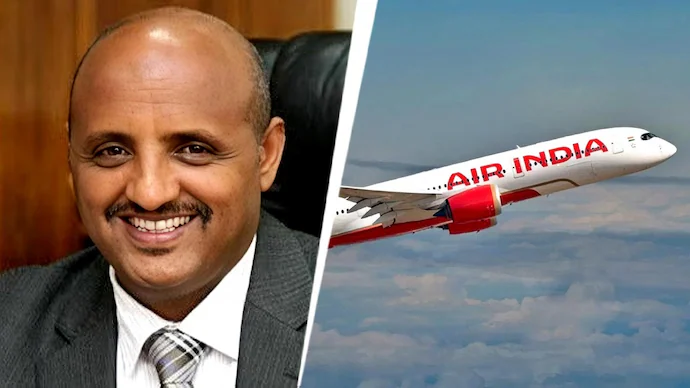
Air India is preparing for a major leadership reshuffle under its new chief executive, Tewolde Gebremariam, as the airline looks to strengthen its management team and improve financial performance. Tata Sons chairman N Chandrasekaran has reportedly given Gebremariam the freedom to select his own senior leadership team, including recruiting experienced executives from outside the company.
According to a report by The Economic Times, the move is intended to bring in professionals with experience in managing large airlines as Air India navigates financial challenges, operational pressures and an ambitious transformation programme.
The proposed restructuring could also lead to changes in the airline’s existing senior management. Nipun Aggarwal, currently Air India’s chief commercial and transformation officer, may move out of his executive role, according to people familiar with the matter cited in the report.
Chandrasekaran Gives Gebremariam Freedom to Build His Team
The reported decision gives Gebremariam greater flexibility to shape Air India’s leadership structure according to his priorities. He will be able to identify and recruit senior executives from outside the Tata Group, particularly professionals who have experience running large-scale airline operations.
Bringing in external talent could help the airline strengthen expertise across important functions, including operations, commercial strategy, network planning, customer experience and financial management. However, the report does not identify any specific candidates or confirm when new appointments might be announced.
The leadership changes come as Air India seeks to improve coordination across its business and establish a more effective management structure. The airline’s financial performance and operational requirements have increased the pressure on its leadership to deliver measurable improvements.
Gebremariam’s freedom to select senior executives could therefore represent an important step in determining the next phase of Air India’s transformation under Tata Group ownership.
Nipun Aggarwal May Move Out of Air India’s Executive Management
One of the significant developments under consideration is the possible departure of Nipun Aggarwal from his current executive position at Air India. Aggarwal has played an important role in the airline’s commercial and transformation plans since the Tata Group took control of the carrier in January 2022.
According to The Economic Times report, Chandrasekaran and Aggarwal have discussed the possibility of the latter moving out of his current role. The Tata Sons chairman is understood to have offered Aggarwal other positions within the Tata Group.
Aggarwal currently serves as Air India’s chief commercial and transformation officer. His responsibilities have included work related to the airline’s commercial strategy and broader transformation efforts.
The report also said there had been opposition to Aggarwal taking over as Air India’s chief executive after Campbell Wilson. Tata Trusts chairman Noel Tata is reportedly understood to have objected to his appointment.
These developments suggest that the airline’s leadership structure could undergo significant changes as Gebremariam establishes his management priorities. However, no formal announcement confirming Aggarwal’s departure or a replacement has been provided in the supplied report.
Tewolde Gebremariam Took Charge of Air India on October 1
Gebremariam assumed charge as Air India’s chief executive on October 1, succeeding Campbell Wilson, who stepped down after nearly four years in the position.
Before joining Air India, Gebremariam headed Ethiopian Airlines for more than a decade. His experience leading a major international carrier is expected to be relevant as Air India works to strengthen its operations and improve its competitive position in the global aviation market.
Wilson resigned in April amid mounting financial losses and the aftermath of the AI171 crash in Ahmedabad in June 2025, which claimed 260 lives. His departure marked a leadership transition at a time when Air India was facing significant operational and financial challenges.
Gebremariam now faces the task of improving the airline’s performance while managing its expansion plans and addressing operational priorities. His experience at Ethiopian Airlines could inform his approach to network planning, cost management and organisational efficiency, although the airline’s specific plans under his leadership will depend on decisions made by its management.
Air India’s Financial Loss More Than Doubles in FY26
Air India’s leadership restructuring comes against the backdrop of a difficult financial year. The airline reported a consolidated net loss of Rs 22,238.23 crore for the financial year ended March 2026, more than double the Rs 10,858.83 crore loss recorded in the previous financial year.
The increase in losses highlights the scale of the financial challenge facing the airline as it attempts to improve its business performance. Revenue declined while expenses continued to rise, putting additional pressure on the company’s efforts to move towards sustainable profitability.
According to the airline’s annual report, consolidated revenue fell to Rs 71,869.94 crore in FY26 from Rs 78,635.61 crore in the previous year. This represents a decline of approximately 8.6%.
At the same time, consolidated expenses increased to Rs 93,733.31 crore from Rs 89,317.12 crore. The combination of lower revenue and higher expenses contributed to the deterioration in the airline’s financial performance.
The figures underline why improving revenue generation, controlling operating costs and increasing efficiency are likely to remain central priorities for the new leadership team.
Passenger Numbers and Load Factor Decline
Air India’s operating performance also weakened during FY26, according to the annual report. The airline carried 36 million passengers during the year, compared with 43.8 million in the previous financial year.
Its passenger load factor declined to 81% from 85%. Passenger load factor measures the proportion of available passenger seating capacity that is occupied by paying passengers. A lower figure can indicate that a smaller share of the airline’s available seats is being filled.
The airline also recorded declines in two important aviation operating indicators: available seat kilometres and revenue passenger kilometres.
- Available seat kilometres (ASK): Declined to 100,828 million in FY26 from 114,226 million in the previous year. ASK measures the passenger-carrying capacity an airline makes available, taking into account the number of seats and the distance flown.
- Revenue passenger kilometres (RPK): Fell to 81,794 million from 96,551 million. RPK measures the distance travelled by paying passengers and is used to assess passenger traffic.
- Passenger numbers: Dropped to 36 million from 43.8 million.
- Passenger load factor: Declined to 81% from 85%.
These indicators provide a broader picture of the airline’s operating environment. Lower passenger traffic and capacity utilisation can affect revenue generation, making network planning and efficient deployment of aircraft important considerations for management.
Geopolitical Tensions and Operational Disruptions Add Pressure
Air India has cited several external and operational factors affecting its performance. These include geopolitical tensions, airspace closures, longer flight times, restrictions on passenger and cargo loads, and operational disruptions.
Airspace restrictions can force airlines to alter established flight routes, increasing journey distances and operating time. Longer routes can also raise fuel consumption and other operating expenses, while restrictions on passenger and cargo loads can limit the revenue generated from individual flights.
Such challenges can be particularly significant for airlines operating extensive international networks. They can affect schedules, aircraft utilisation, costs and the ability to maintain consistent services.
For Air India, addressing these pressures will require management to balance operational reliability with commercial performance. The airline’s leadership will also need to distinguish between challenges arising from external conditions and areas where internal improvements can deliver savings.
Network Strategy Could Become a Major Priority
One of the key areas expected to receive attention under Gebremariam is Air India’s network and hub strategy. The airline is looking to reduce its dependence on Delhi and develop Mumbai and Hyderabad as stronger hubs.
A hub-based airline network allows carriers to connect passengers from different cities through selected airports. A well-planned hub structure can help improve aircraft utilisation, expand connecting traffic opportunities and support more efficient scheduling.
Developing Mumbai and Hyderabad as stronger hubs could help Air India distribute its operations more effectively rather than relying heavily on a single major airport. It could also support the airline’s efforts to strengthen domestic and international connectivity.
However, the success of such a strategy will depend on factors including passenger demand, airport capacity, route economics, aircraft availability and operational reliability. The airline has not provided specific timelines or detailed targets for the proposed hub development in the supplied information.
Gebremariam Wants Employees Involved in Cost Reduction
Gebremariam has also indicated that improving Air India’s financial performance will require participation from employees across the organisation, rather than relying only on senior management or the finance department.
At a recent town hall, he emphasised the need to increase revenue and control expenses to achieve sustainable profitability. He acknowledged that external challenges had slowed the airline’s progress towards breaking even but stressed that improving financial performance remained a priority.
His approach suggests that cost management is expected to become a broader organisational responsibility. Employees working in different departments may be able to identify opportunities to reduce waste, improve processes and make daily operations more efficient.
Given the scale of an airline’s operations, even relatively small savings across multiple departments can potentially have a meaningful cumulative impact. Improvements in fuel efficiency, turnaround times, resource utilisation and administrative processes can all contribute to better cost control when implemented effectively.
Air India Plans Employee Rewards for Cost-Saving Ideas
To encourage employees to participate in the transformation process, Gebremariam said the airline plans to introduce programmes that reward staff members whose suggestions result in measurable cost savings or improved operational efficiency.
The proposed initiative could create a channel for employees to share practical ideas based on their day-to-day experience. Staff members working directly with aircraft operations, airport services, customer support and other functions may identify inefficiencies that are not always visible at the senior management level.
Rewarding suggestions that deliver measurable results could also help build a stronger culture of accountability and continuous improvement. However, Gebremariam did not specify when the programmes would be introduced or how the airline would evaluate suggestions and determine rewards.
The effectiveness of such initiatives will depend on whether employees receive clear guidelines, whether proposed ideas are assessed transparently and whether successful recommendations are implemented across the organisation.
Leadership Restructuring Comes at a Critical Stage for Air India
The proposed management reshuffle comes at an important stage in Air India’s transformation. The airline is attempting to strengthen its position while dealing with rising financial losses, declining passenger numbers and operational pressures.
Giving Gebremariam the freedom to build his own leadership team could allow him to bring in executives whose experience and priorities align with his plans for the carrier. Changes involving existing senior executives, including the possible movement of Aggarwal to another role within the Tata Group, could also reshape the airline’s management structure.
At the same time, appointing experienced professionals alone will not resolve the airline’s financial and operational difficulties. The new leadership will need to translate its strategy into improvements in revenue, cost efficiency, passenger experience, network performance and operational discipline.
Air India’s performance in the coming financial periods will be an important measure of whether the leadership changes and proposed operational initiatives can deliver the improvements the airline needs. For now, the reported restructuring signals a greater role for Gebremariam in shaping the organisation as it works towards sustainable profitability.
For breaking news and live news updates, like us on Facebook or follow us on Twitter and Instagram. Read more on Latest Business on thefoxdaily.com.






COMMENTS 0