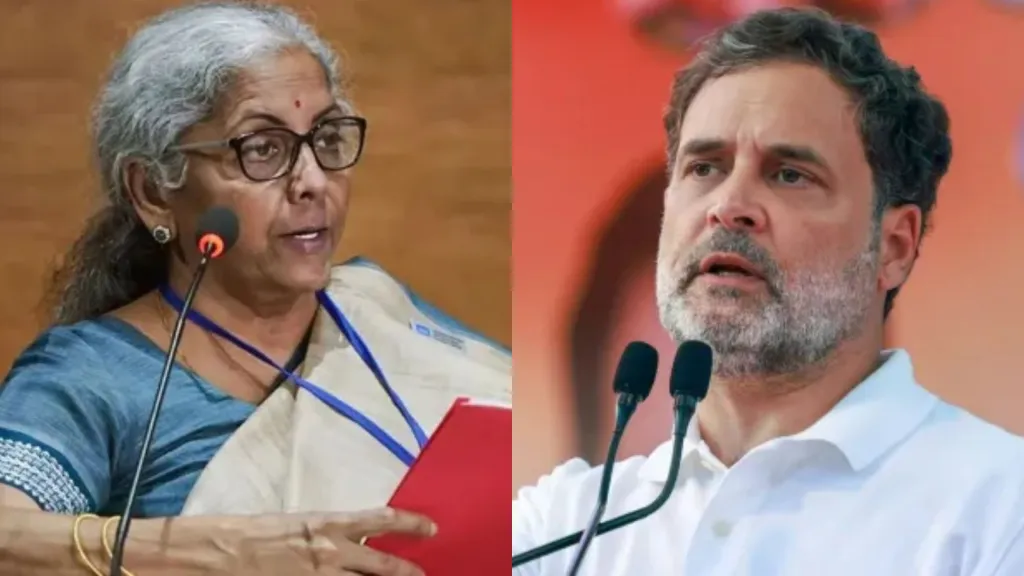
A political confrontation between Congress leader Rahul Gandhi and Union Finance Minister Nirmala Sitharaman intensified on October 28, 2026, after the two exchanged sharp remarks over allegations concerning the Tata Group, the treatment of Indian businesses and the role of the government in supporting industry.
The dispute began when Gandhi, the Leader of the Opposition in the Lok Sabha, accused the government of “criminally destroying” Tata and alleged that business leaders were afraid to speak publicly. Sitharaman responded on social media platform X, urging him not to politicise every issue and arguing that describing commercial and legal matters as criminal was unacceptable.
Gandhi subsequently challenged the finance minister to explain why Tata Trusts and Tata Sons had allegedly been hosted at Union Home Minister Amit Shah’s residence. He also claimed that most Indian businesses, apart from a small number of companies he described as being close to the government, already opposed the ruling establishment.
The exchange has brought several issues into the political spotlight, including corporate independence, the relationship between government and business, the legacy of India’s economic policies and the importance of institutional transparency. However, the competing allegations made by the two leaders do not, by themselves, establish wrongdoing by any individual or organisation.
How the Rahul Gandhi-Nirmala Sitharaman dispute began
The confrontation started with Gandhi’s criticism of the government’s handling of the Tata Group. In his original post on X, he alleged that the conglomerate was being “criminally destroyed” and accused business leaders of remaining silent because they feared the consequences of speaking out.
Gandhi argued that Indian businesses should not be treated as political instruments and called for accountability. His remarks also included a warning that business leaders should not wait until their companies were under greater pressure before raising concerns.
His intervention placed the relationship between political power and corporate India at the centre of the debate. Gandhi’s argument was that business leaders should be able to operate independently and express concerns without fearing repercussions.
However, his initial post did not establish the specific legal or commercial circumstances underlying his allegations. The available account also does not independently demonstrate that the government had committed a criminal act against the Tata Group.
Sitharaman responded by challenging both Gandhi’s language and his broader criticism of the government. She argued that commercial disputes and legal matters should not be casually characterised as criminal conduct.
The finance minister also accused Gandhi of repeatedly criticising the achievements of Indian businesses and entrepreneurs. She questioned whether his comments were intended to encourage business leaders to spread distrust towards the government.
The disagreement quickly expanded beyond Tata, becoming a broader political argument about the government’s economic record and the opposition’s responsibility when making allegations against institutions and businesses.
What Nirmala Sitharaman said in her response
In her October 28 post on X, Sitharaman urged Gandhi to refrain from politicising every issue and challenged his use of criminal terminology in connection with commercial and legal matters.
She also accused the Congress of weakening Indian entrepreneurship during its years in power, invoking the country’s historical Licence-Quota Raj system.
Her response centred on three principal arguments: the Congress government’s economic legacy, the Modi government’s approach to industry and the importance of respecting the country’s legal institutions.
Sitharaman invokes the Licence-Quota Raj
The finance minister argued that Congress governments had restricted the development of Indian entrepreneurs through what she described as the “stifling” Licence-Quota Raj.
The term refers to the system of industrial licensing, government permissions and regulatory controls that shaped large parts of India’s economy before the major economic liberalisation reforms of 1991.
Under the earlier framework, businesses in several sectors faced restrictions on industrial capacity, investment decisions and expansion. The 1991 reforms introduced a substantial shift towards a more open economic model, although the pace and extent of liberalisation varied across sectors.
By invoking this history, Sitharaman sought to contrast the Congress’s economic record with the approach of the Narendra Modi-led government. Her argument was that the current administration recognises private businesses as important contributors to employment and economic growth.
She said the government’s policies were designed to enable enterprise, support industry and encourage investment.
The reference to the Licence-Quota Raj also reflects a longstanding political disagreement over India’s economic transformation. Congress and the BJP have often presented competing interpretations of the country’s development, with both parties emphasising different aspects of economic policy and governance.
However, historical arguments about licensing and economic liberalisation do not directly resolve Gandhi’s allegations concerning the Tata Group. Those allegations would need to be assessed separately on the basis of specific evidence.
The government says industry is central to economic growth
Sitharaman described Indian industry as a source of employment and a driver of economic growth. She argued that political parties, government institutions and public leaders shared a responsibility to support businesses, strengthen farmers and protect the future of young people.
Her response framed the issue as one of constructive engagement rather than confrontation. She accused Gandhi of making allegations that served narrow political interests and said political debate should not undermine confidence in Indian industry.
The finance minister’s position reflects the government’s broader argument that private enterprise is important to investment, job creation and economic development.
Businesses depend on a range of conditions to operate effectively, including predictable regulation, access to capital, reliable infrastructure, a skilled workforce and confidence in the legal system. Political disagreements over these conditions can influence public perceptions of the business environment, even when the underlying claims remain contested.
At the same time, supporting industry does not remove the need for scrutiny of commercial decisions or government-business relationships. The central question in any specific controversy is whether the available evidence supports the allegations being made.
Sitharaman brings the judiciary into the debate
The finance minister also invoked the Constitution and the judiciary, stating that the Constitution guaranteed justice to citizens and that courts were entrusted with upholding it.
She accused Gandhi, the Congress and prime ministers from his party of having demeaned the judiciary. She concluded her response by telling the opposition leader to stop “seeing ghosts everywhere”.
This part of the exchange broadened the dispute from economic policy to institutional credibility. Sitharaman’s argument was that allegations concerning commercial or legal matters should be handled constructively and with respect for the institutions responsible for administering justice.
Nevertheless, invoking the judiciary does not itself establish the merits of either side’s claims. The validity of a specific allegation depends on the relevant evidence, legal framework and facts of the case.
Rahul Gandhi’s reply: Why were Tata Trusts and Tata Sons at Amit Shah’s residence?
Gandhi responded to Sitharaman by questioning the circumstances surrounding an alleged meeting involving Tata Trusts and Tata Sons at the residence of Union Home Minister Amit Shah.
“Which ‘legal and commercial matter’ required Tata Trusts and Tata Sons to be hosted at Amit Shah’s residence?” Gandhi asked in his reply.
He followed the question with a reference to what he called “crony number 1”, asking when that individual would enter the situation and which parts of Tata they might obtain.
Gandhi then made his most sweeping claim, saying that Indian businesses, apart from three or four companies he described as government cronies, already opposed the ruling establishment and did not need encouragement to express their views.
His response shifted the focus back to the relationship between political leadership and large corporations. Rather than accepting Sitharaman’s criticism of his language, Gandhi questioned whether the circumstances surrounding the alleged meeting warranted further scrutiny.
However, the available account does not provide independent confirmation of the meeting’s purpose, the people involved beyond those named in Gandhi’s question, or the details of any decisions allegedly connected to it.
It also does not identify the businesses Gandhi had in mind when referring to three or four companies. His statement should therefore be understood as a political allegation rather than an established description of the views of Indian industry as a whole.
Why the Tata Group is central to the political controversy
The Tata Group is one of India’s most prominent business groups, with operations spanning multiple industries. Its position in the country’s corporate landscape means that allegations involving its businesses or institutions can attract attention beyond the immediate parties involved.
Gandhi’s remarks have placed the group at the centre of a dispute about whether political influence can affect the interests and independence of major Indian companies.
For a conglomerate operating across different sectors, commercial decisions can involve complex ownership structures, boards, legal obligations and regulatory requirements. Any allegation of improper interference would need to be examined in the context of the specific company, transaction or institutional decision concerned.
The term “Tata” can also refer to different entities within the broader group, including Tata Sons and Tata Trusts. These organisations have distinct roles and should not automatically be treated as interchangeable when assessing a particular claim.
This distinction is important because a broad political statement about the Tata Group may encompass several separate issues. Establishing what happened in any one of them requires clarity about the relevant entity, the decision under scrutiny and the evidence supporting the allegation.
Neither Gandhi’s accusation of criminal destruction nor Sitharaman’s rejection of his characterisation settles the underlying questions. The exchange establishes that the leaders disagree sharply, but it does not independently demonstrate criminal wrongdoing or disprove every concern raised about the relationship between government and business.
What the dispute means for Indian businesses
The confrontation raises a wider question about business confidence in India: how should companies balance their commercial interests with their relationship with political authorities?
Businesses operate within legal and regulatory systems established by governments. They may need approvals, licences, contracts and other official decisions to carry out particular activities. At the same time, their long-term interests depend on predictable rules and the ability to make commercial decisions without improper pressure.
When political leaders publicly accuse one another of undermining businesses or favouring particular companies, the resulting debate can influence how investors and entrepreneurs perceive the operating environment. The practical effect depends on the substance of the allegations and whether institutions respond transparently.
Corporate independence and regulatory predictability
Corporate independence does not mean that companies are exempt from regulation or public accountability. Businesses must comply with applicable laws, and governments have legitimate responsibilities to enforce rules and protect public interests.
The concern arises when commercial decisions appear to depend on political access rather than consistent procedures. In such circumstances, businesses may question whether competitors receive equal treatment or whether regulatory outcomes can be anticipated reliably.
Gandhi’s comments raise questions about political influence, while Sitharaman argues that his allegations risk creating distrust without sufficient justification. Determining which interpretation is supported by evidence requires more than the exchange of accusations.
Relevant evidence could include official statements, the documented purpose of meetings, applicable legal procedures and the reasons behind any specific commercial or regulatory decisions. Without such details, the political claims cannot be treated as proof of wrongdoing.
Jobs, investment and entrepreneurs
The dispute also touches on the relationship between industry and employment. Sitharaman emphasised the importance of businesses as job creators and contributors to economic growth, while Gandhi argued that business leaders should not remain silent when they believe their interests are threatened.
Both arguments concern conditions that can matter to the wider economy, although they approach the issue from different political perspectives.
For entrepreneurs, the key considerations include access to markets, the cost of compliance, the availability of finance and confidence that rules will be applied consistently. For workers, the performance and expansion of businesses can affect employment opportunities and career prospects.
However, the exchange does not provide evidence of a specific change in investment, hiring or business activity resulting from the controversy. Any claim that the dispute has already damaged the economy or caused companies to change their plans would go beyond the available information.
Congress versus BJP: A continuing argument over economic governance
The confrontation reflects a wider political contest between Congress and the BJP over India’s economic history and the role of private enterprise.
Sitharaman’s invocation of the Licence-Quota Raj presents the Congress’s earlier economic policies as a period of excessive restrictions on entrepreneurs. Her defence of the Modi government emphasises investment, enterprise and the contribution of industry to economic growth.
Gandhi’s response, by contrast, focuses on the possibility that political power could be used to influence the interests of major corporations. His argument is that business leaders should have the freedom to speak openly and that corporate India should not be treated as an extension of the ruling establishment.
These positions reflect different approaches to evaluating economic governance. One emphasises the government’s policy framework and its stated support for business; the other questions whether relationships between political authorities and corporate groups are sufficiently independent and transparent.
A meaningful assessment requires examining specific policies and decisions rather than relying exclusively on political labels. India’s economic history includes both periods of extensive state control and subsequent liberalisation, while contemporary business conditions are shaped by multiple regulatory, financial and global factors.
Similarly, questions about political influence over a particular company require evidence relating to that company and the decisions concerned. Historical criticism of one party’s economic record cannot establish or dismiss a separate allegation involving a current government.
What happens next in the Rahul Gandhi-Sitharaman row?
The immediate exchange has left the central allegations unresolved in the information available. Sitharaman has rejected Gandhi’s characterisation of the Tata matter and criticised his approach to political debate, while Gandhi has challenged her response by raising questions about an alleged meeting involving Tata Trusts, Tata Sons and Amit Shah.
The next significant development would depend on whether either side provides further details that clarify the underlying commercial or legal issue. An explanation of the alleged meeting, the context in which it took place and any relevant official decisions could help establish what questions warrant further examination.
Until such information emerges, the competing statements should be treated as political claims rather than conclusive evidence. Neither the accusation of criminal destruction nor the rejection of that accusation establishes the full facts of the matter.
The episode also highlights the difficulty of separating political messaging from substantive questions about corporate governance. Strong language can attract attention, but resolving concerns about the independence of businesses requires specific facts, transparent procedures and appropriate institutional scrutiny.
Conclusion: A political clash with wider implications for corporate India
Rahul Gandhi’s exchange with Nirmala Sitharaman has turned allegations concerning Tata into a broader argument about Indian industry, political influence and economic governance.
Sitharaman has defended the Modi government’s approach to business and criticised Gandhi for using criminal language without establishing the basis for it. Gandhi has countered by questioning an alleged meeting involving Tata Trusts and Tata Sons at Amit Shah’s residence and claiming that most Indian businesses already distrust the ruling establishment.
The dispute illustrates how questions about corporate independence can become part of a larger political contest over investment, employment and institutional accountability. It also demonstrates why allegations involving major businesses need to be assessed through evidence rather than political rhetoric alone.
For Indian businesses, the lasting significance will depend less on the sharpness of the exchange than on whether the underlying questions receive clear and verifiable answers. Predictable regulation, transparent decision-making and fair treatment remain important considerations in evaluating the relationship between government and industry.
For breaking news and live news updates, like us on Facebook or follow us on Twitter and Instagram. Read more on Latest India on thefoxdaily.com.






COMMENTS 0