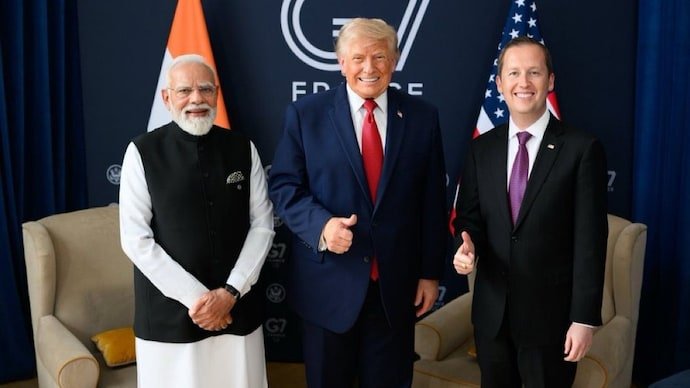
The June 2026 meeting between US President Donald Trump and Prime Minister Narendra Modi at the G7 Summit in France was more than a routine bilateral engagement. For policymakers, diplomats, and strategic analysts, it symbolized the revival of a relationship that had faced one of its most challenging periods in recent years.
What made the meeting especially significant was the context surrounding it. The previous sixteen months had witnessed growing tensions over trade, security, tariffs, regional conflicts, and differing diplomatic priorities. Yet by the time Trump and Modi sat down together in Evian-les-Bains, the tone had shifted dramatically.
Many observers credit that transformation to a quiet but highly strategic diplomatic effort led by US Ambassador to India Sergio Gor, who spent months rebuilding channels of communication, restoring political confidence, and ensuring that both governments remained focused on the larger strategic picture.
The story offers a fascinating case study in modern Diplomacy and demonstrates how individual diplomats can sometimes influence the trajectory of major international relationships.
Why the US-India Relationship Matters More Than Ever
The United States and India share one of the most consequential strategic partnerships in the world.
Together, they represent:
- The world’s largest and oldest democracies
- Two of the largest economies globally
- Major technology and innovation hubs
- Key security partners in the Indo-Pacific
- Critical players in global supply chains
- Important stakeholders in maritime security
Over the last two decades, bilateral cooperation has expanded across Defense, trade, technology, energy, education, space exploration, and intelligence sharing.
As geopolitical competition intensifies in Asia, the importance of strong US-India ties has only increased.
This is precisely why the deterioration of relations during 2025 generated concern among policymakers on both sides.
The Beginning of the Diplomatic Crisis
The optimism generated by President Trump’s return to office and his early interactions with Prime Minister Modi initially suggested that bilateral relations would deepen further.
However, several developments complicated that expectation.
Trade Disagreements
Trade became one of the first major friction points. Expectations of an early trade framework failed to materialize, leading to growing frustration within Washington.
Subsequent tariff measures added pressure to an already sensitive economic relationship.
Regional Security Concerns
Geopolitical tensions in South Asia introduced another layer of complexity.
Differences in perception regarding regional security developments created uncomfortable diplomatic moments, particularly as conflict-related narratives emerged internationally.
Political Messaging Problems
Public commentary from various political figures, analysts, and media personalities further complicated matters.
What might have remained manageable policy disagreements increasingly became public controversies, creating the impression of a broader diplomatic drift.
By mid-2025, concerns were growing that years of strategic progress could be undermined.
Who Is Sergio Gor?
While political leaders often dominate headlines, diplomats frequently shape outcomes behind closed doors.
Sergio Gor entered the spotlight at a critical moment for US-India relations.
Before assuming his role as Ambassador to India, Gor had already developed a reputation in Washington as a skilled political operator with strong access to senior decision-makers.
Unlike traditional diplomats who often focus exclusively on protocol, Gor became known for combining political instincts with strategic messaging.
His appointment signaled Washington’s recognition that repairing relations with India required more than standard diplomatic engagement.
The First Signs of a Reset
Successful diplomatic recoveries rarely begin with dramatic announcements.
Instead, they start with small but meaningful signals.
One of the earliest indications came through renewed communication between senior Leadership in Washington and New Delhi.
Political observers noted a gradual shift in tone.
Public messaging became more measured. Communication channels that appeared strained began functioning more effectively. Senior officials resumed discussions focused on long-term cooperation rather than short-term disagreements.
These developments may have appeared routine to outsiders, but experienced diplomats understood their significance.
Trust was being rebuilt.
The Importance of Personal Diplomacy
One of the most overlooked aspects of International Relations is the role of personal relationships.
Government institutions matter, but trust between leaders and senior officials often determines whether negotiations succeed or fail.
Diplomats frequently serve as bridges between political systems.
In the case of US-India relations, rebuilding confidence required:
- Frequent communication
- Private consultations
- Managing misunderstandings
- Reducing public tensions
- Identifying shared interests
- Creating opportunities for cooperation
Reports from diplomatic circles suggest Gor focused heavily on these fundamentals.
Rather than chasing headlines, the emphasis was on restoring working relationships.
The Trade Breakthrough That Changed Momentum
Economic cooperation has long served as one of the strongest pillars of the US-India partnership.
Trade disputes therefore posed a significant challenge.
Progress toward an interim trade framework became an important milestone because it demonstrated that practical cooperation remained possible despite broader disagreements.
The agreement provided both governments with an opportunity to shift the conversation away from conflict and toward collaboration.
This change in momentum proved crucial.
Diplomatic relationships often improve when tangible results replace political rhetoric.
The Technology Factor: Why India Became Even More Important
One of the most significant developments influencing the relationship is the growing importance of technology.
The global race for leadership in artificial intelligence, semiconductors, advanced manufacturing, and digital infrastructure has elevated India’s strategic value.
India offers:
- A massive technology workforce
- A growing innovation ecosystem
- Expanding semiconductor ambitions
- Strong digital public infrastructure
- A rapidly growing consumer market
For the United States, deeper technological cooperation with India aligns with broader economic and security objectives.
This shared interest provided another incentive for both sides to repair relations quickly.
The Quad and Indo-Pacific Strategy
The revival of diplomatic momentum also reinforced the importance of the Quadrilateral Security Dialogue, commonly known as the Quad.
Comprising India, the United States, Japan, and Australia, the Quad has become one of the most influential strategic groupings in the Indo-Pacific.
The framework focuses on:
- Maritime security
- Supply chain resilience
- Critical technologies
- Disaster response
- Infrastructure development
- Regional stability
Maintaining strong US-India ties is essential to the effectiveness of the Quad.
Any prolonged deterioration in bilateral relations would inevitably weaken broader regional initiatives.
The G7 Summit: The Moment the Reset Became Visible
The June 2026 G7 Summit provided the first clear public demonstration that relations had improved.
The meeting between Trump and Modi featured several notable moments.
Discussions covered:
- Trade cooperation
- Maritime security
- Strategic partnerships
- Regional stability
- Economic collaboration
- Technology cooperation
The tone was markedly different from the tensions that had characterized much of the previous year.
Perhaps most importantly, both leaders emphasized the strength of the bilateral relationship and the importance of future cooperation.
For diplomats who had spent months working behind the scenes, the summit represented validation that the recovery effort was succeeding.
Why This Diplomatic Recovery Matters Globally
The significance of the US-India reset extends far beyond bilateral relations.
A stable partnership between Washington and New Delhi influences several global issues:
| Area | Why It Matters |
|---|---|
| Global Trade | Supports supply chain diversification and economic stability |
| Technology | Strengthens cooperation in AI, semiconductors, and innovation |
| Defense | Enhances security coordination in the Indo-Pacific |
| Energy | Supports energy security and transition goals |
| Maritime Security | Protects critical shipping routes and commerce |
| Democracy | Reinforces cooperation between major democratic powers |
Because of these overlapping interests, both countries have strong incentives to maintain a productive relationship despite periodic disagreements.
The Leadership Lesson Behind the Turnaround
The Sergio Gor story offers an important lesson about diplomacy in the modern era.
Many international disputes attract attention because of dramatic speeches or headline-grabbing confrontations. Yet lasting solutions usually emerge through patient engagement, relationship-building, and strategic persistence.
The ability to keep communication channels open during difficult periods often determines whether tensions escalate or eventually subside.
In this case, the turnaround illustrates how sustained diplomatic effort can gradually reverse even significant political friction.
What Comes Next for US-India Relations?
The recovery process is not complete.
Several issues still require careful management, including trade negotiations, Immigration concerns, market access discussions, defense cooperation, and regional security challenges.
However, the trajectory now appears considerably more positive than it did a year ago.
Analysts expect the next phase of the relationship to focus on:
- A broader trade agreement
- Expanded technology partnerships
- Defense collaboration
- Semiconductor investments
- Artificial intelligence cooperation
- Supply chain resilience initiatives
There is also growing speculation about a major presidential visit that could further elevate bilateral ties and potentially lead to significant strategic announcements.
Conclusion: The Diplomat Behind the Recovery
The restoration of US-India relations did not happen overnight. It required months of engagement, trust-building, negotiation, and strategic patience.
While Presidents Trump and Modi ultimately provided the political leadership necessary to move the relationship forward, diplomats played a critical role in creating the conditions for success.
Among them, Sergio Gor has emerged as one of the most influential figures in the recent turnaround. His efforts highlight the continuing importance of diplomacy in an era increasingly shaped by geopolitical competition and global uncertainty.
As the United States and India prepare for the next chapter of their partnership, the events of the past sixteen months serve as a reminder that even the strongest strategic relationships require constant attention, careful management, and leaders willing to rebuild bridges when circumstances become challenging.
If current momentum continues, the June 2026 G7 meeting may ultimately be remembered not simply as a diplomatic photo opportunity, but as the moment a crucial global partnership found its footing once again.
For breaking news and live news updates, like us on Facebook or follow us on Twitter and Instagram. Read more on Latest World on thefoxdaily.com.





COMMENTS 0