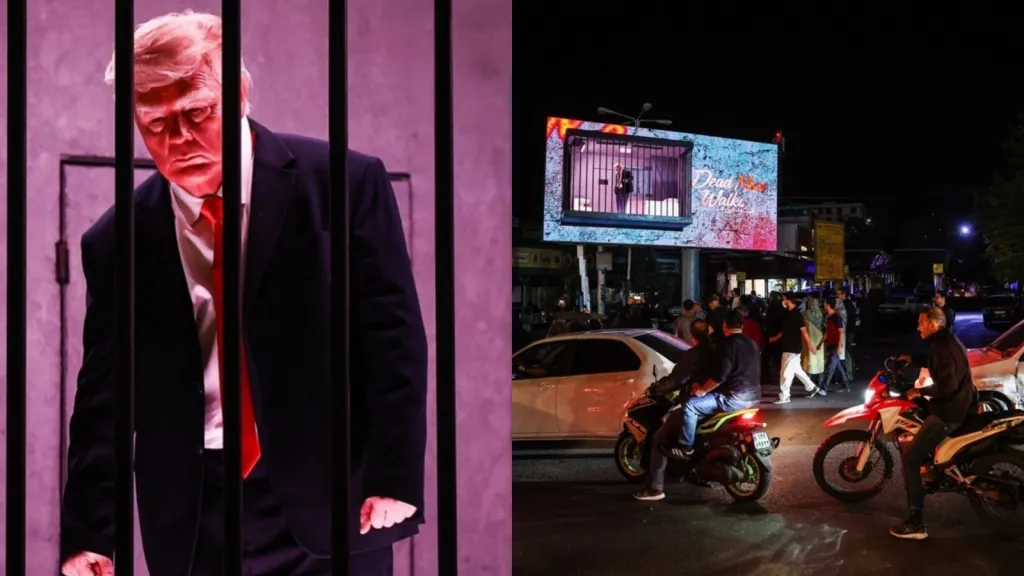
A provocative public art installation in Tehran has drawn attention by depicting a man portraying US President Donald Trump inside a mock prison cell. Displayed in the Iranian capital’s busy Tajrish Square, the installation combines political messaging, theatrical performance and references to past US military actions, turning a public billboard into a stage for protest amid continuing tensions between Washington and Tehran.
The installation features a prison cell built into a live billboard, where an actor dressed as Trump can be seen walking around and sitting behind bars. The display invites passers-by to stop and watch the performance, presenting an imagined scene of the US president in custody rather than depicting an actual arrest or imprisonment.
One of the most prominent messages accompanying the installation reads, “It is a crime not to see this scene.” The slogan appears to encourage people to engage with the spectacle, while the actor’s movements and interactions with onlookers give the display an interactive character.
The installation appeared as tensions between the United States and Iran continued to shape political debate in the region. By placing an actor portraying Trump behind bars in a busy public square, the display uses a familiar image of imprisonment to communicate a political message directed at the American president and his administration.
What Does the Tehran Square Installation Show?
The installation was set up in Tehran’s Tajrish Square, a busy public area where the display could attract the attention of pedestrians. Its central feature is a mock prison cell incorporated into a billboard, allowing people passing through the square to observe the performance.
Inside the cell, an actor dressed to resemble Donald Trump walks around and sits behind the bars. The performance presents the US president as a prisoner, using theatrical representation to convey criticism rather than documenting a real legal or law-enforcement event.
The display also encourages participation from the public. Onlookers can be seen shouting commands at the actor inside the mock cell, making the installation more than a conventional static billboard. The interaction between the performer and spectators adds a dramatic element to the scene and helps attract attention to its political message.
The slogan, “It is a crime not to see this scene,” reinforces the invitation to watch. It frames the installation as something that people should stop to observe, while the prison setting communicates the intended imagery of confinement and accountability.
The installation was displayed in Tehran on Wednesday, according to the supplied report. Its appearance comes against the backdrop of the conflict between Iran and the United States, giving the artistic display a political context beyond its theatrical presentation.
Billboards Reference US Military Actions
Alongside the mock prison cell, billboards around the installation referenced previous US military actions. These included references to an attack on a school in Minab and a wedding celebration in Sirik.
The references place the installation within a broader narrative of Iranian criticism of US military operations. By displaying the actor portraying Trump behind bars alongside references to these incidents, the installation connects its central image to grievances associated with the conflict.
The supplied material does not provide further details about the individual billboard messages or explain the circumstances of each referenced incident. However, their inclusion indicates that the display was designed to communicate more than a general image of imprisonment. It also sought to draw attention to the human consequences and disputed legacy of military action.
Political art and public installations can communicate messages through visual symbolism rather than lengthy statements. In this case, the prison cell, the actor’s resemblance to Trump and the surrounding references to military actions combine to create a direct political statement in a public space.
Why Has the Installation Attracted Attention?
The installation places a recognisable political figure at the centre of a public performance. Rather than presenting Trump in a formal speech, official photograph or news broadcast, it portrays him in an imagined situation in which he is confined behind bars.
This visual reversal is central to the display’s message. A prison cell is commonly associated with detention, punishment and legal accountability. By placing an actor portraying the US president inside one, the installation invites viewers to consider a scenario that is symbolic rather than real.
The public setting also matters. Located in Tajrish Square, the installation is designed to be encountered by people moving through an everyday urban environment. Passers-by do not need to enter a gallery or attend a formal event to see it.
The slogan encouraging people to watch, combined with the opportunity to shout commands at the actor, makes the display participatory. Spectators become part of the performance by reacting to the person inside the cell, creating a public spectacle around its political message.
At the same time, the installation should be understood as a form of political expression. It does not establish that Trump has been arrested, charged or imprisoned. The actor’s appearance and the mock cell are elements of a staged display, not evidence of an actual legal development involving the US president.
How Did the US-Iran Conflict Begin?
The supplied report traces the current US-Iran conflict to February 28, 2026, when the United States and Israel launched coordinated strikes on Iran following unsuccessful nuclear negotiations. The attacks targeted Iranian military infrastructure and senior leadership, significantly escalating tensions between the countries.
The strikes killed Iran’s Supreme Leader, Ayatollah Ali Khamenei, along with several senior officials, according to the supplied account. Washington and Israel said their military action was intended to weaken Iran’s military capabilities. Tehran condemned the attacks and responded with military operations of its own.
The initial strikes marked a major escalation in the confrontation. The conflict expanded beyond Iran as the country launched missile and drone attacks against Israel and US-linked military facilities across the Gulf.
The exchange of attacks raised concerns about the possibility of a wider regional conflict. Military activity involving multiple countries and locations also increased uncertainty for civilians, businesses and governments across the region.
The conflict provides important context for understanding the political message of the Tehran installation. Its portrayal of Trump behind bars comes amid a confrontation in which Iranian officials and supporters have criticised US military actions and challenged Washington’s stated objectives.
Missile and Drone Attacks Widened the Conflict
Following the US and Israeli strikes, Iran responded with missile and drone attacks on Israel and US-linked military facilities across the Gulf. These operations extended the confrontation beyond the original targets and increased the number of locations affected by the fighting.
The conflict also resulted in civilian casualties, according to the supplied report. The effects extended beyond the immediate military confrontation, with disruption to air travel and growing concern about the safety of shipping routes used for international trade.
One particularly important concern involved the Strait of Hormuz, a strategic waterway through which a significant share of global oil supplies travels. Threats to shipping in the area can have consequences far beyond the countries directly involved in the conflict.
Any disruption to maritime traffic through the strait can create uncertainty for energy markets and countries that depend on oil imports. The conflict therefore raised concerns about the availability and cost of energy supplies, particularly for economies with substantial dependence on imported petroleum.
For countries such as India, which relies heavily on oil imports from the region, instability around the Strait of Hormuz can create economic concerns. Changes in supply conditions and global oil prices can affect energy costs and contribute to uncertainty for governments, businesses and consumers.
The supplied material does not quantify the precise economic impact of the conflict on India or provide detailed figures for changes in oil prices. It does, however, identify the safety of shipping and the stability of global oil supplies as significant concerns arising from the fighting.
Ceasefire Efforts and the Breakdown of the Truce
Efforts to pause the fighting produced a ceasefire in April, according to the supplied report. A broader agreement followed in June, creating an opportunity for a temporary reduction in hostilities.
However, the truce did not lead to a lasting settlement. Both sides accused each other of violating its terms, undermining the arrangements intended to reduce the fighting.
The supplied account says that fighting resumed in July, with fresh US strikes on Iranian targets and Iranian attacks on US military bases in the region. The renewed exchanges demonstrated the difficulty of maintaining a ceasefire while disagreements over security and the conflict’s underlying issues remained unresolved.
By August, efforts to secure a lasting agreement had stalled. Two central points of disagreement identified in the supplied material were Iran’s nuclear programme and control of the Strait of Hormuz.
The nuclear issue has been a major source of tension between Iran and the United States. Failed negotiations preceded the February strikes, while disagreements over Iran’s nuclear programme remained an obstacle to reaching a lasting agreement later in the year.
Control and security around the Strait of Hormuz presented another challenge. The waterway’s importance to international energy shipments means that disputes over access and security can have consequences well beyond the immediate parties to the conflict.
The reported breakdown of ceasefire efforts helps explain the continuing political tension surrounding the installation. The display appeared against a background of renewed fighting, disputed ceasefire terms and stalled attempts to reach a longer-term agreement.
What the Installation Says About Political Messaging in Iran
The mock prison cell uses visual symbolism to communicate criticism of a foreign leader. By depicting Trump as a prisoner, the installation presents an imagined reversal of power and authority. Its message is conveyed through the setting and performance rather than through a detailed written argument.
The inclusion of references to US military actions gives the display an additional dimension. Rather than focusing exclusively on Trump’s public image, the surrounding billboards connect the installation to the consequences of military operations cited in the Iranian political narrative.
The installation also demonstrates how public spaces can be used to communicate political messages. A billboard ordinarily serves as a surface for advertising or public information, but the addition of a live performance transforms it into a temporary stage.
Passers-by can observe the actor, respond to the performance and engage with the message. The result is a combination of visual art, theatre and political commentary.
However, the installation’s imagery should not be confused with a statement of legal fact. The depiction of Trump behind bars is symbolic. The supplied report does not indicate that the US president was arrested or that any actual imprisonment took place.
Why the Strait of Hormuz Matters to the Wider Conflict
Although the Tehran installation focuses on Trump, the wider conflict described in the supplied report involves strategic and economic concerns that extend beyond the United States and Iran.
The Strait of Hormuz is a key route for global oil shipments. Any threat to shipping through the waterway can raise concerns about the continuity of energy supplies and the costs associated with transporting oil.
The conflict’s impact on shipping is particularly relevant because the Gulf region plays an important role in international energy markets. Military escalation can increase uncertainty among shipping operators, energy companies and governments that rely on oil moving through the area.
India is among the countries with significant dependence on imported oil from the region. As a result, instability in the Gulf can become an economic concern for India even when the fighting takes place outside its borders.
The supplied report links the conflict to concerns about global oil markets and the reliability of supplies. It does not provide specific projections for oil prices or quantify possible losses, so the scale of the economic effects cannot be established from the material alone.
What Happens Next in US-Iran Relations?
The supplied account describes a conflict that has continued despite attempts to establish a ceasefire and pursue a broader agreement. Disputes over Iran’s nuclear programme and the Strait of Hormuz remained unresolved as efforts to secure a lasting settlement stalled in August.
The installation in Tajrish Square does not itself indicate a change in diplomatic or military policy. It is a public display reflecting political criticism, rather than an official announcement about negotiations or a new development in the conflict.
Its appearance nevertheless illustrates how the confrontation is being represented in public spaces. The use of an actor portraying Trump, a mock prison cell and references to past military actions brings the wider political dispute into an everyday setting in Tehran.
The future course of US-Iran Relations depends on developments beyond the installation, including the status of negotiations, the parties’ positions on the nuclear programme and security arrangements around the Strait of Hormuz. The supplied material does not establish whether another ceasefire or agreement will be reached.
Conclusion
The installation in Tehran’s Tajrish Square has drawn attention by portraying US President Donald Trump behind bars in a mock prison cell built into a live billboard. An actor dressed as Trump walks and sits inside the cell, while the slogan “It is a crime not to see this scene” encourages passers-by to stop and watch.
Surrounding billboards reference US military actions, including attacks on a school in Minab and a wedding celebration in Sirik. Together, these elements frame the installation as a form of political protest amid tensions between Washington and Tehran.
The display appeared against the background of a conflict that began with US and Israeli strikes on Iran on February 28, 2026, followed by Iranian missile and drone attacks, civilian casualties, concerns about shipping through the Strait of Hormuz and unsuccessful efforts to secure a lasting ceasefire.
While the mock prison cell offers a striking visual statement, it does not depict an actual arrest or imprisonment. Its significance lies in the political symbolism and public performance through which the installation expresses criticism during an ongoing period of US-Iran tension.
For breaking news and live news updates, like us on Facebook or follow us on Twitter and Instagram. Read more on Latest World on thefoxdaily.com.

COMMENTS 0