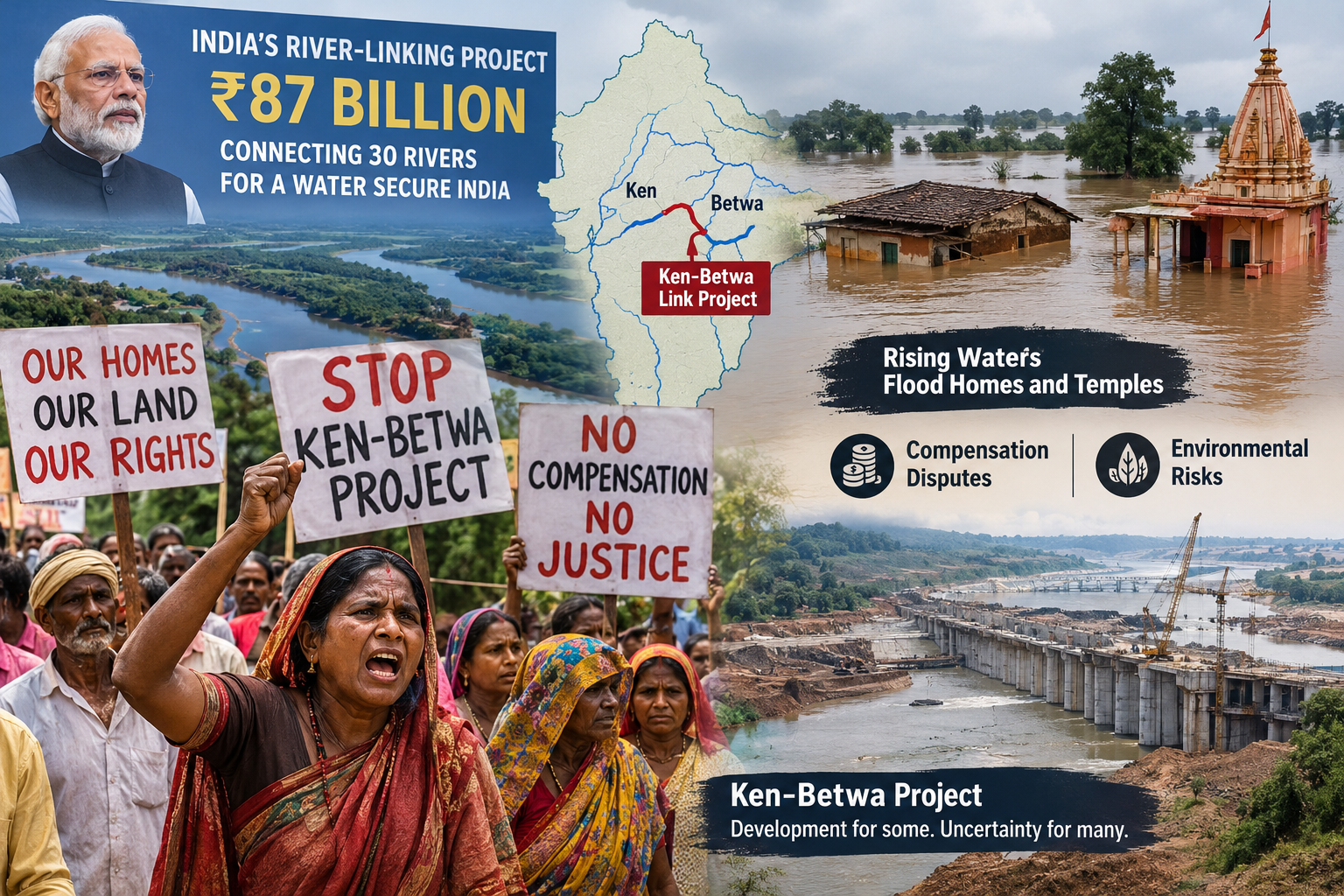
Villagers in Madhya Pradesh are protesting India‘s ambitious river-linking project after rising waters from construction work flooded homes and submerged a local temple. The $87 billion national programme, championed by Prime Minister Narendra Modi, aims to connect around 30 rivers to redistribute water to drought-prone regions. However, affected residents say the compensation offered by the government does not adequately cover their losses, while environmentalists have raised concerns about the project’s impact on forests, wildlife and local ecosystems.
Villagers Protest Over Displacement and Compensation
In Ajaygarh, Madhya Pradesh, tribal residents have voiced their opposition to the river-linking project as rising water levels along the Ken River threaten their homes and ancestral lands. Bitti Bai Kondar, whose family has farmed the land for more than a century, is among hundreds of villagers demanding better compensation and alternative places to live.
Kondar has joined the protests alongside her four adult sons. Several women have demonstrated their opposition by lying on mock funeral pyres, highlighting their determination to remain connected to their ancestral homes.
Residents argue that the project is taking away their land and water without providing sufficient resources to rebuild their lives. For many families, the dispute extends beyond the loss of property to concerns about their livelihoods, cultural connections and long-standing community ties.
Government Compensation Offers Fall Short for Some Residents
The government has offered residents along the Ken River in Panna district compensation of at least 1.25 million Indian rupees, or approximately $13,000, per hectare. The amount is more than double the initial offer of 500,000 rupees per hectare.
Usha Parmar, the district administrator, said compensation had already been paid to more than 90% of eligible residents. However, some affected families maintain that the payments do not account for all the losses associated with the project.
The impact extends to local religious institutions and the people who depend on them for their livelihoods. Dhaniram Bhatnagar, a priest from the area, said the temple where he worked had been completely submerged. He explained that the temple had been his only source of income and that the compensation offered covered his home but did not address the loss of his livelihood.
The dispute highlights the challenges of balancing large-scale Infrastructure development with the needs of communities facing displacement. While the government has offered financial compensation, some residents continue to demand arrangements that reflect the full extent of their losses.
India’s Ambitious River-Linking Programme
India’s river-linking programme is designed to connect approximately 30 rivers across the country, with the goal of transferring water from regions considered water-rich to areas facing shortages. The initiative has been under discussion for decades but has gained momentum in recent years under Prime Minister Narendra Modi.
The government aims to improve water availability in drought-prone regions, strengthen agricultural production and support food security. Agriculture remains a major source of employment in India, making reliable irrigation supplies important for millions of farmers.
The first phase involves connecting the Ken River in Madhya Pradesh with the Betwa River in Uttar Pradesh. The project is estimated to cost approximately $4.6 billion and is intended to improve water availability in the Bundelkhand region.
According to a government statement issued on August 21, the project is expected to address chronic water scarcity by providing irrigation, drinking water and hydropower. However, critics have questioned whether the anticipated benefits justify the financial, social and environmental costs.
Environmental Concerns Over the Daudhan Dam
Environmentalists have raised concerns about the proposed 2-kilometre-long Daudhan Dam on the Ken River. The project is expected to inundate approximately 9,000 hectares, or 22,200 acres, of land, including a significant portion of the Panna Tiger Reserve.
The reserve is recognised for its tiger conservation programme, and environmental campaigners warn that flooding large areas could affect wildlife habitats and damage sensitive ecosystems. The potential loss of forest cover and disruption to local biodiversity have become central issues in the debate over the project’s future.
The government has acknowledged that some environmental impacts are unavoidable but has said they can be mitigated through measures such as tree planting and wildlife conservation.
Environmentalists, however, remain concerned about whether these measures will adequately address the consequences of large-scale construction and flooding. The project’s effects on forests, wildlife and surrounding communities continue to raise questions about how its development objectives will be balanced against environmental protection.
Experts Question the Scientific Basis of the Project
Beyond environmental concerns, some critics have questioned the hydrological assumptions underpinning the river-linking programme. The plan relies on the premise that the Ken River basin has surplus water while the Betwa basin faces a deficit.
Himanshu Thakkar, coordinator of the South Asia Network on Dams, Rivers and People, said the project’s feasibility remained uncertain because the assumption of a water surplus in the Ken basin and a deficit in the Betwa basin had not been conclusively established.
These questions are significant because the project’s intended benefits depend on the availability of water for transfer between the two river basins. Establishing the reliability of water estimates is therefore central to assessing whether the proposed link can deliver its promised irrigation and drinking-water supplies.
A government spokeswoman did not immediately comment on the scientific assumptions behind the project and referred Reuters to the August 21 statement outlining its expected benefits.
Balancing Water Security With Local and Environmental Costs
India’s river-linking initiative reflects the country’s efforts to address uneven water availability and strengthen agricultural resilience. By connecting rivers, the government hopes to improve irrigation, expand access to drinking water and generate hydropower in regions experiencing shortages.
However, protests along the Ken River demonstrate the difficulties of implementing large infrastructure projects in areas where communities depend on ancestral land, local religious institutions and natural resources for their livelihoods.
The concerns surrounding the Ken-Betwa link extend beyond compensation payments to include the long-term consequences of displacement, the protection of wildlife habitats and the scientific reliability of the project’s underlying assumptions.
As construction advances, the government’s ability to address residents’ concerns and manage environmental risks will remain central to the debate over the project. The dispute illustrates the broader challenge facing India’s water infrastructure plans: pursuing Water Security and agricultural development while accounting for the social and ecological costs borne by affected communities.
For breaking news and live news updates, like us on Facebook or follow us on Twitter and Instagram. Read more on Latest Business on thefoxdaily.com.






COMMENTS 0