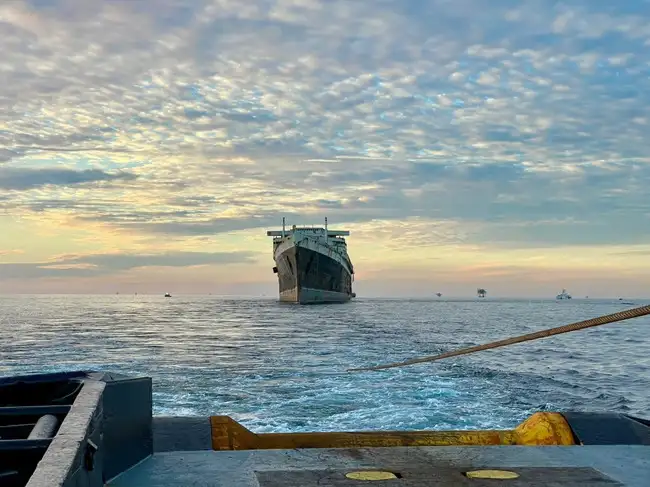
One of America’s most celebrated ocean liners is preparing for its final journey above water. The historic SS United States, which once held the record for the fastest transatlantic crossing by a passenger liner, is scheduled to be deliberately sunk off Florida’s Gulf Coast on Wednesday, November 11, 2026. The 990-foot vessel will begin a new chapter underwater as what organisers describe as the world’s largest artificial reef.
The sinking marks the end of an extraordinary maritime story that began in the early 1950s. Launched in 1952, the ship became a symbol of American engineering and speed, carrying thousands of passengers across the Atlantic before being retired in 1969. After spending decades docked in Philadelphia and undergoing extensive preparations in Alabama, it is now being converted into an underwater habitat and diving destination near Destin-Fort Walton Beach, Florida.
The operation was originally scheduled for November 12 but was moved forward by a day because of forecasts of heavy winds and unsafe weather. The revised date coincides with Veterans Day in the United States, giving the vessel’s final deployment additional historical significance. People unable to attend in Florida can follow the operation through online livestream coverage.
SS United States Sinking: Date, Time and Location
The SS United States is scheduled to be sunk on Wednesday, November 11, 2026, off the coast of Okaloosa County in Florida. The deployment site is in the Gulf of Mexico, approximately 22 nautical miles southwest of Destin-Fort Walton Beach.
According to the revised schedule, deployment operations are expected to begin at 1 p.m. Central Time, equivalent to 2 p.m. Eastern Time. The livestream is expected to be available before the operation begins, with coverage announcements indicating a start around noon Eastern Time.
The key details of the planned sinking are:
- Vessel: SS United States, a historic American ocean liner.
- Scheduled date: Wednesday, November 11, 2026.
- Deployment time: 1 p.m. Central Time or 2 p.m. Eastern Time.
- Livestream: Expected to begin around noon Eastern Time.
- Location: Approximately 22 nautical miles southwest of Destin-Fort Walton Beach, Florida.
- Purpose: To create what organisers describe as the world’s largest artificial reef.
- Expected depth: Approximately 180 feet (55 metres) to the seabed.
For viewers in India, the expected livestream start around noon Eastern Time corresponds to approximately 10:30 p.m. IST on November 11. Deployment operations scheduled for 2 p.m. Eastern Time would begin at approximately 12:30 a.m. IST on November 12.
How to Watch the SS United States Sinking Livestream
People around the world can follow the historic operation online without travelling to Florida. Organisers and media outlets are providing livestream coverage so viewers can watch the vessel’s final deployment from shore.
The official website, TheSSUS.com, is expected to provide the livestream information ahead of the operation. Coverage is also being made available through news broadcasters and their digital platforms.
- Official project website: Visit TheSSUS.com for deployment updates and the livestream link.
- ABC and local affiliate coverage: ABC News and its local television affiliates are providing updates and livestream information.
- CBS Philadelphia: CBS Philadelphia is offering live coverage of the ship’s final journey.
- FOX coverage: FOX local news platforms are also providing livestream options and updates.
Livestream availability and start times may differ between broadcasters. Viewers should check the official project website or the relevant broadcaster’s live coverage page before the scheduled operation.
The actual moment when the ship reaches the seabed may not coincide exactly with the beginning of deployment operations. The sinking is a controlled process, and the time required for the vessel to flood and descend will depend on how the operation proceeds.
Why Is the SS United States Being Sunk?
The decision to sink the SS United States is part of a long-planned project to transform the retired ocean liner into a large artificial reef. Instead of allowing the vessel to be dismantled entirely for scrap, Okaloosa County in Florida acquired it to give the ship a new purpose beneath the water.
The project has two major objectives: creating a habitat for marine organisms and developing a major attraction for divers and fishing enthusiasts. The vessel’s enormous structure will provide a substantial underwater surface where marine life can gradually establish itself.
Artificial reefs are structures deliberately placed underwater to provide habitat for marine organisms. They can offer surfaces for algae, corals, sponges and other organisms to attach to, while creating shelter and feeding opportunities for fish and other marine species.
The SS United States is particularly significant because of its size. At approximately 990 feet long, it will create an extensive underwater structure in the Gulf of Mexico. Organisers expect the reef to attract marine life, including larger fish species such as tuna, marlin and swordfish.
The project is also intended to strengthen tourism around Destin-Fort Walton Beach. The area already has an established artificial reef programme, and the addition of a historic ocean liner could create a distinctive diving destination. Visitors may eventually travel to the site to explore the vessel and experience its transformation from a passenger ship into an underwater attraction.
What Makes the SS United States Historically Important?
The SS United States was not an ordinary passenger ship. When it entered service in 1952, it represented a major achievement in American shipbuilding, engineering and maritime design. Built in Virginia by Newport News Shipbuilding, the vessel was designed to combine exceptional speed with safety and the ability to serve a national purpose if required.
Measuring approximately 990 feet in length, it was the largest passenger ship ever built in the United States. More than 3,000 workers contributed to its construction between 1950 and 1951.
One of its most distinctive features was its innovative construction. Large quantities of aluminium were used to reduce the ship’s weight, helping it achieve extraordinary speeds. Its design also incorporated fire-safety considerations, reflecting the priorities of its designer, William Francis Gibbs.
The ship was built primarily as a luxury passenger liner, but its design also allowed it to be converted into a troop transport in an emergency. This dual-purpose capability reflected the strategic thinking behind major American passenger ships during the early Cold War period.
Its maiden voyage in July 1952 established its place in maritime history. The SS United States crossed the Atlantic from New York to Europe in approximately three days, 10 hours and 40 minutes, averaging about 35.59 knots. It broke the existing transatlantic speed record and captured the prestigious Blue Riband for the fastest passenger-liner crossing.
More than seven decades later, the vessel continues to hold the record for the fastest transatlantic crossing by an ocean liner in regular passenger service.
SS United States History: From Record-Breaking Ocean Liner to Artificial Reef
The story of the SS United States reflects the rise and decline of the great transatlantic passenger liners. It began as a symbol of American technological ambition before changing travel patterns and financial pressures brought its commercial career to an end.
1952: The Ship Makes Its Historic Maiden Voyage
The SS United States entered service in 1952 after years of planning and construction. Its maiden voyage began on July 3, 1952, from New York. During the crossing to Europe, the ship achieved an average speed of approximately 35.59 knots and established a new transatlantic passenger-liner record.
The achievement made the vessel an international symbol of American maritime engineering. Its speed, size and distinctive design attracted attention from the public and the shipping industry.
1950s and 1960s: Carrying Celebrities and Prominent Passengers
During its years of service, the ship transported passengers across the Atlantic more than 800 times. Its passenger lists included prominent figures from politics, entertainment and international society.
Among those associated with its voyages were Hollywood stars Grace Kelly and Elizabeth Taylor, as well as political figures such as John F. Kennedy. Former US President Bill Clinton also travelled aboard the vessel in 1968 while heading to Oxford University as a Rhodes Scholar.
The ship became known not only for its speed but also for its role as a prestigious transatlantic passenger liner during an era when ocean travel remained an important part of international journeys.
1969: Commercial Service Comes to an End
By the late 1960s, the passenger shipping industry was facing major changes. Commercial aviation had become faster and increasingly accessible, reducing demand for long-distance ocean voyages.
Rising operating costs and the growing popularity of air travel made it difficult to maintain the economics of large passenger liners. The SS United States was withdrawn from active service in 1969, ending its 17-year career as a transatlantic liner.
1996–2025: Decades Along the Philadelphia Waterfront
After its retirement, the ship passed through different ownership arrangements as various proposals emerged to preserve or repurpose it. Ideas included returning it to passenger service and transforming it into a different type of commercial or public attraction.
From 1996, the SS United States remained docked along Philadelphia’s Delaware River waterfront. Its presence near the Walt Whitman Bridge made it a familiar landmark, but maintaining such a large and ageing vessel became increasingly difficult.
The SS United States Conservancy acquired the ship in 2011 and worked to protect its historical legacy. However, the costs associated with its upkeep and the difficulty of securing a viable restoration plan remained major obstacles.
2024–2026: Florida Acquires the Ship and Prepares It for Reefing
Okaloosa County acquired the SS United States in 2024 for its artificial reef project. The vessel left Philadelphia in February 2025 and was towed to Mobile, Alabama, where it underwent extensive remediation and preparation work.
Crews removed materials and equipment that could create environmental or safety concerns underwater. The ship’s iconic smokestacks were also removed and preserved for a planned land-based museum dedicated to its history.
After the preparation work, the vessel was moved towards its final deployment location off Florida’s Gulf Coast in November 2026. The planned sinking marks the completion of the transition from historic ocean liner to artificial reef.
How Will the SS United States Be Sunk Without Explosives?
The sinking is being carried out through a controlled flooding process rather than by using explosives. This approach is intended to allow the ship to descend in a managed manner and settle on the seabed as an artificial reef.
Preparations have involved modifying the vessel so seawater can enter its interior. Workers have opened sections of the hull and decks, removed more than 400 portholes and prepared the ship’s seawater systems for the operation.
The vessel originally had piping that brought seawater into tanks as part of its machinery and boiler-cooling systems. After the necessary modifications, opening the relevant valves will allow water to enter the hull and gradually increase the ship’s weight.
As the flooding progresses, the ship is expected to lose buoyancy and sink. The operation is designed to bring it down in an upright position rather than allowing it to descend uncontrollably.
Federal environmental and explosives regulations prevent the use of explosives for the scuttling operation. The controlled-flooding method is therefore central to the project’s deployment plan.
Where Will the Ship Rest Underwater?
The SS United States is expected to settle on the Gulf of Mexico seabed approximately 25 miles southwest of Destin, Florida. The planned site is in water around 180 feet deep, or approximately 55 metres.
Although the seabed is relatively deep, the vessel’s upper deck is expected to remain around 60 feet below the surface. This positioning is intended to make parts of the structure accessible to recreational divers, subject to appropriate training, certification, weather and diving conditions.
Not every section of the ship will be open to exploration. Contractors have prepared the vessel for its new underwater role, including sealing off compartments and lower-deck areas considered unsafe for divers.
The site will also be subject to safety arrangements during deployment. Authorities are expected to maintain a security perimeter around the operation, meaning spectator boats will not be permitted to approach the vessel closely.
How Could the Artificial Reef Support Marine Life?
The transformation of the SS United States into an artificial reef is intended to create a new underwater habitat. Once the ship rests on the seabed, its surfaces and structural features can provide places for marine organisms to attach, grow and establish communities.
Over time, organisms such as algae, sponges and other marine life may colonise the structure. Smaller organisms can attract fish, while larger species may use the surrounding area for feeding or shelter.
The vessel’s size could make it an important addition to the region’s artificial reef network. Its decks, openings and remaining structural components will create a complex underwater Environment, although the speed and exact nature of ecological development will depend on local conditions.
The project is also attracting scientific interest. Researchers from the Woods Hole Oceanographic Institution are studying how marine organisms colonise the structure and how an ecosystem develops around a large artificial reef. The site could provide an opportunity to observe ecological changes from the beginning of the process.
However, an artificial reef does not automatically become a healthy natural ecosystem simply because a ship is placed underwater. Its long-term environmental value will depend on the condition of the vessel, water quality, marine conditions and the development of biological communities over time.
Why Is the Project Important for Florida’s Tourism Industry?
Okaloosa County expects the SS United States reef to become a major attraction for divers and fishing enthusiasts. Its size and historical background could make it different from conventional artificial reef sites, offering visitors the opportunity to explore a vessel that once represented the height of American ocean-liner engineering.
Destin-Fort Walton Beach already attracts visitors for its beaches, fishing and water-based activities. A large underwater attraction could expand the region’s tourism offering by drawing ship enthusiasts, experienced divers and visitors interested in maritime history.
The project is part of a wider investment in the area’s artificial reef programme. Organisers have described it as a combination of environmental, recreational and economic development goals, with the potential to support tourism-related businesses.
Its eventual success will depend on visitor interest, safe access and the ability to maintain the reef as a sustainable attraction. The ship’s historical identity could provide an additional reason for people to visit the region, even after its original function as a passenger liner has ended.
Why Was the SS United States Sinking Moved to November 11?
The sinking was initially scheduled for Thursday, November 12, 2026. However, organisers moved the deployment forward to Wednesday, November 11, after forecasts indicated heavy winds and unsafe weather conditions for the original date.
Okaloosa County officials said safety was the priority behind the schedule change. Moving the operation forward was considered a safer option than proceeding under potentially dangerous weather conditions on Thursday.
The revised date also coincides with Veterans Day, a federal holiday in the United States that honours military veterans. County officials noted the significance of the ship’s name and its history as a vessel designed with the potential to serve as a troop transport during a national emergency.
The date change affected the public programme surrounding the deployment. A previously planned send-off ceremony was cancelled, while a public viewing party in Destin was expected to continue with a live feed from the deployment site.
Preservation Debate: Why Some Groups Opposed Sinking the Historic Ship
The plan to turn the SS United States into an artificial reef has not been without controversy. The vessel is widely regarded as an important example of American maritime engineering, and preservation supporters have argued that its historical value deserves protection above water.
The SS United States Preservation Foundation and its supporters challenged the plan in court, seeking to prevent the ship from being sunk. Their objections included concerns about historic preservation and the environmental review process. The group supported the broader artificial reef programme but argued that another suitable vessel could be used instead.
A federal judge denied the group’s request for a temporary restraining order on November 6, 2026, allowing the deployment plan to proceed. The legal challenge highlighted the difficult choice between preserving a historic vessel in its original form and finding a financially and practically viable way to give it a new purpose.
The SS United States Conservancy has also worked to preserve important components of the ship. Its iconic funnels, radar mast, anchor and other materials have been secured for a planned land-based museum. The museum is intended to tell the story of the vessel’s engineering, design and place in American maritime history.
What Happens to the SS United States After It Sinks?
Once the vessel reaches the seabed, its role will change from passenger transport to underwater habitat and diving attraction. It will no longer carry passengers across the Atlantic, but its structure will remain a physical reminder of its historic maritime career.
The development of the reef will take time. Marine organisms will gradually interact with the structure, and researchers will be able to observe how the underwater community changes. Divers may eventually explore accessible sections of the vessel under established safety rules.
Meanwhile, the planned land-based museum will preserve parts of the ship that have been removed before deployment. This approach means the vessel’s history will continue to be presented through physical artefacts and exhibitions even as the main structure becomes part of the marine environment.
SS United States Sinking: The End of an Era and the Beginning of a New One
The sinking of the SS United States represents a major turning point in the story of one of America’s most famous ocean liners. From breaking the transatlantic speed record in 1952 to spending decades docked in Philadelphia, the vessel has remained an important part of the country’s maritime heritage.
Its transformation into an artificial reef reflects the challenges of preserving large historic ships when restoration is financially and practically difficult. Rather than being completely lost through scrapping, the vessel is being given a new role intended to benefit marine life, scientific research, diving and regional tourism.
The decision remains controversial among preservation supporters, but the deployment marks the beginning of a different future for the historic liner. As the SS United States descends beneath the Gulf of Mexico, its record-breaking days at sea will give way to a new chapter on the ocean floor.
For viewers following the livestream on Veterans Day, the operation is more than the sinking of a retired ship. It is the final voyage of a vessel that once represented American engineering ambition and a reminder of how the role of historic maritime landmarks can change over time.
For breaking news and live news updates, like us on Facebook or follow us on Twitter and Instagram. Read more on Latest World on thefoxdaily.com.






COMMENTS 0