Jharkhand‘s recruitment system is facing one of its biggest tests in years after the state government cancelled 44 examinations conducted by the Jharkhand Public Service Commission (JPSC) and Jharkhand Staff Selection Commission (JSSC), along with the JSSC Combined Graduate Level examination.
The decision followed weeks of student protests over alleged examination irregularities and came after a cabinet meeting on Monday. Eight notifications issued late Tuesday night formally listed the examinations affected by the government’s decision.
The cancellations cover a wide range of recruitment exercises held since 2014, including examinations for administrative, technical, scientific, judicial, medical and forest-related positions.
But the government’s attempt to restore confidence in the recruitment system has created a new dispute. Around 2,000 candidates WHO had already been appointed after clearing the JSSC-CGL examination protested in Ranchi, arguing that cancelling the examination punishes successful candidates instead of those allegedly responsible for malpractice.
That conflict now places the Jharkhand government between two groups with competing demands: students who want recruitment exams to be demonstrably clean and appointed candidates who want their jobs protected while the alleged wrongdoing is investigated.
Why did Jharkhand cancel 44 recruitment examinations?
The government has defended the cancellations as a step intended to restore confidence in the state’s recruitment system.
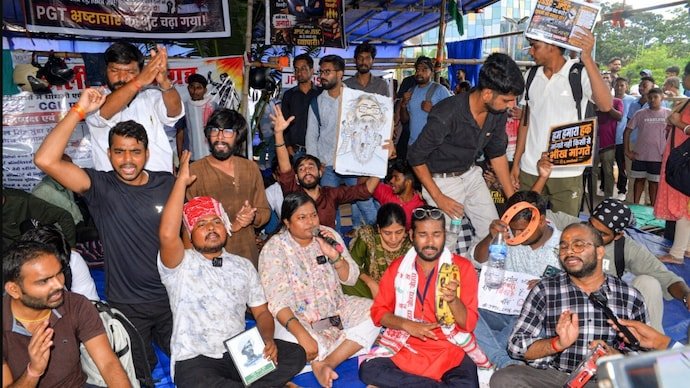
The decision came after a 25-day student agitation at Jaipal Singh Munda Stadium in Ranchi, led by the JPSC-JSSC Reforms Manch. Protesters had raised allegations of irregularities and demanded changes to the way government recruitment examinations are conducted.
The controversy has grown beyond a single examination. The list released by the government covers recruitment tests conducted by the state public service commission and an outsourced agency over a period stretching back to 2014.
The affected examinations include recruitment for posts such as drug inspectors, assistant professors, lecturers, senior scientific officers, assistant conservators of forests and forest range officers.
Several judicial and administrative examinations have also been included, meaning the decision could affect recruitment processes across multiple departments rather than a single government service.
Which major exams have been cancelled?
The list includes examinations for a broad range of state government positions.
- Jharkhand Combined Civil Services Examination at various stages
- JSSC Combined Graduate Level examination
- Civil Judge (Junior Division) recruitment
- Assistant Public Prosecutor recruitment
- Deputy Collector recruitment
- Assistant Engineer recruitment
- Dentist recruitment
- Drug Inspector recruitment
- Assistant Professor recruitment in government engineering and medical colleges
- Lecturer recruitment in government polytechnics
- Senior Scientific Officer recruitment
- Assistant Conservator of Forests and Forest Range Officer examinations
- Food Safety Officer and Food Analyst examinations
- Child Development Project Officer examinations
- Agriculture Officer, Geologist and Chemist examinations
- Various other administrative, technical and specialised recruitment tests
The breadth of the list explains why the announcement has generated concern among both aspiring candidates and people who have already entered government service.
For students preparing for competitive examinations, cancellation means potentially starting the recruitment process again. For candidates already appointed through the JSSC-CGL examination, the issue is more immediate because their employment and Career decisions are now directly affected.
JSSC-CGL candidates protest against cancellation
The strongest backlash has come from candidates who cleared the JSSC-CGL examination and subsequently received government appointments.
Around 2,000 appointed candidates marched from the state Secretariat towards Birsa Chowk in Ranchi on Tuesday, one day after Chief Minister Hemant Soren announced the cancellation.
The protesters said they were not opposed to investigating allegations of malpractice. Their objection is to cancelling the entire examination when many successful candidates believe they earned their positions legitimately.
Assistant Section Officer Kaushal Kumar summed up their grievance with the words, “Tell us our crime. Don’t throw us out.”
The candidates have called for an independent investigation, including a possible CBI probe, rather than a blanket cancellation of the examination.
Several protesters said they had already joined departments such as finance, home, road transport, labour and information and public relations. Some also claimed they had left other government or public-sector employment after being selected for Jharkhand government positions.
That creates a practical problem for the administration. Reversing appointments can have consequences well beyond the examination itself, affecting salaries, seniority, career progression and candidates who may have already changed their lives around their new jobs.
The central dispute: cancel the exam or punish the guilty?
The disagreement essentially comes down to two different approaches to dealing with alleged examination malpractice.
The protesting students argue that if an examination process has been compromised, the integrity of the recruitment system must take priority. From their perspective, allowing a potentially compromised process to stand could undermine confidence among thousands of candidates who prepare for competitive examinations on the assumption that selection is based on merit.
The appointed JSSC-CGL candidates take a different position. They argue that wrongdoing should be established through investigation and that individuals found responsible should face action rather than all successful candidates being treated as if they were involved.
Both concerns are significant.
A recruitment examination cannot command public confidence if credible evidence of paper leaks, manipulation or other malpractice is ignored. But cancelling an examination after appointments have been made can also create serious hardship for candidates who were not involved in any wrongdoing.
The eventual legal and administrative resolution will therefore need to distinguish between the integrity of the examination process and the conduct of individual candidates.
What is the government doing beyond cancellations?
The government has announced several measures intended to address the structural problems exposed by the controversy.
One proposal is to request that the High Court establish a fast-track court for cases involving alleged irregularities in JPSC and JSSC examinations.
The government has also proposed internal vigilance cells in both recruitment commissions.
In addition, a reform committee headed by senior IAS officer Amitabh Kaushal has been tasked with recommending changes to the examination system. The committee has been given two months to submit its report.
The panel is expected to examine the recruitment process and recommend measures designed to prevent paper leaks, manipulation and other forms of malpractice.
The reform exercise could prove more important in the long term than the cancellations themselves. Repeating examinations does not solve the underlying problem if the same vulnerabilities remain in the system.
Why an examination reform panel matters
Competitive recruitment depends on more than conducting a written test.
The process can involve applications, eligibility verification, question-paper preparation, printing, transportation, examination-centre security, candidate identification, evaluation, result preparation and document verification.
A weakness at any stage can undermine confidence in the final selection.
That is why a credible reform programme would need to look at the entire recruitment chain rather than focusing only on question-paper leaks.
For candidates, transparency is equally important. They need to know what happens when an irregularity is detected, how evidence is evaluated and what standard of proof is used before an examination is cancelled.
A predictable framework could reduce uncertainty in future cases. Candidates would know whether a suspected leak leads to cancellation, a re-test, investigation of specific centres or some other corrective measure.
CID investigation adds another layer to the controversy
The government’s decision comes as the Jharkhand CID investigates alleged recruitment irregularities.
The investigation has already resulted in multiple arrests. CID officials arrested Sushma Kumari, the wife of key accused Abhay Tiwari, and his brother Akshay Tiwari after questioning them.
Abhay Tiwari, a former TDPL employee who had been posted as a block supply officer in Poriyahat in Godda district, was arrested by the CID on July 22.
According to officials, investigators are examining his record after finding that he had qualified in around 12 competitive examinations over a period of 13 years.
Those examinations reportedly included tests conducted by organisations such as the police, Indian Navy, Bhabha Atomic Research Centre, Central Reserve Police Force and Northern Coalfields.
Investigators are examining application forms, supporting documents, evaluation records and selection details as they try to establish how the alleged irregularities may have operated.
Alleged “rate charts” are under investigation
CID officials have also alleged that Tiwari told investigators about different “rate charts” supposedly used for candidates seeking to qualify in competitive examinations.
Officials have claimed that alleged payments ranged from Rs 2 lakh to Rs 70 lakh.
These are allegations forming part of an ongoing investigation and have not been established in court. That distinction is important, particularly in a case involving a large number of candidates and examinations.
If investigators ultimately establish that organised malpractice affected recruitment, it could provide evidence for stronger action against individuals involved in manipulating examinations. But the existence of allegations alone does not establish that every candidate selected through a particular examination benefited from wrongdoing.
The CID has also questioned JSSC Secretary Sudhir Gupta after evidence was reportedly recovered during a raid at the commission’s office.
With the latest arrests, the number of people held in connection with the case has risen to 22, according to officials.
Students want stronger guarantees for future exams
The student movement has not treated the cancellation of the examinations as the end of the issue.
The JPSC-JSSC Reforms Manch said it would decide its next course of action after receiving greater clarity on the government’s decisions and how they would be implemented.
JLKM leader Devendra Mahto, who ended a 16-day hunger strike following the government’s announcement, has said a second phase of agitation would be launched.
His demands include guarantees that future JPSC and JSSC examinations will be free from paper leaks and other irregularities. He has also sought a monitoring committee and a comprehensive audit of the recruitment system.
Those demands indicate that protesters are seeking institutional changes rather than simply the cancellation of disputed examinations.
Political parties split over the government’s decision
The cancellation has also divided political opinion in Jharkhand.
A congress delegation comprising ministers and legislators met Hemant Soren and welcomed the government’s action. The party said the decision would protect students seeking a fair recruitment process.
Leader of Opposition Babulal Marandi took the opposite view, accusing the JMM-led government of “cheating” protesting students by cancelling examinations without accepting their demand for a CBI investigation.
The political disagreement reflects the complexity of the issue. The government can claim that cancelling disputed examinations demonstrates its commitment to clean recruitment, while the opposition can question whether cancellation alone addresses the alleged wrongdoing.
For candidates, however, the political debate is secondary to the practical question of what happens to their careers and future examinations.
Why the JSSC-CGL cancellation is especially sensitive
The JSSC-CGL examination is different from many of the older examinations on the cancellation list because successful candidates have already entered government service.
That changes the consequences dramatically.
A candidate waiting for an examination to be conducted again loses time and preparation. An appointed employee facing cancellation potentially risks a job, salary and professional stability.
The appointed candidates’ demand for an independent investigation is therefore not simply an attempt to preserve the result. It is also an argument about individual responsibility.
If investigators identify specific candidates who benefited from malpractice, the administration could take action against them based on evidence. The more difficult question is what should happen to candidates against whom there is no allegation of wrongdoing if the overall examination is found to have been compromised.
That question may ultimately require judicial scrutiny.
What happens to the cancelled examinations now?
The immediate challenge for the government will be to provide a clear roadmap for candidates affected by the cancellations.
Repeating dozens of examinations is a major administrative undertaking. New schedules, question papers, examination centres, security arrangements, evaluation systems and verification procedures will have to be organised.
The government will also need to communicate clearly about eligibility and whether candidates who previously appeared will have to complete the entire process again.
For young people who have spent years preparing for government employment, uncertainty itself can become a serious burden.
A transparent timetable would therefore be important if the state wants the cancellations to restore confidence rather than create another wave of frustration.
The bigger lesson for Jharkhand’s recruitment system
The controversy goes beyond the fate of 44 examinations.
Government recruitment is one of the most consequential functions of a state administration. A large number of candidates invest years in preparation, often while limiting other career options, because a government position offers the prospect of stable employment.
That makes confidence in the selection process particularly important.
If candidates believe examinations can be manipulated, the damage is not limited to one recruitment cycle. It can discourage legitimate applicants, encourage speculation about corruption and reduce trust in public institutions.
Conversely, if examinations are cancelled without a transparent explanation or without protecting candidates who were not involved in wrongdoing, confidence can also suffer.
Jharkhand’s challenge is therefore to achieve both objectives: establish accountability for alleged malpractice and protect the principles of fairness for candidates who entered the recruitment process in good faith.
What should candidates watch next?
The next important developments are likely to come from three areas: the reform committee, the CID investigation and the legal process surrounding the cancelled examinations.
The reform committee’s recommendations could determine whether JPSC and JSSC introduce stronger safeguards across question-paper preparation, examination security, evaluation and monitoring.
The CID investigation may provide greater clarity on the alleged network behind the irregularities and whether specific candidates or officials benefited from it.
Meanwhile, legal challenges from appointed JSSC-CGL candidates could determine how the government is required to handle existing appointments.
Until those processes develop, it would be premature to assume that every cancelled examination was affected in the same way or that every candidate selected through them was involved in wrongdoing.
Jharkhand now faces a difficult test of recruitment reform
The cancellation of 44 recruitment examinations is an unusually broad response to allegations that have shaken confidence in Jharkhand’s public recruitment system.
For protesting students, the decision represents recognition that the integrity of competitive examinations cannot be compromised. For candidates who have already been appointed, however, the same decision feels like collective punishment for wrongdoing they say they did not commit.
The government’s reform measures, including the proposed vigilance cells, High Court fast-track mechanism and the Amitabh Kaushal-led committee, will determine whether the episode produces lasting institutional change.
The CID investigation will be equally important because a credible recruitment system requires more than re-examinations. It requires accountability when evidence of malpractice is established.
Ultimately, Jharkhand’s task is to rebuild trust without sacrificing fairness. The students demanding clean examinations and the appointed candidates demanding protection from unjust cancellation are asking different questions, but both are fundamentally concerned with the same thing: whether merit can still be trusted in the state’s recruitment system.
For breaking news and live news updates, like us on Facebook or follow us on Twitter and Instagram. Read more on Latest India on thefoxdaily.com.





COMMENTS 0