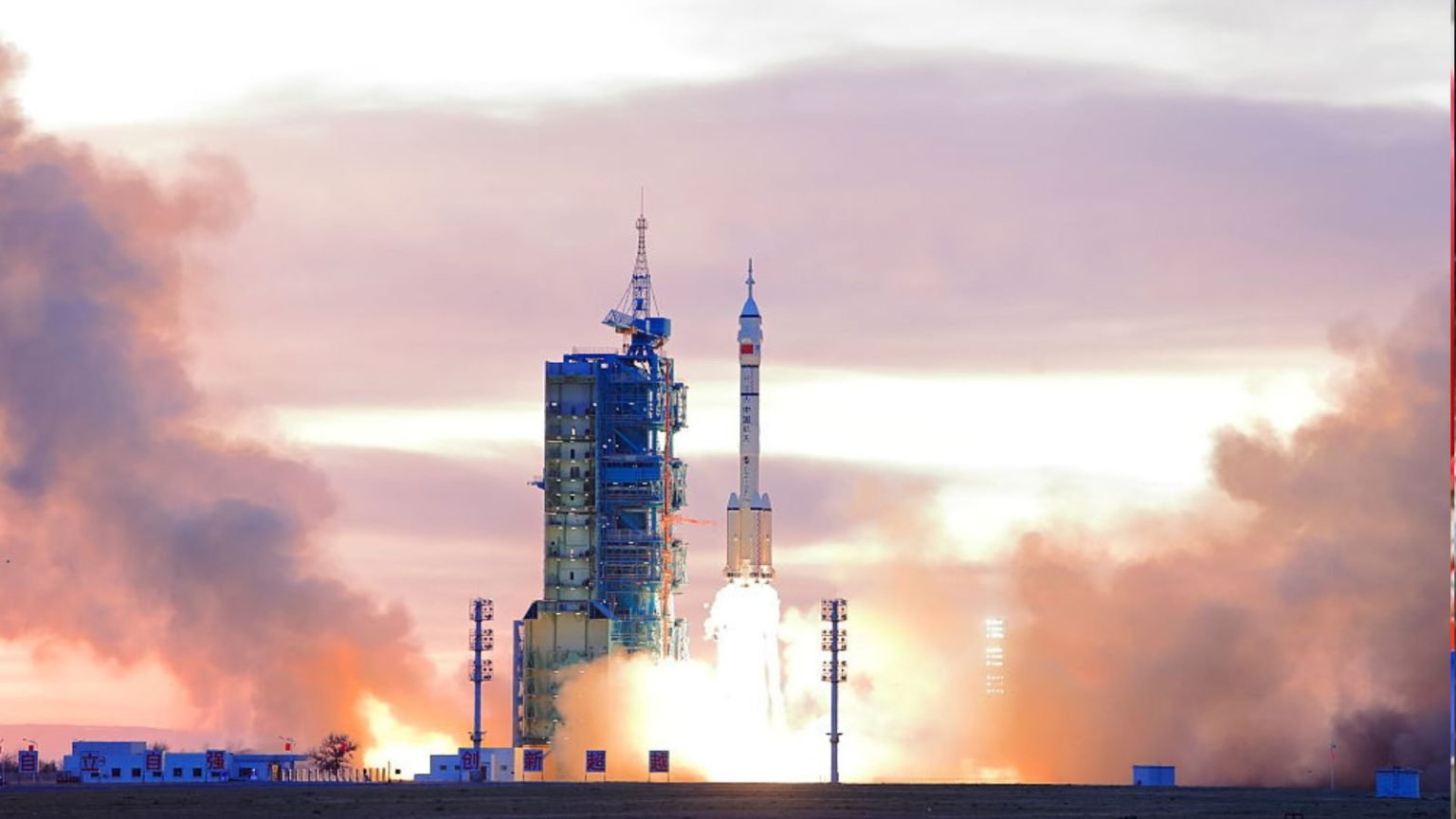
China has welcomed its first foreign crew member aboard the Tiangong space station after the Shenzhou-24 spacecraft successfully completed its journey from Earth on Wednesday, November 25, 2026. Pakistani astronaut Muhammad Zeeshan Ali, 40, entered the orbital facility alongside Chinese astronauts Tang Hongbo and Wu Yi, becoming the first non-Chinese national to visit China’s space station.
The mission represents a significant development in China’s efforts to position Tiangong as a platform for international scientific cooperation. It is also a major milestone for Pakistan, which has sent its first astronaut into orbit through a partnership with the Chinese space programme.
The spacecraft lifted off from the Jiuquan Satellite Launch Centre in northwestern China at 8:18 a.m. Beijing time aboard a Long March-2F rocket. After separating from the rocket and entering its planned orbit, the Shenzhou-24 crew completed the journey to Tiangong and joined three astronauts already living aboard the station.
The arriving astronauts were welcomed by the existing crew with hugs and a celebratory cake. The six astronauts also gathered for photographs, marking the beginning of a historic period of joint operations aboard China’s independently developed space station.
Shenzhou-24 Crew Successfully Reaches Tiangong Space Station
The Shenzhou-24 mission carried three astronauts with different responsibilities. Tang Hongbo served as the mission commander, Wu Yi joined as a flight engineer, and Pakistan’s Muhammad Zeeshan Ali travelled as a payload specialist.
For Ali and Wu, the mission marked their first journey into space. Tang, however, was an experienced astronaut returning to orbit for the third time. His latest flight also made him the first astronaut to board China’s Tiangong space station on three separate occasions.
After reaching the station, the new crew met the three Shenzhou-23 astronauts who were already aboard the orbital complex. The meeting was an important moment for the mission because it brought together Chinese and Pakistani personnel for the first foreign crewed visit in the history of China’s space programme.
Ali expressed his excitement in Chinese after entering the station, describing the moment as a historic experience. His ability to communicate in Mandarin reflected the language training he had completed during preparations for the mission.
Unlike the standard long-duration rotation of Chinese astronauts, Ali’s visit is planned as a short-term mission. He is expected to remain aboard Tiangong for approximately five to ten days before returning to Earth with two astronauts from the Shenzhou-23 mission aboard the Shenzhou-23 spacecraft.
Who Is Muhammad Zeeshan Ali, Pakistan’s First Astronaut?
Muhammad Zeeshan Ali is a 40-year-old former Pakistan Air Force pilot selected to participate in China’s crewed space programme as a payload specialist. His journey represents Pakistan’s first step in sending one of its own citizens into orbit.
Ali was selected in April 2026 as one of the first Pakistani candidates for China’s astronaut training programme. He was chosen alongside Khurram Daud, with both candidates beginning preparations for the opportunity to participate in a Chinese space mission.
His training involved learning spacecraft operations, space station systems, emergency procedures and the scientific tasks required during the mission. He also underwent intensive Mandarin-language instruction so that he could communicate effectively with Chinese astronauts and understand technical commands.
According to reports, Ali spent seven months training in Beijing. His preparation included learning Chinese songs, reading poetry, practising calligraphy and playing table tennis alongside his technical and operational training.
At a press conference before the launch, Ali demonstrated his Mandarin skills by quoting a line from a Chinese poem about climbing higher to gain a wider view. He compared the message to his daily training, describing it as a process of reaching new heights through consistent effort.
His participation is significant not only because he is Pakistan’s first astronaut in orbit but also because he is the first foreign astronaut to join a crewed Chinese space mission and visit Tiangong.
More Than 90 Scientific Experiments Planned During the Mission
The Shenzhou-24 mission is not limited to transporting astronauts to the space station. The crew is expected to conduct more than 90 scientific experiments and technology tests, covering research areas that could contribute to future Space Exploration and the development of advanced technologies.
These activities will include experiments related to biotechnology, materials science and the effects of the space environment on biological systems. The research is designed to use the unique conditions of an orbital laboratory, where microgravity and other factors allow scientists to examine processes that behave differently on Earth.
Ali to Conduct a Cyanobacteria Experiment
One of Ali’s assigned activities involves an experiment using photosynthetic cyanobacteria. These microorganisms can use light to produce energy through photosynthesis and are being studied for their potential applications in future space missions.
Research involving photosynthetic organisms is relevant to the development of biological life-support systems. In long-duration missions, astronauts may need technologies that help recycle resources, support food production and contribute to oxygen generation.
Although the experiment is not expected to create a complete life-support system during this short mission, it forms part of broader scientific efforts to understand how biological processes can be used in space environments.
Research Into Self-Healing Spacecraft Materials
Ali will also participate in research involving self-healing carbon-fibre composites. The experiment is intended to examine whether advanced materials can automatically repair small cracks or damage under space conditions.
Materials used in spacecraft and other space infrastructure must withstand demanding operating environments. Even small structural defects can become important when equipment is exposed to repeated temperature changes, mechanical stress and long periods of operation.
Self-healing materials could eventually help improve the durability of spacecraft components and reduce the need for certain repairs during missions. Such technology may become particularly valuable for future lunar and deep-space exploration, where sending replacement parts or repair equipment can be difficult and expensive.
The wider Shenzhou-24 research programme is expected to contribute to China’s continuing work on space science, station operations and technologies that may support longer human missions beyond Earth’s orbit.
China-Pakistan Space Agreement Behind the Historic Mission
Ali’s journey is part of a broader agreement signed by China and Pakistan in February 2025 to expand cooperation in human spaceflight. The arrangement created a pathway for Pakistani candidates to receive training in China and potentially participate in its crewed missions.
The selection and preparation of Pakistani astronauts marked a new phase in a space relationship that has developed over several decades. China has previously supported Pakistan through satellite launches and other space-related cooperation.
The two countries have also discussed further joint projects. A Pakistani-built rover is expected to be part of a Chinese lunar mission around 2028, extending cooperation beyond Earth orbit and into lunar exploration.
For Pakistan, the Shenzhou-24 mission offers an opportunity to gain experience in astronaut training, scientific experimentation and the operational requirements of human spaceflight. Participation in an established programme can provide access to technical expertise and infrastructure that would be difficult to develop independently in a short period.
For China, bringing a Pakistani astronaut aboard Tiangong demonstrates how its space station can accommodate international partners and conduct joint scientific activities. The mission also gives Beijing an opportunity to strengthen its position in international space cooperation.
Pakistan Celebrates Its First Astronaut in Space
The launch triggered celebrations across Pakistan, where families, government officials and scientists followed the mission through television broadcasts and online updates.
People gathered in restaurants and public places to watch the spacecraft lift off from the Jiuquan launch centre. Cheers celebrating Pakistan-China friendship were heard as Ali began his journey towards orbit.
Scientists at the headquarters of Pakistan’s space agency also watched the launch, treating it as an important achievement for the country’s developing space ambitions.
Pakistani President Asif Ali Zardari and Chinese President Xi Jinping exchanged congratulatory messages following the mission. According to a statement from Zardari’s office, both leaders described the astronaut’s participation as a milestone in the relationship between the two countries.
Chinese state broadcaster CCTV reported that Xi described China’s space station as a platform for peace, friendship and cooperation. He also said China was willing to work with other countries to promote the peaceful use of outer space.
Pakistan’s Prime Minister Shehbaz Sharif congratulated the country and described Ali’s mission as a source of national pride and inspiration for young people interested in Science and Technology.
“This is not just one astronaut’s journey, but the journey of 240 million Pakistanis,” Sharif wrote on X, thanking China for including a Pakistani astronaut in the mission.
Pakistan’s Planning Minister Ahsan Iqbal, who attended the launch-related events in China, also welcomed the achievement. He said he hoped the mission would mark the beginning of deeper cooperation between the two countries.
When asked whether Pakistan would eventually be able to send astronauts into space independently, Iqbal expressed confidence that the country could reach that stage in the future.
“The sky is no longer our limit, it is our launching pad,” he said, describing the mission as a source of motivation for young Pakistanis pursuing careers in science, engineering and technology.
How Ali’s Mission Strengthens China-Pakistan Relations
The Shenzhou-24 flight extends the China-Pakistan partnership into one of the most technologically demanding areas of international cooperation: human spaceflight.
Although the two countries have worked together on satellites and other space-related projects for years, sending a Pakistani astronaut aboard a Chinese spacecraft represents a different level of collaboration. Human missions require extensive coordination involving astronaut selection, training, spacecraft operations, medical preparation, scientific planning and emergency procedures.
Ali’s participation also required cooperation beyond the launch itself. He had to learn the technical language used by Chinese astronauts, understand the station’s operating procedures and develop the ability to work as part of a multinational crew.
Chinese astronaut Tang Hongbo acknowledged before the launch that differences in language, culture and psychology had made joint training more challenging. However, he said the efforts made by both sides were producing positive results.
The mission therefore demonstrates how international cooperation in space depends on more than agreements between governments. It also requires individual astronauts and technical teams to develop trust, communication skills and the ability to operate together in a demanding environment.
For Pakistan, the experience could help build a foundation for future participation in scientific missions. For China, it provides a practical demonstration of its willingness to include foreign astronauts in its space programme.
Why China’s Tiangong Space Station Matters
China’s Tiangong space station, whose name translates to “Heavenly Palace”, is a permanently crewed orbital facility developed independently by the country. The station became fully operational in late 2022 and serves as a platform for scientific research, technology testing and long-duration human spaceflight.
Unlike the International Space Station, which was developed through cooperation among several countries and space agencies, Tiangong is operated by China. Its development reflects Beijing’s ambition to maintain an independent presence in human space exploration.
The station can accommodate up to six astronauts during crew handovers, when an incoming three-person team arrives before the outgoing crew departs. This capacity makes it possible to conduct temporary overlaps between missions and coordinate transfers of responsibility.
The Shenzhou-24 mission represents an important test of Tiangong’s role as an international platform. The presence of a Pakistani astronaut shows that the station can host foreign crew members under China’s partnership arrangements.
China is promoting Tiangong as a facility for international scientific cooperation at a time when the future of the International Space Station is also under discussion. The ISS faces possible retirement around 2030, although its future will depend on decisions by the participating space agencies.
If Tiangong continues to expand its international partnerships, it could become an important destination for countries seeking access to human spaceflight and orbital research facilities.
Shenzhou-23 Crew Handover and a Record-Breaking Stay
The arrival of Shenzhou-24 also coincides with an unusual crew arrangement aboard Tiangong.
Three astronauts from the Shenzhou-23 mission were already living on the station when Ali and his Chinese crewmates arrived. The two groups met following the successful arrival of the new spacecraft, allowing the station to temporarily host six astronauts.
However, the handover will not follow the usual pattern in which an entire incoming or outgoing crew remains together for a standard rotation. Shenzhou-23 commander Zhu Yangzhu is scheduled to remain aboard Tiangong for an extended period of approximately one year.
His extended stay will support Chinese research into how the human body responds to long-duration exposure to the space environment. Scientists study changes in areas such as physical health, muscle strength and other biological functions to prepare for missions that may last much longer than a conventional space station rotation.
By the time he completes the planned stay, Zhu is expected to set a record for the longest single period spent in orbit by a Chinese astronaut.
Ali’s short visit, meanwhile, will allow him to participate in joint experiments before returning to Earth aboard the Shenzhou-23 spacecraft with two members of its crew.
China’s Moon Landing Ambition and the US Space Race
The Shenzhou-24 mission is taking place as China accelerates preparations for human exploration beyond Earth’s orbit. Beijing is targeting its first crewed lunar landing by 2030, an ambition that places it in direct competition with the United States in the next phase of Moon exploration.
NASA is targeting 2028 for its planned return of astronauts to the lunar surface through the Artemis programme. Both countries see lunar exploration as an important step towards establishing a sustained human presence beyond Earth.
China’s plans extend beyond a single landing. The country is also working towards a lunar research base, with cooperation involving Russia expected to play a role in its longer-term plans.
These ambitions require progress in several areas, including advanced spacecraft, launch systems, life-support technologies, astronaut training and the ability to operate in environments far more demanding than low Earth orbit.
Research aboard Tiangong can contribute to this preparation. Experiments involving biological systems, advanced materials and the effects of long-duration spaceflight can provide knowledge relevant to future missions.
Ali’s participation does not mean Pakistan has joined China’s lunar programme as a crewed mission partner. His remarks about future cooperation extending to the Moon and Mars reflect his hopes for the relationship rather than confirmed plans for joint human missions.
What Happens Next for Muhammad Zeeshan Ali?
Ali’s immediate task is to complete the planned experiments and operational activities during his short stay aboard Tiangong. He is expected to return to Earth within approximately five to ten days of arriving at the station.
His return is planned aboard the Shenzhou-23 spacecraft alongside two astronauts from that mission. The arrangement will allow China to complete the crew transition while Zhu Yangzhu continues his extended stay in orbit.
After returning, Ali’s experience could become an important reference point for future Pakistani astronaut candidates. His mission has demonstrated the training and coordination required for a foreign national to participate in China’s human spaceflight programme.
Whether Pakistan eventually develops the ability to conduct independent crewed missions will depend on long-term investment, technical capabilities, infrastructure and sustained training programmes. The Shenzhou-24 flight is an important first step, but it does not by itself establish an independent Pakistani human spaceflight capability.
A Historic Step for Pakistan and China’s Space Diplomacy
The successful arrival of Shenzhou-24 at Tiangong marks a new chapter in China’s crewed space programme and Pakistan’s space ambitions. Muhammad Zeeshan Ali has become the first Pakistani astronaut in orbit and the first foreign national to board China’s space station.
Beyond the symbolic importance, the mission provides a practical opportunity for scientific cooperation through experiments involving biotechnology, advanced materials and the challenges of working in space.
For China, the flight supports its ambition to make Tiangong a platform for international partnerships while continuing preparations for a crewed lunar landing. For Pakistan, it offers valuable experience and a milestone that could encourage a new generation to pursue careers in science, engineering and space technology.
The mission’s longer-term significance will depend on what follows this first joint flight. If the two countries expand their cooperation into additional astronaut missions, satellite projects and scientific research, Shenzhou-24 could be remembered not only as a historic journey but also as the beginning of a broader partnership in space exploration.
For breaking news and live news updates, like us on Facebook or follow us on Twitter and Instagram. Read more on Latest World on thefoxdaily.com.





COMMENTS 0