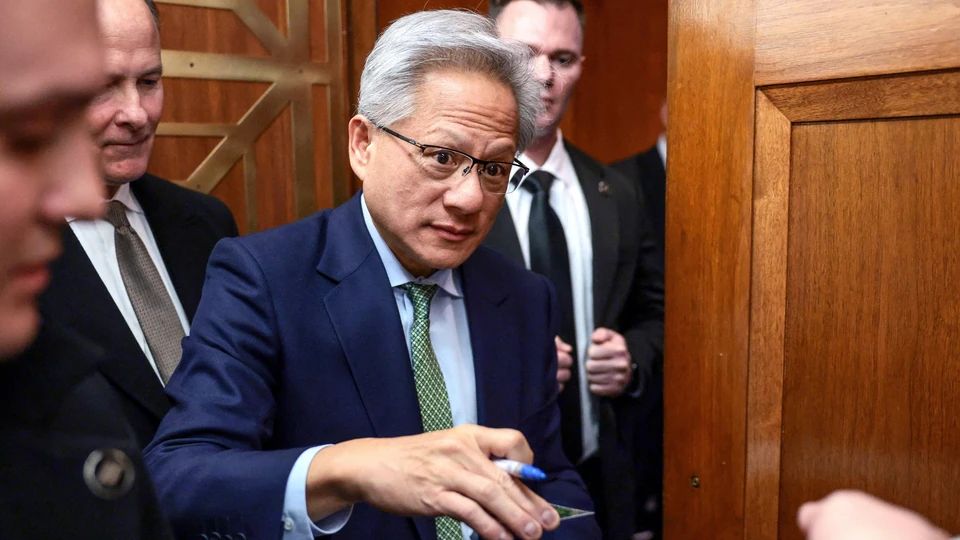
Nvidia chief executive Jensen Huang has reportedly defended the company’s decision not to maintain a conventional CEO succession plan, telling board members that the organisation does not need the kind of leadership structure typically used by large corporations. According to reports by the Financial Times and CNBC, Huang argued that Nvidia already has multiple capable executives overseeing different parts of its business, making a formal succession framework unnecessary.
His comments come shortly after his return as CEO following a brief leadership crisis that raised questions about Corporate Governance, executive accountability and the company’s ability to maintain continuity without its long-serving leader. Huang had stepped down earlier in November, prompting Nvidia to place Chief Financial Officer Colette Kress in the interim CEO position while the board considered its next steps.
Huang has since resumed leadership, but the reported discussion about succession planning has brought renewed attention to how dependent Nvidia is on its founder and whether its existing management structure can withstand an unexpected leadership change.
Why Jensen Huang Says Nvidia Does Not Need a Succession Plan
According to the Financial Times and CNBC, Huang told Nvidia board members that the company does not require a traditional succession plan because its organisational structure is different from that of a typical corporation.
He reportedly explained that Nvidia has developed a team of executives capable of leading separate areas of its operations. Rather than relying on one designated successor, the company distributes leadership responsibilities among several senior figures who oversee different business functions.
Huang’s argument is that formally identifying a successor could introduce an additional layer of hierarchy into an organisation that already operates through multiple experienced leaders. He reportedly described such a structure as unnecessary, suggesting that Nvidia’s existing leadership arrangements provide the flexibility the company needs.
The position reflects Huang’s long-standing approach to running Nvidia, where he has remained closely involved in major strategic decisions while relying on senior executives to manage specialised areas of the business.
However, the distinction between having capable executives and having a documented succession plan is important. A company can distribute operational responsibilities across several leaders while still maintaining a formal process for determining who takes charge if its chief executive suddenly becomes unavailable.
Without a clearly communicated succession framework, questions can arise over who has final authority during a leadership emergency, how responsibilities should be transferred and how investors and employees should be informed.
Huang’s Return Followed an Unusual Leadership Crisis
The succession debate gained significance after Huang’s departure earlier in November. Reports surrounding his personal relationships and allegations involving individuals connected to the technology industry created a period of uncertainty around Nvidia’s leadership.
Following his resignation, CFO Colette Kress was appointed interim CEO. Her temporary appointment placed one of Nvidia’s most senior financial executives in charge while the company considered its leadership arrangements.
Huang subsequently returned to the chief executive position after the board decided to reinstate him. The reversal brought the immediate leadership uncertainty to an end, but it also highlighted the challenges of managing an unexpected departure at a company whose identity and strategy are closely associated with its founder.
The episode was particularly significant because Nvidia is not an ordinary technology company facing a routine executive transition. It has become one of the most important businesses in the global Artificial Intelligence industry, supplying the advanced processors and computing platforms used to develop and operate many of today’s leading AI systems.
Any uncertainty surrounding its top leadership can therefore attract attention beyond the company itself, including from investors, technology customers, semiconductor suppliers and governments concerned about access to advanced computing infrastructure.
Colette Kress’s Interim Role Highlights the Succession Question
Colette Kress’s appointment as interim CEO demonstrated that Nvidia had a senior executive capable of taking on additional leadership responsibilities during Huang’s absence. As chief financial officer, she already held a central position in the company’s management structure.
However, an interim appointment is not necessarily the same as a permanent succession arrangement. The former provides temporary leadership during an unexpected vacancy, while the latter establishes a process for transferring authority over the longer term.
Huang’s reported comments suggest that he believes Nvidia’s existing executive team can collectively provide the necessary leadership continuity. This approach may allow individual executives to focus on their areas of responsibility without creating a formal hierarchy around a single potential successor.
But it also leaves important questions about decision-making authority during an emergency. If Huang were suddenly unable to lead the company, would the board appoint one executive, distribute responsibilities among several leaders or follow another arrangement?
A clearly documented succession process can help resolve such questions before a crisis occurs. It can also reassure employees, shareholders and business partners that the company has prepared for leadership disruptions.
What Nvidia’s Succession Debate Means for Corporate Governance
Succession planning is a central part of corporate governance, particularly at large publicly traded companies. Boards generally have responsibility for overseeing the CEO’s performance, identifying potential future leaders and preparing for circumstances in which the chief executive leaves unexpectedly.
The process does not necessarily require a company to publicly announce the name of its next CEO. Many organisations maintain confidential succession arrangements that identify internal candidates, assess leadership capabilities and establish emergency procedures.
These plans are designed to reduce uncertainty during a transition. They can also prevent disagreements over authority at a time when employees and investors need clear direction.
Nvidia’s situation illustrates why succession planning can become especially important at founder-led businesses. Founders often possess deep institutional knowledge, strong relationships with customers and suppliers, and considerable influence over product strategy. Their departure can create challenges that go beyond filling a vacant executive position.
Huang’s argument, as reported, is that Nvidia has avoided this problem by developing a broad group of capable leaders rather than building its organisation around a designated successor. Whether that arrangement provides the same level of preparedness as a formal plan is a separate governance question.
There is also a difference between operational continuity and strategic continuity. Senior executives may be able to keep departments running during a leadership change, but decisions about long-term investment, product direction, major partnerships and corporate strategy may require a clear source of authority.
Why Jensen Huang’s Leadership Matters So Much to Nvidia
Huang co-founded Nvidia in 1993 and has led the company through its transformation from a graphics-chip manufacturer into a major supplier of accelerated computing technology.
Nvidia initially became widely recognised for graphics processing units used in personal computers and gaming systems. Over time, its GPUs became increasingly important in scientific computing, data centres and artificial intelligence research.
The rapid expansion of generative AI has further strengthened the company’s position. Its processors are used in large-scale computing systems that train and operate advanced AI models, while its software ecosystem provides developers with tools to build applications around Nvidia hardware.
This transformation has made Huang one of the most influential executives in the semiconductor industry. His public appearances, product announcements and comments about AI demand are closely followed by investors and technology companies.
His leadership is also closely connected to Nvidia’s corporate identity. The company has developed a distinctive management culture under Huang, with a strong emphasis on technical execution, rapid product development and ambitious long-term goals.
That founder-led model has helped Nvidia maintain a consistent strategic direction during a period of significant technological change. At the same time, it raises the question of how easily the company could preserve that direction without Huang at the top.
What Happened to Nvidia’s Code of Conduct?
Another important part of the reported board discussion concerns Nvidia’s code of conduct. According to the Financial Times, Huang referred to his personal involvement in writing the company’s code of conduct, which has become relevant to the controversy surrounding his departure.
The issue raises questions about the relationship between corporate rules and executive accountability. Codes of conduct establish expectations for employees and leadership, covering professional behaviour, conflicts of interest and responsibilities toward the organisation.
When senior executives are involved in allegations of misconduct, companies face the additional challenge of ensuring that internal standards are applied consistently, regardless of an individual’s position.
Huang’s reported reference to the code of conduct is therefore significant because it places the company’s governance framework alongside the leadership controversy. However, the existence of a code and an executive’s role in drafting it do not, by themselves, establish whether a particular policy violation occurred or how the board assessed the matter.
The board’s handling of the situation remains an important part of the wider corporate governance debate surrounding Nvidia.
Allegations Involving Megaspeed and Links to China Require Careful Distinction
Reports surrounding Huang’s departure have also included allegations involving personal relationships and a business investigation connected to the semiconductor industry. These claims have added complexity to an already unusual leadership episode.
The supplied reports refer to an alleged relationship involving an executive associated with Singapore-based Megaspeed, as well as another individual identified in media coverage as Kimberly Powell. The claims should be treated as reported allegations rather than established findings.
Megaspeed has also been linked in reports to an investigation into the alleged diversion or smuggling of advanced chips to China. Separate allegations have raised questions about whether an individual associated with the reported relationship had links to Chinese intelligence.
These are serious claims, but an alleged relationship, an investigation into suspected chip smuggling and an accusation of intelligence connections are distinct matters. None should automatically be treated as proof of the others.
There is also an important distinction between Nvidia’s corporate responsibilities and the actions of outside individuals or businesses. Any investigation into suspected technology transfers would need to establish the relevant transactions, participants and evidence before conclusions could be drawn.
The allegations have nevertheless placed additional attention on the company’s internal controls, executive conduct and the responsibilities of its board.
Why Investors Will Watch Nvidia’s Leadership Structure
Nvidia’s leadership stability matters to investors because the company occupies a central position in the global AI infrastructure market. Its products are used by major cloud computing providers, technology companies, research institutions and organisations building AI systems.
Customers making large investments in Nvidia-based infrastructure need confidence that the company can continue delivering products, supporting its software ecosystem and maintaining its long-term technology roadmap.
A sudden leadership change does not automatically disrupt those operations. Nvidia has a large workforce and an established group of senior executives responsible for different business areas. However, uncertainty at the top can create questions about strategic priorities and the company’s ability to respond to rapidly changing market conditions.
Investors will therefore be interested in more than whether Huang remains CEO. They will also want to understand how much authority other executives possess, how decisions are made and what arrangements exist if the company faces another unexpected leadership transition.
A formal succession plan could provide reassurance, but Nvidia may believe its distributed leadership model already addresses the practical requirements. The effectiveness of that model will ultimately depend on how clearly responsibilities are defined and how well the company can function without its chief executive’s direct involvement.
The Bigger Question: Can Nvidia Remain Founder-Led Without a Named Successor?
Huang’s reported defence of Nvidia’s succession approach reflects a broader challenge facing founder-led technology companies. A founder can remain central to a business for decades, shaping its products, culture and strategic direction. But the larger the company becomes, the more important it is to ensure that its operations do not depend on one individual.
Nvidia’s argument appears to be that its leadership depth makes a traditional succession structure unnecessary. Multiple executives oversee important parts of the business, allowing the organisation to distribute responsibilities rather than concentrate them in a single successor.
That approach may preserve flexibility and avoid creating competition for a position that is not currently vacant. However, it does not remove the need for the board to prepare for emergencies and define how authority would transfer if Huang were unable to continue.
The recent leadership episode has made that question more visible. Huang has returned to the CEO position, but the debate over succession planning is unlikely to disappear simply because the immediate vacancy has been resolved.
For Nvidia, the central issue is not necessarily whether it should publicly name a future chief executive. It is whether the company has a sufficiently clear and tested process to protect decision-making, business continuity and investor confidence when its current leader is no longer available.
Huang may believe that a formal succession plan would create unnecessary hierarchy. The board, however, must ensure that Nvidia’s distributed leadership model can deliver continuity even in circumstances that the company cannot predict.
For breaking news and live news updates, like us on Facebook or follow us on Twitter and Instagram. Read more on Latest World on thefoxdaily.com.




COMMENTS 0