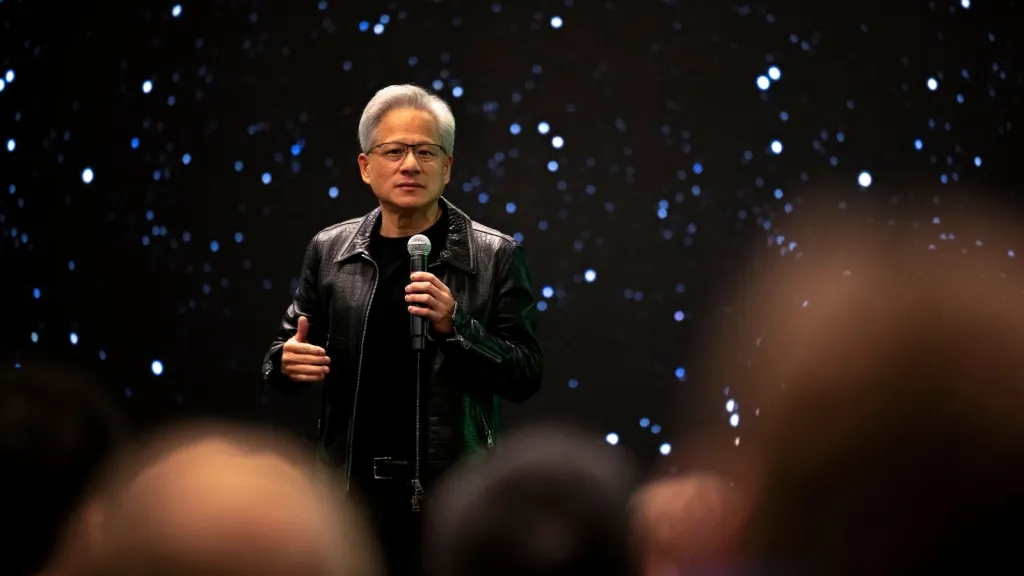
Nvidia CEO Jensen Huang has rejected the idea of introducing a traditional succession plan at the world’s leading AI chipmaker, arguing that the company already has enough experienced executives to manage its different operations. His comments came during his first employee meeting since the Nvidia board reinstated him on November 23, ending an extraordinary leadership crisis that began with his resignation earlier in the month.
The 63-year-old executive reportedly told employees that Nvidia operates differently from conventional organisations because several capable leaders oversee important parts of its business. According to CNBC, Huang argued that a formal succession structure could create unnecessary hierarchy rather than strengthen the company’s existing leadership model.
His remarks come at a time when succession planning has become a major concern for Nvidia investors. Huang co-founded the company in 1993 and has remained its central leadership figure throughout its transformation from a graphics-chip manufacturer into a dominant supplier of processors and systems used in Artificial Intelligence infrastructure.
Beyond succession planning, the all-hands meeting addressed Huang’s conduct, his demanding management approach and the standards expected of Nvidia employees. He apologised for mistakes in his personal life, thanked interim CEO Colette Kress for leading the company during his absence and promised to hold himself to higher standards.
Why Jensen Huang Says Nvidia Does Not Need a Traditional Succession Plan
Huang’s position is based on his belief that Nvidia has developed a leadership structure capable of operating without a conventional succession arrangement. Rather than depending entirely on one executive to direct every part of the business, he argued that the company has multiple experienced leaders responsible for different functions.
According to people familiar with the employee meeting, Huang explained that Nvidia’s business model and management structure are different from those of a typical organisation. He reportedly suggested that introducing a formal succession plan could create unnecessary layers of hierarchy.
The argument reflects Huang’s longstanding management philosophy, which emphasises direct involvement, fast decision-making and close coordination between senior executives. Nvidia’s leadership team includes executives responsible for finance, engineering, operations, software, sales and other important areas of the company.
However, Huang’s rejection of a conventional succession plan raises a broader corporate governance question: how should a company prepare for the unexpected departure of a founder who has led it for more than three decades?
Nvidia’s recent leadership crisis demonstrated why that question matters. When Huang resigned on November 12, the board appointed Chief Financial Officer Colette Kress as interim CEO and announced that it would begin searching for a permanent replacement. The company therefore had to rely on an interim leadership arrangement even though Huang now argues that its broader executive team makes traditional succession planning unnecessary.
His comments do not mean that Nvidia has no capable executives who could take on greater responsibilities. Instead, they indicate that Huang does not favour a conventional succession framework as the primary way to organise leadership continuity.
Huang Thanks Colette Kress for Leading Nvidia During His Absence
Huang reportedly began the meeting by thanking Colette Kress for managing Nvidia during the period when he was away from the company. Kress, who has served as Nvidia’s chief financial officer since 2013, was appointed interim CEO following his resignation.
Her temporary leadership became particularly important because Nvidia was dealing with questions about corporate governance, national security and the future of its executive structure. The company also had to reassure employees, customers, suppliers and investors that its operations and long-term technology plans would continue.
When Nvidia announced Huang’s reinstatement on November 23, the board credited Kress and the executive team for leading the company during the transition. Kress returned to her regular responsibilities as CFO after Huang resumed the CEO position.
Huang’s public acknowledgement of her role was significant because the controversy had briefly placed Nvidia’s leadership structure under intense scrutiny. The company had to demonstrate that its operations did not depend entirely on the availability of its founder.
Jensen Huang Apologises to Employees and Says He Made Serious Mistakes
The meeting was not limited to questions about Nvidia’s future leadership. Huang also addressed the circumstances surrounding his departure and the personal conduct that led to the board accepting his resignation.
According to reports from employees familiar with the meeting, Huang described the gathering as the second-hardest meeting of his life, with the first being a difficult conversation with his wife. He reportedly told employees that he had made serious personal mistakes and was attending therapy for approximately an hour and a half each day.
Huang also thanked employees for supporting him and acknowledged that his actions had affected the people working alongside him. His remarks were described as apologetic and remorseful, reflecting an effort to address the concerns that had emerged during his absence.
The controversy followed reports of multiple extramarital relationships, including an alleged relationship involving a Chinese businesswoman suspected by US authorities of having connections to Chinese intelligence. The allegations have attracted attention because of the woman’s reported links to a company involved in Nvidia-related business and wider questions about the security of advanced AI chip supply chains.
Importantly, allegations involving possible foreign intelligence activity remain subject to investigation. Nvidia’s board has established an independent committee to examine the matter, and the company has said that the investigation will continue following Huang’s reinstatement.
Huang’s return therefore does not mean that all questions surrounding the controversy have been resolved. The board has restored him to the CEO position while retaining the investigation into the circumstances that contributed to his departure.
Nvidia’s Code of Conduct Will Remain in Place, Huang Says
Another major subject during the employee meeting was Nvidia’s workplace code of conduct. Huang reportedly told employees that the company’s standards remain in force and that violations will be taken seriously.
He also acknowledged that individual cases should be assessed according to their specific circumstances and the people involved. This suggests that Nvidia intends to maintain its existing conduct framework while examining allegations and potential violations on a case-by-case basis.
The issue carries particular importance because Huang was involved in writing the company’s code of conduct. His own departure followed disclosures about personal behaviour that Nvidia’s board said was inconsistent with the company’s standards and cultural expectations.
That creates an important test for the company’s governance. A workplace code of conduct can only maintain credibility if its expectations apply consistently, including to senior executives and the CEO.
By promising to take the standards seriously, Huang is attempting to reassure employees that his return will not mean abandoning the rules that govern workplace behaviour. However, the effectiveness of that commitment will depend on how the company handles its continuing investigations and applies its policies in practice.
Huang Acknowledges That His Intense Management Style Hurt Employees
Huang also addressed criticism of his management approach, which he has previously described as intensely demanding. His leadership style has been closely associated with Nvidia’s fast-moving culture, where employees are expected to work at a high level and respond quickly to changing technology and market conditions.
During the meeting, he reportedly acknowledged that his intensity had sometimes negatively affected employees. Although he believes his demanding approach has helped push people to achieve more, he admitted that it could also go too far and leave colleagues feeling disempowered.
Huang recognised that this was not acceptable and said he needed to find a way to maintain his dedication to Nvidia without causing harm to the people working alongside him.
The acknowledgement is notable because Nvidia’s success has often been associated with Huang’s direct and demanding leadership. The company has grown through several major technology transitions, including the expansion of graphics processing, accelerated computing and generative AI.
But a management approach that works during periods of rapid growth can also create workplace pressures. As Nvidia has expanded into a global technology business with a large workforce and increasingly complex operations, maintaining a high-performance culture while supporting employees has become an important leadership challenge.
Jensen Huang Promises Monthly 360-Degree Performance Reviews
To demonstrate greater accountability, Huang reportedly told employees that he would undergo monthly 360-degree performance reviews. The process will apply specifically to him rather than being introduced as a new requirement for every Nvidia employee.
A 360-degree review collects feedback about an individual’s performance from people who work with them in different professional capacities. Depending on how the process is structured, feedback can come from colleagues, direct reports, supervisors and other workplace contacts.
For a chief executive, such reviews can provide insight into how leadership decisions and communication styles affect the wider organisation. They can also help identify areas where an executive’s behaviour may be creating problems that are not visible through conventional performance measures.
Huang’s decision to make the process specific to himself suggests that he wants to demonstrate personal responsibility rather than impose another administrative requirement on the workforce.
However, the value of the reviews will depend on whether employees can provide honest feedback and whether the process leads to meaningful changes. Monthly assessments could give Huang regular opportunities to evaluate his behaviour, but their effectiveness will ultimately be judged by how he responds to criticism.
Huang Says Nvidia Will Remain Politically Neutral
Huang also addressed Nvidia’s relationship with the US government and political neutrality. His return attracted political attention after President Donald Trump publicly supported bringing him back to the company.
Trump had been among the influential figures who urged Nvidia’s board to reconsider its position. The board ultimately reinstated Huang after discussions and meetings, stating that it had received input from senior US government officials and was satisfied that his return did not pose a national security risk.
During the employee meeting, Huang reportedly rejected the suggestion that political pressure was the reason for his reinstatement. He maintained that the board had reviewed the situation and made its decision based on its assessment of the facts.
He also said Nvidia remained politically neutral, despite expressing appreciation for Trump. The company’s position is important because Nvidia operates in an industry where government decisions on export controls, national security and semiconductor manufacturing can have significant commercial consequences.
Advanced AI chips are particularly sensitive because of their importance to military, scientific and commercial applications. Nvidia must therefore maintain relationships with policymakers while navigating restrictions on technology exports to countries such as China.
Political neutrality does not remove the need for the company to comply with government regulations or respond to national security concerns. It does, however, signal Huang’s intention to present Nvidia as a business serving the broader interests of the United States rather than a company aligned with one political administration.
Support for Women Employees and Work-Life Balance
Huang also highlighted his commitment to supporting women employees and maintaining workplace policies that allow greater flexibility. The comments came amid scrutiny of his personal conduct and the company’s approach to workplace standards.
Flexible workplace policies can help employees manage professional responsibilities alongside family and personal commitments. For a large technology company competing for specialised engineering and research talent, workplace culture can influence recruitment, employee retention and productivity.
Huang’s comments indicate that he wants to reinforce the importance of a respectful working environment as he returns to the CEO role. However, the company’s broader credibility on workplace issues will depend on how consistently its policies are implemented and whether employees feel comfortable raising concerns.
Why Jensen Huang Resigned and How He Returned to Nvidia
Huang’s leadership crisis began on November 12, 2026, when Nvidia announced that he had resigned as president, CEO and a member of the board with immediate effect. The board appointed CFO Colette Kress as interim CEO and said it would begin searching for a permanent successor.
The resignation followed reports about Huang’s personal relationships and concerns involving a Chinese businesswoman suspected of having links to foreign intelligence. The disclosures raised questions about his personal conduct, potential conflicts and national security considerations connected to Nvidia’s business relationships.
On November 17, Huang publicly acknowledged that he had made serious mistakes in his personal life and said he was willing to return if the board concluded that doing so was in the company’s best interests. At that point, Nvidia’s chairman Harvey C. Jones had said the board did not intend to reinstate him.
The situation changed after further discussions involving Huang, the board and senior US government officials. On November 23, Nvidia announced that its board had unanimously voted to reinstate him as president, CEO and a member of the board.
The board said it was satisfied with Huang’s candour and ability to lead the company. It also stated that government input had helped it assess whether his return presented a national security risk.
However, the board’s decision did not end the investigations. Nvidia said its independent committee would continue examining the reported foreign intelligence effort involving Huang, while the company also established a separate committee to oversee national security and export-control risks.
How Nvidia’s Leadership Crisis Affected Its Stock Price
Huang’s resignation triggered significant uncertainty among investors because of his central role in Nvidia’s strategy and corporate identity. The company’s shares fell sharply during the period when he was away from the CEO position.
According to the figures cited in market reports, Nvidia shares declined approximately 24.5% between November 12 and November 20, falling from $166.19 to $125.53. The decline reflected concerns about leadership continuity and the potential consequences of losing the executive who had guided Nvidia through its transformation into a major force in AI computing.
The announcement of Huang’s reinstatement on November 23 triggered a dramatic recovery. Nvidia shares surged approximately 31.5% during that trading session, adding more than $950 billion to the company’s market value.
The rebound demonstrated how closely investors associate Nvidia’s leadership with its long-term business strategy. Huang has become a highly visible figure in the global AI industry, and uncertainty over his departure had raised questions about whether the company could maintain its momentum without him.
However, the initial rally did not eliminate the risks. Nvidia shares fell again on November 24 as investors reassessed the implications of Huang’s return, the ongoing investigations and the company’s governance arrangements. The market reaction illustrates that restoring the founder to the CEO position does not automatically resolve every concern about the business.
Does Nvidia Have Enough Leaders to Operate Without Jensen Huang?
Huang’s rejection of a conventional succession plan raises an important question for Nvidia: can its existing executive team manage the company if its founder becomes unavailable again?
The company has experienced executives across several major business areas. Colette Kress leads finance, while other senior leaders oversee engineering, operations, software development and commercial activities. Their responsibilities are important to maintaining the company’s operations, particularly as demand for AI infrastructure continues to create complex manufacturing and supply-chain requirements.
Nevertheless, leadership continuity involves more than having capable executives in individual departments. A permanent succession framework can clarify who has authority during an unexpected departure, how strategic decisions are made and how the board evaluates potential replacements.
Nvidia’s board demonstrated that it was prepared to establish an interim leadership arrangement when Huang resigned. Its initial decision to search for a permanent CEO also showed that directors recognised the need to consider alternatives, even if Huang believes the company’s internal structure makes a traditional succession plan unnecessary.
The difference between operational continuity and long-term succession planning is important. A business may continue functioning through a capable executive team while still lacking a clearly communicated process for selecting its next permanent chief executive.
For investors, the issue is especially relevant because Nvidia’s market value and strategic importance have grown enormously. The company supplies critical technology to businesses building AI systems, data centres and advanced computing infrastructure. Any leadership uncertainty can therefore have implications beyond its own workforce and shareholders.
What Happens Next for Jensen Huang and Nvidia?
Huang’s return gives Nvidia continuity at the top after one of the most unusual leadership episodes in its history. His comments at the first all-hands meeting suggest that he wants to rebuild employee confidence while maintaining the management philosophy that helped shape the company.
But several challenges remain. The independent investigation into the reported foreign intelligence effort is continuing, questions about export controls and national security require oversight, and the board must demonstrate that its governance standards apply consistently.
Huang’s promises to undergo monthly performance reviews and reconsider the impact of his management style will also face scrutiny. Employees will be looking for evidence that his apology leads to practical changes in how he communicates, delegates responsibilities and responds to workplace concerns.
His rejection of a traditional succession plan is likely to remain a subject of debate among corporate governance experts and Nvidia investors. The company has a substantial leadership team, but its recent experience has shown how quickly uncertainty can emerge when a founder-led business loses its central executive.
For now, Huang is back in charge and insists that Nvidia has the leadership depth to operate without a conventional succession structure. Whether that approach can provide the same confidence as a clearly defined succession process will depend on how effectively the company manages its next leadership challenge and maintains trust among employees, shareholders and business partners.
For breaking news and live news updates, like us on Facebook or follow us on Twitter and Instagram. Read more on Latest Technology on thefoxdaily.com.





COMMENTS 0