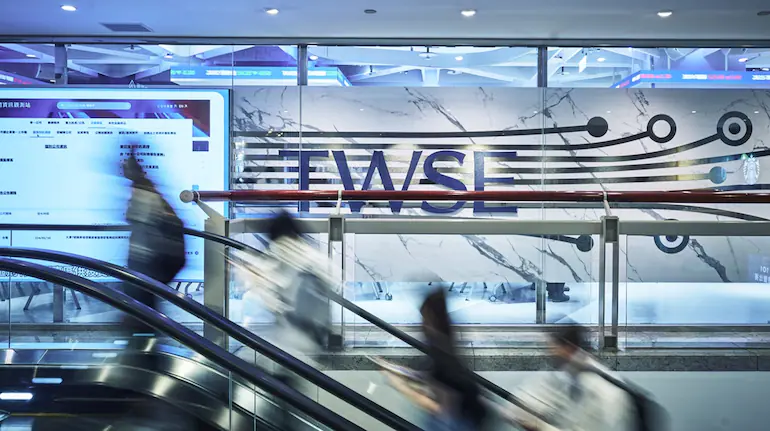
Taiwan’s Stock Market has witnessed its biggest reduction in leveraged equity positions in at least three decades, as investors rushed to cut borrowed exposure following a sharp decline in share prices. The unprecedented unwinding of margin loans highlights the pressure facing the island’s equity market and helps explain why government efforts to stabilise prices have so far had a limited impact.
The amount of outstanding margin loans fell by 49 billion Taiwan dollars, or approximately $1.5 billion, on Friday. According to data compiled by Bloomberg since 1996, this was the largest single-day decline in margin lending during the period. The reduction indicates that investors are rapidly reducing positions financed through borrowing as market volatility intensifies.
Taiwan’s benchmark stock index moved between gains and losses on Monday after plunging 17.5% during the previous week. This marked its biggest weekly decline since 1991, underlining the severity of the latest market correction.
Record Decline in Margin Loans Signals Investor Deleveraging
Margin loans allow investors to borrow money from brokers to purchase shares, increasing their potential exposure to market movements. While borrowing can magnify gains when stock prices rise, it can also amplify losses when markets fall.
When the value of shares purchased with borrowed funds declines, investors may face margin calls requiring them to deposit additional money or sell securities. If they cannot meet these requirements, brokers may liquidate their positions to recover outstanding loans. Such forced selling can add further pressure to an already falling market.
The 49 billion Taiwan dollar reduction in outstanding margin loans on Friday suggests that investors were making substantial efforts to reduce borrowed exposure. The total amount of margin lending has now fallen by more than 30% from its record high of approximately 653 billion Taiwan dollars, reached in October.
This rapid decline represents a significant change in investor behaviour after a period of strong market optimism. It also indicates that the recent correction is affecting not only share prices but also the financing structures supporting equity investments.
Taiwan’s Benchmark Index Suffers Its Worst Weekly Fall Since 1991
The scale of the market decline has made the latest correction particularly significant. Taiwan’s benchmark index lost 17.5% last week, recording its largest one-week fall since 1991. Trading remained volatile on Monday, with the index alternating between positive and negative territory.
The market has experienced considerable fluctuations throughout the year. Earlier optimism surrounding Artificial Intelligence encouraged investors to increase their exposure to technology-related stocks. Taiwan, home to major semiconductor and electronics businesses, benefited from expectations that rising AI demand would support the technology sector.
However, sentiment has changed as investors increasingly question the financial sustainability of the enormous investments required to expand AI infrastructure. Concerns about the scale of spending needed for data centres, computing capacity and other supporting technologies have contributed to selling pressure across technology shares.
The shift illustrates how quickly market expectations can change. Companies and industries associated with a promising technology may attract substantial investment during periods of optimism, but concerns about future returns can trigger sharp corrections when valuations and spending expectations come under scrutiny.
Margin-Call Risks Remain Elevated Despite Reduction in Borrowed Positions
Although investors have substantially reduced their leveraged positions, market risks remain high. Alvin So, a strategist at Goldman Sachs Group Inc. in Hong Kong, warned that margin-call and forced-deleveraging risks continue to be elevated.
In a research note published on Saturday, So said retail leverage had fallen sharply but highlighted the continuing vulnerability of the market. He noted that Taiwan’s aggregate maintenance margin ratio had declined to 132%, close to the 130% margin-call threshold.
According to his assessment, 53% of stocks were already below that level. This suggests that a significant portion of the market remains exposed to additional selling pressure if share prices decline further.
The maintenance margin ratio is an important indicator of the financial buffer available to investors who purchase shares using borrowed money. When the ratio approaches the required threshold, investors may need to provide additional collateral or reduce their positions. If prices continue falling, these requirements can create further selling pressure.
The situation also demonstrates why a reduction in total margin loans does not necessarily mean that the market has become safe. Investors who continue holding leveraged positions may still face pressure if their stocks lose value. Further declines could lead to additional forced selling, particularly among investors with limited capacity to provide fresh funds.
Why Government Stabilisation Efforts May Have Limited Impact
Authorities have been attempting to contain the market decline, but the rapid reduction in margin lending highlights the challenges involved in restoring investor confidence during a sharp correction.
Market stabilisation measures can help address short-term volatility and reassure investors. However, they may have limited influence when selling is driven by concerns about investment valuations, financing risks and the future profitability of major technology businesses.
The latest deleveraging also reflects decisions made by individual investors and brokers. When investors face margin calls or decide that their borrowing exposure has become too risky, they may sell shares regardless of broader efforts to support market sentiment.
In such circumstances, stabilising prices becomes more complicated because selling pressure can come from both changing investment expectations and the need to reduce outstanding debt. A large decline in margin lending can therefore occur even while authorities are trying to prevent further losses.
AI Investment Concerns Add to Pressure on Taiwan’s Technology Market
Taiwan’s stock market is particularly sensitive to developments in the global technology sector because of its substantial exposure to semiconductor and electronics businesses. The island has been an important beneficiary of the global expansion of artificial intelligence, with investors previously placing strong expectations on companies connected to the technology supply chain.
However, the latest correction reflects growing uncertainty about whether the returns from AI-related investments will justify the enormous spending involved. The development of advanced computing infrastructure requires significant capital, and investors are increasingly assessing how quickly that investment can translate into sustainable revenue and profits.
This does not necessarily mean that demand for artificial intelligence technology is weakening. Instead, the market is reassessing the relationship between expected growth, investment costs and future earnings. Even companies with exposure to long-term technological opportunities can face share-price pressure when investors become less willing to pay high valuations.
For Taiwan, the combination of technology-sector uncertainty and leveraged retail investment has created an additional source of volatility. When market optimism weakens, investors who borrowed heavily to purchase shares may be particularly vulnerable to sudden price movements.
What Investors Will Watch in the Coming Sessions
The immediate direction of Taiwan’s stock market could depend on whether selling pressure begins to ease and whether investors continue reducing their borrowed positions. The movement in outstanding margin loans, maintenance margin ratios and the benchmark index will remain important indicators of market conditions.
If margin lending continues to decline, it could indicate that investors are still reducing financial risk. However, a slower pace of deleveraging, combined with improved market stability, could suggest that some of the immediate pressure from forced selling is easing.
Investors will also monitor developments in the global AI sector, particularly expectations surrounding infrastructure spending and the ability of technology companies to generate returns from their investments. A renewed improvement in confidence could support technology shares, while further concerns about valuations and spending could prolong market uncertainty.
For now, the record reduction in margin loans provides a clear indication of how severely the latest selloff has affected leveraged investors. Although much of the borrowed exposure has already been removed, the maintenance margin figures highlighted by Goldman Sachs suggest that the risk of additional forced selling has not disappeared.
Taiwan’s market recovery will therefore depend not only on efforts to stabilise trading but also on a broader improvement in investor confidence. Until concerns over AI investment, equity valuations and leveraged positions ease, volatility could remain a major feature of the market.
For breaking news and live news updates, like us on Facebook or follow us on Twitter and Instagram. Read more on Latest Business on thefoxdaily.com.






COMMENTS 0