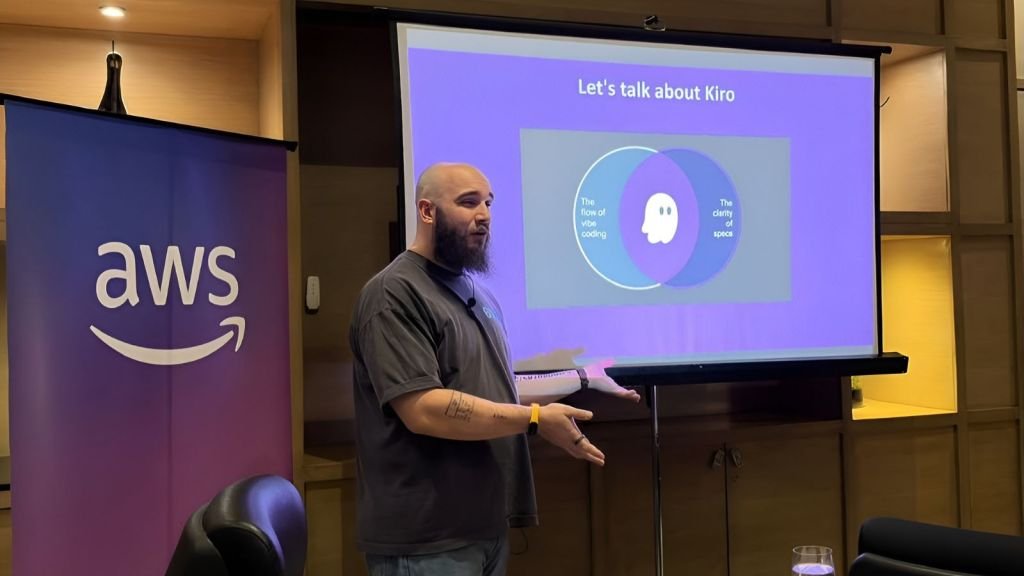
Artificial Intelligence is rapidly changing the way software is designed, written and tested, but developers are unlikely to become less important as AI coding tools become more capable. Instead, the role of software developers is expanding beyond writing code, according to AWS Distinguished Developer Advocate Darko Mesaroš.
“Vibe coding is not going away,” Mesaroš said while discussing the growing use of AI coding agents and tools. But he also pointed to a more structured approach for developers who already understand what they want to build: spec-driven development.
During his recent visit to India, Mesaroš spoke about the changing nature of software engineering, the rise of AI-assisted development and the limitations that still affect AI agents. He also discussed AWS’ approach to spec-driven development through Kiro, an AI-powered integrated development environment, as well as the company’s efforts to expand India’s developer and cloud ecosystem.
His central argument is that AI is changing the mechanics of coding without eliminating the broader discipline of software engineering. As AI tools take on more of the work involved in producing code, developers increasingly need to understand the systems around that code.
AI is changing coding, not eliminating software engineering
Mesaroš has spent about 11 years at AWS after more than two decades working across technology, systems administration and Software Development. His experience has shaped his view that coding is only one component of building useful and reliable software.
“Software engineering, as a practice, is so much more than coding,” he said. “Writing code was just one part of it a big part, because it took the most effort but it’s only part of the picture.”
AI coding assistants can now generate functions, suggest implementations, explain errors and perform other tasks that previously required developers to write or investigate code manually. AWS itself has been developing tools such as Kiro to help developers work with AI throughout the software development process.
But generating code does not automatically solve the larger engineering problem. Developers still have to understand who the software is for, what problem it is supposed to solve, how different components interact and what happens when the system operates at scale.
Mesaroš specifically pointed to customer understanding, systems design, scaling and operations as areas that remain central to software engineering.
That is why he expects developers to broaden their skill sets rather than simply focus on becoming faster at writing code.
“I see that software developers are going to expand their skill sets slightly more than just being strictly coders,” he said, describing a future in which developers understand much more than how to write an effective function in a particular programming language.
What is vibe coding?
The term “vibe coding” has become increasingly associated with a style of AI-assisted development in which a developer communicates with an AI agent, reviews what it produces and continues refining the result through repeated interactions.
Rather than manually writing every line of code, developers can describe what they want in natural language and allow an AI system to generate an implementation. They can then test it, identify problems, provide additional instructions and continue iterating.
Mesaroš does not view this approach as something that should simply disappear as more structured AI development methods emerge.
Instead, he sees a useful role for vibe coding in exploration, experimentation and prototyping. Developers may not always know precisely how a new idea should work when they begin building it. An AI agent can help them rapidly explore possibilities and discover what is practical.
“Vibe coding is there to help you explore, build prototypes, and experiment with what you want to build,” Mesaroš said.
The distinction becomes more important when an experimental idea needs to become a reliable piece of software that matches defined requirements.
Why spec-driven development is gaining attention
Spec-driven development, or SDD, takes a more structured approach. Instead of beginning with an open-ended conversation with an AI agent and gradually discovering the implementation, developers first establish what the software should do and how it should be designed.
A specification can define requirements, expected behaviour and important design decisions before an AI system generates the implementation. This gives the developer and the AI agent a clearer reference point throughout the development process.
AWS’ Kiro is designed around this approach. The AI-powered development environment focuses on helping developers establish requirements and design decisions before moving deeper into code generation.
Mesaroš described the specification as effectively a contract between the developer and the AI agent that defines what needs to be produced.
This does not mean that every software project requires an elaborate specification before a single line of code can be generated. Instead, the approach offers developers a way to introduce structure when a project moves beyond experimentation.
For developers working on larger applications, clarity around requirements can become particularly important because AI-generated code can otherwise move quickly in a direction that does not match the original intention.
From experimentation to reliable software
The difference between experimentation and production software is one reason Mesaroš sees value in using both approaches rather than treating them as competing philosophies.
A developer might use vibe coding to test an idea, create a prototype or explore different technical approaches. Once the direction becomes clear, specifications can provide a stronger foundation for implementation and further development.
Mesaroš also connected structured development with concerns about the quality of AI-generated applications. The rapid availability of generative AI has made it easier to produce software, but faster production does not necessarily mean better software.
“We’ve seen so much AI slop out there,” he said, referring specifically to low-quality applications produced with AI. In his view, establishing clear specifications can help reduce the gap between what a developer intends to build and what an AI agent ultimately produces.
The underlying issue is not simply whether AI can generate code. It is whether the resulting software satisfies the requirements, works reliably and can be maintained as the system evolves.
AI agents still struggle with context and memory
Despite the rapid improvement in AI coding tools, Mesaroš identified persistent context as one of the challenges developers continue to encounter.
Developers often have preferences about their technology stack, coding practices, project architecture and working methods. If an AI tool does not retain that information across interactions, developers may have to repeatedly explain the same requirements.
Mesaroš highlighted Kiro Crew, AWS’ open-source AI agent orchestrator, as an example of an effort to address the problem through memory.
He said the system had accumulated 273 lessons from his own interactions with it. Those lessons reflected his preferences and coding habits, allowing the system to build a better understanding of how he works over time.
Persistent memory can potentially make AI-assisted development more useful because the developer does not have to restart the relationship with the agent every time a new session begins. However, the value of memory also depends on how accurately the system retains and applies the information it has learned.
Cost remains an important consideration
Another practical issue surrounding AI coding agents is cost. More capable AI models generally require greater computational resources, making it inefficient to use the most powerful model for every task.
Mesaroš pointed to Kiro’s “auto” model selection as one way of addressing this challenge. The system can route simpler tasks to less expensive models instead of automatically relying on the largest model available.
This reflects a broader consideration for AI-assisted development: developers and organisations are not only deciding whether AI can complete a task, but also which model should perform it and how much computational cost is justified.
As AI agents become involved in more stages of development, model selection and resource management could become part of the everyday workflow alongside traditional decisions about programming languages, frameworks and infrastructure.
Human responsibility does not disappear
Greater AI involvement in software development also raises a fundamental question about responsibility. If an AI agent generates a significant portion of an application’s code, who remains accountable for the resulting software?
For Mesaroš, the answer is the developer.
He pointed to Kiro Crew’s development as an example. The open-source project has accumulated more than 10,000 pull requests, but Mesaroš noted that every pull request and software change was approved by a human.
His point is that automation of implementation does not transfer responsibility from the developer to the AI system. Developers still need to review changes, understand what is being introduced and determine whether the resulting software is appropriate.
This distinction becomes increasingly important as AI agents move from generating small code snippets to making larger changes across software projects. The more responsibility an AI agent takes for implementation, the more important human oversight becomes in deciding whether its output should actually be used.
Developers need to broaden and deepen their skills
Mesaroš’ advice for developers entering a more AI-driven industry is not to focus exclusively on learning more programming languages or frameworks.
Instead, he recommends broadening and deepening technical knowledge at the same time.
“I think broadening and deepening your skill set at the same time should be a focus of developers,” he said.
Broadening can mean understanding system architecture, infrastructure, deployment and operations. Deepening can involve using AI tools to investigate how the systems being built actually work rather than treating generated code as a black box.
This approach could become increasingly important as AI handles more routine implementation work. If developers spend less time manually producing individual pieces of code, their value can increasingly come from understanding the larger system and making decisions about how its components should fit together.
AWS is expanding its developer focus in India
Mesaroš also discussed AWS’ efforts to strengthen India’s developer ecosystem. The company has made a global commitment of more than $500 million toward student cloud and AI training, while an AWS Builder Loft is planned for India.
According to Mesaroš, more than 10 million people in India have gone through AWS training and certification programmes. These initiatives form part of a broader push to build cloud and AI skills as demand for those technologies increases.
Amazon has also announced plans for more than $13 billion in Investment in AI and cloud infrastructure between 2026 and 2030, following comments by Amazon CEO Andy Jassy during a recent visit.
The infrastructure investment and developer-training efforts address different parts of the same ecosystem. Cloud infrastructure provides the computing environment required to build and operate AI applications, while training programmes aim to increase the pool of people capable of developing and deploying those applications.
India’s developers and AI adoption
India has become an important market for cloud services, software development and AI experimentation, but Mesaroš was cautious about describing Indian developers as fundamentally different from developers elsewhere.
“I wouldn’t say there’s any specific nature of developers in India compared to everything else,” he said.
Instead, he highlighted the enthusiasm and care shown by developers using AI tools to build new applications and experiment with technology.
That observation also reflects the broader nature of AI adoption in software development. The technology itself is increasingly accessible across markets, while differences in adoption can depend on the types of problems developers are trying to solve, the availability of infrastructure and skills, and the resources available to teams.
The future of coding may be less about code alone
The debate around AI and programming is often framed around whether machines will eventually replace developers. Mesaroš’ perspective points toward a different evolution: developers may spend less of their time manually writing code while taking on greater responsibility for defining, designing, reviewing and operating software.
Vibe coding is likely to remain useful for rapid exploration and experimentation. Spec-driven development can provide more structure when requirements become important and the software needs to reliably match a defined objective.
Neither approach removes the need for engineering judgment. AI can generate implementation options, but developers still need to determine whether those implementations are correct, secure, scalable and appropriate for the users they serve.
As AI agents become more capable, understanding systems could therefore become just as important as understanding syntax. Developers who combine coding knowledge with architecture, infrastructure, operations, customer understanding and the ability to work effectively with AI tools will be operating across a broader definition of software engineering.
The future of coding, in this view, is not necessarily a future without programmers. It is a future in which writing code becomes one part of a larger process of building software, with humans remaining responsible for deciding what should be built, why it should be built and whether the resulting system actually works.
For breaking news and live news updates, like us on Facebook or follow us on Twitter and Instagram. Read more on Latest Technology on thefoxdaily.com.






COMMENTS 0