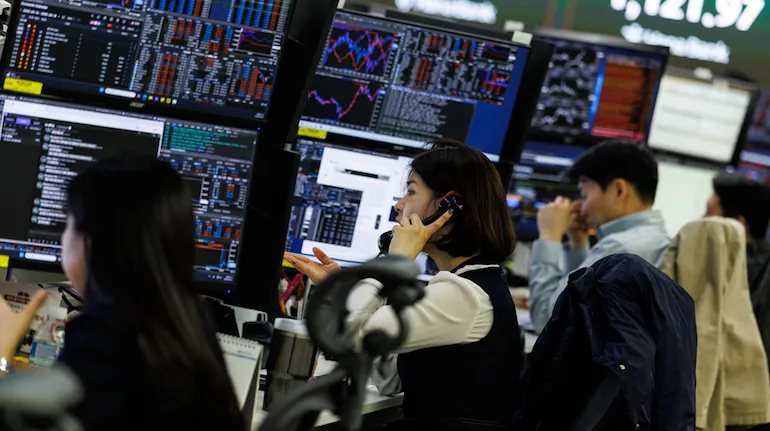
South Korea‘s government believes its latest market-stabilisation measures will help restore investor confidence, even as the country’s benchmark Kospi index extended its losses on Monday. Finance Minister Lee Hyoung Il said authorities remained committed to stabilising financial markets following a sharp selloff driven by concerns over Artificial Intelligence (AI) investment and semiconductor demand.
The Kospi fell as much as 5.5% on Monday, extending Friday’s 5.2% decline. The continued weakness highlighted the challenges facing policymakers as they attempt to calm investors amid uncertainty surrounding the sustainability of massive spending on AI infrastructure.
Authorities announced a series of measures on Sunday, including preparations for a stock-market stabilisation fund, relaxed restrictions on corporate share buybacks and stronger surveillance of illegal short-selling activities. The government hopes these steps will reduce excessive volatility and reassure market participants.
Finance Minister Says Measures Will Restore Investor Confidence
Finance Minister Lee Hyoung Il said the government’s commitment to stabilising the market should help improve investor sentiment.
Speaking to reporters on Monday, Lee said, “We have made clear the government’s commitment to stabilizing the market. We expect this to help improve investor sentiment.”
His remarks came as Korean equities continued to decline despite the announcement of policy interventions. The market reaction suggests that investors remain focused on underlying concerns about technology-sector valuations, AI infrastructure spending and the future demand outlook for semiconductor products.
Lee indicated that the government was prepared to respond to changing market conditions. However, he did not suggest that the stabilisation fund would be activated immediately.
South Korea Prepares Stock-Market Stabilisation Fund
One of the central elements of the government’s response is a plan to prepare a stock-market stabilisation fund that could be deployed if market conditions require intervention.
The fund is designed to provide support during periods of severe market volatility. It would be financed by banks and other financial institutions, allowing authorities to establish a mechanism for responding to sharp declines in equity markets.
Lee said the decision to activate the fund would depend on market conditions. This means the announcement represents preparation for a possible intervention rather than confirmation that the fund will immediately begin purchasing shares or supporting market prices.
South Korea has used similar arrangements during previous periods of financial stress. The stabilisation fund was last deployed during the 2008 global financial crisis.
Previous Stabilisation Fund Plans During the Covid Crisis
Authorities subsequently announced plans to revive the mechanism during periods of market turbulence. In 2020, as the Covid-19 pandemic disrupted financial markets, South Korea announced plans for a stabilisation fund worth approximately 10.76 trillion won, equivalent to around $7.2 billion at the time.
However, the planned fund was never activated. Its announcement nevertheless demonstrated the government’s willingness to prepare financial support mechanisms during periods of heightened uncertainty.
The latest proposal follows a similar approach, with authorities preparing a potential intervention tool while leaving the final activation decision dependent on market developments.
Whether the current fund will be used remains uncertain. Its effectiveness in restoring confidence may also depend on whether investors see signs of improvement in the underlying conditions affecting Korean equities.
Corporate Share Buyback Restrictions to Be Eased
Another part of the government’s response involves easing restrictions on corporate share buybacks. Share repurchases allow listed companies to purchase their own shares from the market, potentially providing additional demand during periods of weakness.
Relaxing restrictions could give companies greater flexibility to carry out buyback programmes when market conditions become unstable. Such purchases may help support share prices, although their actual impact will depend on the scale and timing of corporate activity.
Buybacks are not a guaranteed solution to falling markets. If investors remain concerned about company earnings, valuations or broader economic conditions, corporate repurchases alone may not be enough to reverse a sustained selloff.
Authorities Intensify Surveillance of Illegal Short Selling
The government has also announced stronger monitoring of illegal short-selling activities as part of its efforts to contain market volatility.
Short selling involves borrowing shares and selling them in the expectation that their prices will decline, allowing traders to buy them back at a lower price. It is a recognised market activity in many financial systems, but illegal practices can undermine market integrity and investor confidence.
South Korean authorities intend to intensify surveillance to identify and respond to unlawful transactions. The measure is aimed at ensuring fairer trading conditions rather than preventing every form of short selling.
Stronger enforcement could help address concerns about market manipulation and improve confidence in trading practices. However, it may not directly resolve the valuation and business concerns currently affecting technology stocks.
AI Investment Concerns Drive South Korea’s Market Selloff
The latest decline in Korean equities reflects broader investor concerns about the sustainability of enormous investments in artificial intelligence infrastructure.
Technology companies have committed substantial resources to data centres and related infrastructure to support the expansion of AI services. Investors are increasingly examining whether expected future revenue and demand will justify the scale of this spending.
Concerns about financing requirements and regulatory risks have added to uncertainty. If companies struggle to generate sufficient returns from their AI investments, expectations for future growth and profitability could come under pressure.
These concerns are particularly important for South Korea because its equity market has significant exposure to semiconductor manufacturers. Changes in expectations for AI-related chip demand can therefore influence investor sentiment towards the broader market.
Lee Remains Optimistic About Semiconductor Demand
Despite the selloff, Finance Minister Lee sought to reassure investors about the outlook for South Korea’s semiconductor industry.
He said AI-driven investment in data centres was likely to continue expanding despite concerns about financing and regulatory risks. Lee also pointed to the position of the country’s two major chipmakers, which have already secured substantial orders through long-term supply contracts.
According to the minister, their inventories are also continuing to decline rapidly. These developments were cited as indicators supporting the outlook for the semiconductor sector.
Long-term supply contracts can provide manufacturers with greater visibility into future demand and production planning. Declining inventories may also indicate that existing supplies are being absorbed by customers.
However, these factors do not eliminate the risks associated with the technology sector. Future performance will still depend on actual demand, pricing conditions, investment decisions and the ability of companies to generate returns from AI-related spending.
Why the Kospi’s Continued Decline Matters
The Kospi’s fall of as much as 5.5% on Monday, following Friday’s 5.2% tumble, shows that the government’s announcements have not immediately reversed the market’s downward momentum.
Sharp movements in a major equity index can affect investor confidence, trading activity and expectations about corporate valuations. They can also increase pressure on policymakers to demonstrate that financial markets have adequate safeguards during periods of stress.
For international investors, developments in South Korea are also relevant because the country’s semiconductor industry is closely connected to global technology supply chains. Continued uncertainty surrounding chip demand and AI spending could influence sentiment across other Asian technology markets.
Nevertheless, the Kospi’s decline does not by itself establish that the government’s measures will fail. Stabilisation policies may take time to influence market behaviour, while broader technology-sector concerns could continue to dominate trading in the near term.
Outlook: Market Recovery Depends on Confidence and Technology Demand
South Korea’s latest measures reflect an effort to prepare financial support mechanisms, improve corporate flexibility and strengthen market oversight. The government has indicated that it is ready to respond if volatility requires further intervention.
However, the immediate market reaction shows that investors remain concerned about AI infrastructure spending, financing risks and the outlook for semiconductor demand. Lee’s comments about long-term chip orders and declining inventories provide the government’s perspective on why the sector’s growth prospects remain intact.
The next key development will likely depend on whether technology-sector fundamentals support investor expectations and whether the government’s measures help reduce excessive market volatility. For now, the stabilisation fund remains a contingency plan, while the Kospi’s continued decline highlights the difficulty of restoring confidence during a broader market reassessment.
For breaking news and live news updates, like us on Facebook or follow us on Twitter and Instagram. Read more on Latest Business on thefoxdaily.com.






COMMENTS 0