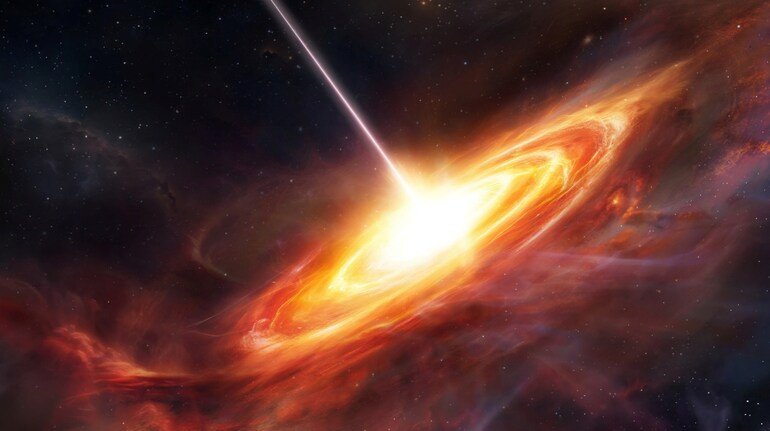
Astronomers have discovered a record-breaking quasar that existed when the universe was only 630 million years old, offering a rare opportunity to investigate how enormous Black Holes emerged during the earliest stages of cosmic history. The object, formally identified as J1504+6252 and nicknamed Dún Aonghasa, is located more than 13.1 billion light-years away in the observable universe’s distant past.
The discovery was made using observations from the European Space Agency’s (ESA) Euclid space telescope and subsequently confirmed through an extensive campaign involving powerful ground-based and space-based observatories. Measurements from the James Webb Space Telescope (JWST) revealed that the quasar is powered by a supermassive black hole with approximately 360 million times the mass of the Sun.
What makes the discovery particularly important is not simply its age or distance. The black hole had already reached an extraordinary mass at a time when the universe was still undergoing major changes. Even more puzzling, observations indicate that it is consuming surrounding material at a relatively slow rate, making it difficult to explain how it accumulated so much mass within the available time.
The discovery, led by astronomer Julien Wolf and published in the journal Astronomy & Astrophysics on November 24, 2026, pushes the known quasar record approximately 40 million years further back than the previous record-holder. It also provides new evidence for investigating whether some of the earliest supermassive black holes formed through the direct collapse of enormous gas clouds rather than growing exclusively from the remnants of the first stars.
What is the newly discovered quasar Dún Aonghasa?
Dún Aonghasa is an extremely distant quasar powered by a supermassive black hole at the centre of its host galaxy. Its formal astronomical designation is J1504+6252, while its nickname comes from an ancient stone fort called Dún Aonghasa on the Irish island of Inis Mór.
The researchers selected the name because the prehistoric fort stands on a cliff overlooking the Atlantic Ocean, creating a striking connection with the quasar’s position at the observational frontier of the universe. Just as the fort faces an immense horizon, the newly identified object provides astronomers with a view into a period of cosmic history that remains difficult to study.
The quasar existed approximately 630 million years after the Big Bang, which scientists estimate occurred around 13.8 billion years ago. Its light has travelled for more than 13 billion years before reaching modern telescopes, allowing researchers to observe the object as it appeared when the universe was less than five per cent of its current age.
Its measured redshift is 8.13, making it the first confirmed quasar identified beyond a redshift of eight. Redshift describes how light wavelengths stretch as the universe expands. The greater the redshift of a distant object, the further back in cosmic history astronomers are generally looking.
The discovery is approximately 40 million years earlier than the previous record-holder announced in July 2026. Although 40 million years may seem relatively small compared with the universe’s age, it represents a significant advance when studying the first billion years of cosmic evolution.
At these distances, astronomers are investigating an era when the first stars and galaxies were still developing. Every newly confirmed object can help scientists understand how quickly the earliest cosmic structures emerged and how the conditions for modern galaxies were established.
A black hole 360 million times more massive than the Sun
The most striking feature of Dún Aonghasa is the enormous black hole powering its bright central region. Researchers estimate its mass at approximately 360 million solar masses, meaning it contains the equivalent of 360 million Suns.
For comparison, the supermassive black hole at the centre of the Milky Way, known as Sagittarius A*, has a mass of approximately four million Suns. The black hole powering Dún Aonghasa is therefore roughly 90 times more massive than the one located at the heart of our galaxy.
This difference is particularly remarkable because the newly discovered quasar existed during the universe’s infancy. Astronomers have long struggled to explain how black holes could become so massive within the first billion years after the Big Bang, given the limited time available for them to accumulate matter.
Black holes are regions of spacetime where gravity becomes so strong that nothing, including light, can escape after crossing a boundary called the event horizon. Their mass can increase when they absorb surrounding gas, dust and other material.
When a large quantity of material approaches a black hole, it does not necessarily fall directly into it. Instead, the material can form a rotating structure known as an accretion disk. Friction and gravitational interactions heat the gas to extremely high temperatures, causing it to release enormous amounts of radiation.
In a quasar, this process produces such intense brightness that the central region of a galaxy can outshine the combined light of its surrounding stars. This extraordinary luminosity allows astronomers to detect quasars even when they are billions of light-years away.
Silvia Belladitta, an astronomer involved in the research, explained that the energy released by material falling towards a supermassive black hole can make the quasar shine hundreds or even thousands of times more brightly than the rest of its host galaxy.
Studying these objects helps researchers investigate the relationship between early galaxies and the enormous black holes that developed at their centres. Dún Aonghasa provides an especially valuable example because its black hole had already reached hundreds of millions of solar masses during an extremely early period.
How Euclid discovered the oldest-known quasar
The discovery began with observations collected by ESA’s Euclid space telescope, which was launched in 2023 to investigate dark matter, dark energy and the large-scale structure of the universe.
Euclid is designed to survey enormous areas of the sky rather than concentrate only on a small number of individual objects. Its combination of sensitive imaging and wide coverage makes it particularly useful for identifying rare and distant astronomical sources, including ancient quasars.
The research team led by Julien Wolf identified Dún Aonghasa while examining millions of objects recorded in Euclid’s Wide Survey. The initial observations revealed a promising candidate, but additional measurements were necessary to establish its identity and determine how far back in cosmic history it existed.
The team used observations from several major astronomical facilities. The W. M. Keck Observatory and the Hubble Space Telescope provided important early information, while the Large Binocular Telescope helped researchers investigate the object’s properties. Ultimately, observations from the James Webb Space Telescope established the redshift of 8.13 and helped determine the black hole’s mass.
This combination of instruments was essential because identifying an extremely distant object is not the same as confirming its nature. Astronomers need to examine the light it emits, measure its spectral characteristics and establish whether the source is genuinely a quasar rather than another type of distant astronomical object.
Euclid’s discovery also demonstrates the importance of wide-field space surveys. By examining millions of astronomical sources, the telescope can identify unusual candidates that would be difficult to locate through observations focused on smaller regions of the sky.
Why the black hole’s rapid growth is puzzling scientists
The central scientific question raised by Dún Aonghasa is how its black hole became so massive in such a short period after the Big Bang.
Black holes grow by accumulating matter, but this process takes time. The amount of material they can consume is influenced by several factors, including the availability of surrounding gas, the rate at which matter falls towards them and the energy released during accretion.
Researchers have found that the black hole powering Dún Aonghasa appears to be consuming material at a relatively slow rate compared with what might be expected for an object that reached such an enormous mass so early in the universe.
This creates a problem for conventional growth scenarios. If the black hole began as the relatively small remnant of an ordinary early star, it would have needed to grow extraordinarily quickly to reach 360 million solar masses by the time the universe was only 630 million years old.
The observed feeding rate makes that explanation difficult to reconcile with the black hole’s current mass. It suggests that the object may have started its existence with a much larger initial mass than a typical stellar-remnant black hole.
Scientists are therefore examining alternative explanations, particularly the possibility that some early black holes formed through direct collapse. This mechanism could provide a way for black holes to begin with substantially greater masses and reduce the amount of subsequent growth required.
Could the black hole have formed through direct collapse?
One of the leading explanations being investigated is a process known as direct collapse, in which an enormous cloud of gas forms a massive central object that eventually collapses into a black hole.
Under ordinary conditions, large clouds of gas tend to cool, fragment into smaller structures and eventually produce stars. Those stars can later collapse into black holes after exhausting their nuclear fuel or undergoing other stages of stellar evolution.
However, researchers believe that different physical conditions in the early universe could sometimes prevent gas clouds from fragmenting in the usual way.
If a sufficiently large gas cloud remains warm and avoids breaking into numerous smaller pieces, much of its material could flow towards a central region. Instead of producing many ordinary stars, the cloud could build an exceptionally massive central object that eventually collapses into a black hole.
Such a black hole would begin with a much larger mass than one produced through the collapse of a typical first-generation star. This could help explain how an object like Dún Aonghasa reached hundreds of millions of solar masses within the first billion years of cosmic history.
Julien Wolf and his colleagues examined possible formation scenarios to understand how the observed black hole could have reached its current mass. Their analysis indicates that a massive initial seed, potentially produced through direct collapse, offers an important explanation for the discovery.
However, direct collapse is not a confirmed description of exactly how this particular black hole formed. The available observations place important constraints on possible explanations, but further research will be needed to establish the physical history of the object.
The discovery is therefore significant because it gives scientists a more demanding example against which different black hole formation models can be tested.
The quasar formed during the universe’s reionisation era
Dún Aonghasa existed during one of the most important transitional periods in the history of the universe, known as the epoch of reionisation.
Immediately after the Big Bang, the universe was extremely hot and dense. As it expanded, it cooled and eventually allowed atoms to form. Hydrogen became the dominant component of ordinary matter, creating a largely neutral environment through which light could not travel freely in the same way it does today.
For a period, the universe remained relatively dark, without the large population of stars and galaxies visible in the modern cosmos. Astronomers often describe this stage as the cosmic dark ages.
The situation began changing when the first stars and galaxies formed. Their radiation gradually ionised the surrounding hydrogen gas, removing electrons from hydrogen atoms and allowing light to travel more freely through space.
This transformation is known as reionisation. It was not an instantaneous event but a gradual process that unfolded as the first generations of stars, galaxies and energetic cosmic objects developed.
Dún Aonghasa existed while this transformation was still underway. Its discovery therefore gives researchers a direct opportunity to study an enormous black hole and its host galaxy during a period when the universe was becoming increasingly transparent.
Quasars are particularly useful for investigating this era because their intense radiation can interact with the surrounding gas. By studying their light, astronomers can learn about the conditions of the early universe and the way matter was distributed around the first galaxies.
The discovery also raises questions about how early galaxies acquired enough material to support such massive black holes. Understanding the relationship between the growth of galaxies and their central black holes is an important part of explaining how today’s large cosmic structures developed.
Euclid has discovered more ancient quasars than expected
Dún Aonghasa is part of a broader increase in discoveries of extremely distant quasars made possible by Euclid’s observations.
In July 2026, researchers announced the discovery of 31 ancient quasars using data from the telescope. Twelve of those objects were found beyond a redshift of seven, substantially expanding the known population of quasars from the early universe.
The latest discovery pushes that observational boundary further by identifying the first confirmed quasar with a redshift greater than eight. It also demonstrates how quickly astronomers can make progress when large-scale surveys are combined with detailed follow-up observations.
Finding these objects is challenging because they are extremely rare. At a redshift of eight, astronomers expect only a relatively small number of quasars across the entire area Euclid will survey.
The telescope’s wide-field approach is therefore important. Rather than searching for individual quasars without a broader survey, researchers can identify potential candidates among millions of sources and then use more powerful instruments to investigate the most promising ones.
Euclid’s mission is primarily focused on understanding the dark universe, including the influence of dark matter and dark energy. However, its observations are also creating opportunities for research into the first galaxies, ancient quasars and the formation of supermassive black holes.
Could astronomers discover an even older quasar?
Researchers believe Dún Aonghasa may not remain the oldest-known quasar for long. The discovery establishes a new observational record, but theoretical models suggest that the first quasars could have appeared much earlier in cosmic history.
Some models place the possible emergence of the earliest quasars between approximately 270 million and 470 million years after the Big Bang. If future observations confirm objects from this period, astronomers could gain access to an even earlier stage of black hole and galaxy formation.
Such discoveries would help researchers determine whether the first supermassive black holes formed through unusual conditions that produced massive initial seeds or through extremely rapid periods of accretion.
Euclid’s continuing survey could identify additional candidates, while instruments such as the James Webb Space Telescope can provide the detailed observations required to confirm their distances and physical properties.
However, detecting a candidate does not automatically establish a new record. Researchers must confirm its redshift, determine whether it is genuinely a quasar and establish the characteristics of the black hole powering it.
The discovery of Dún Aonghasa shows that the observational boundary is still moving. As astronomers examine increasingly distant objects, they are finding evidence of massive cosmic structures that existed much earlier than many traditional models could easily explain.
Why the Dún Aonghasa discovery matters for our understanding of the universe
The discovery of the oldest-known quasar is important because it provides a new test of theories explaining how the universe’s earliest supermassive black holes developed.
For decades, astronomers have known that enormous black holes exist at the centres of many galaxies. The Milky Way itself contains Sagittarius A*, while other galaxies host black holes billions of times more massive than the Sun.
What remains difficult to explain is how some of these black holes became so large so early in cosmic history. Dún Aonghasa adds another important example to this scientific problem, with its 360-million-solar-mass black hole already established when the universe was only 630 million years old.
Its relatively slow feeding rate makes the discovery particularly useful. It suggests that scientists cannot explain every early supermassive black hole simply by assuming that it continuously consumed enormous quantities of material from the moment it formed.
Instead, researchers may need to consider a wider range of initial conditions, including the possibility of massive black hole seeds created through direct collapse. The discovery does not settle the debate, but it narrows the range of explanations that can account for the observed properties.
It also demonstrates how modern space telescopes are changing the study of cosmic history. Euclid can identify rare objects across enormous areas of the sky, while Webb and other observatories can investigate their light in greater detail.
For now, Dún Aonghasa represents the farthest confirmed quasar discovered by astronomers. Its black hole offers a remarkable glimpse into the universe’s earliest stages and leaves researchers with a fundamental question: how did something so massive grow so quickly when the cosmos itself was still in its infancy?
The answer may lie in the conditions under which the first black holes were born. As Euclid continues surveying the distant universe, astronomers may soon find even older quasars that reveal more about the origins of these extraordinary cosmic objects.
For breaking news and live news updates, like us on Facebook or follow us on Twitter and Instagram. Read more on Latest Technology on thefoxdaily.com.




COMMENTS 0