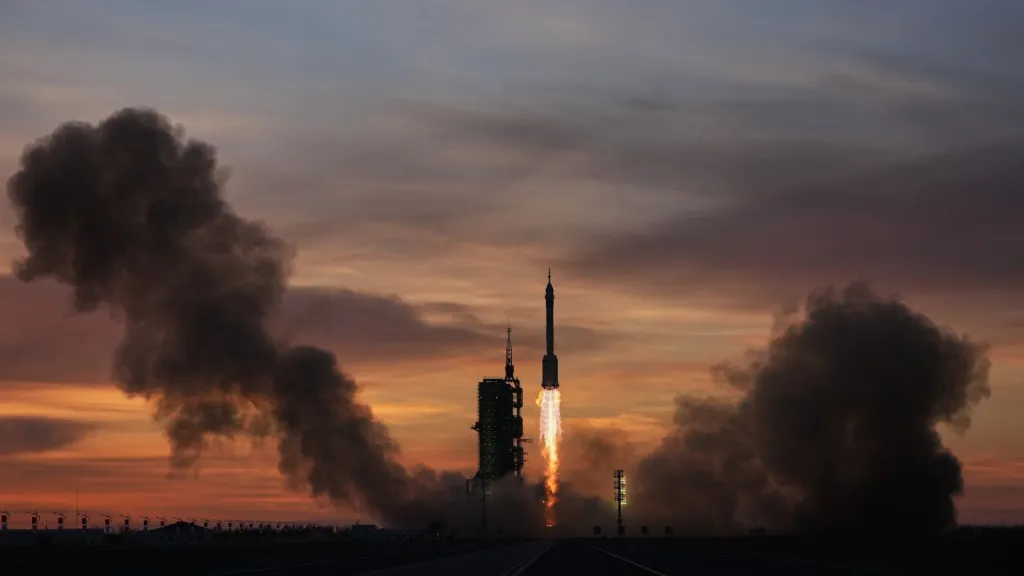
The spacecraft was launched at 8:18 a.m. Beijing time from the Jiuquan Satellite Launch Centre in northwestern China. A Long March-2F rocket carried the crew into space, and the spacecraft successfully entered its planned orbit. The Beijing Aerospace Control Centre subsequently declared the launch a complete success.
Ali, 40, is serving as a payload specialist on the mission. He is accompanied by Chinese astronaut Tang Hongbo, 51, who is commanding the flight, and flight engineer Wu Yi, 39. While Tang has previously travelled to space, the mission marks the first spaceflight for Ali and Wu.
For Pakistan, the launch represents a major milestone in its space programme. For China, it is the first time a foreign astronaut has joined a crewed mission to its own space station, demonstrating Beijing’s growing willingness to involve international partners in its human spaceflight activities.
Shenzhou-24 Launch: What Happened During the Liftoff?
The Shenzhou-24 spacecraft departed from the Jiuquan Satellite Launch Centre in China’s northwestern Gansu province aboard the Long March-2F rocket. The launch took place at 8:18 a.m. local time on November 25, 2026, with the rocket rising from the launchpad in the Gobi Desert region.
Less than 10 minutes after liftoff, the spacecraft separated from the rocket’s second stage and continued towards its planned orbit. The next major step was its rendezvous and docking with China’s Tiangong space station, an operation expected to take approximately three hours.
Chinese state media broadcast the launch, showing the rocket climbing into the sky before the spacecraft continued its journey. Officials at the Beijing Aerospace Control Centre confirmed that the launch had been successful.
The mission attracted attention in both China and Pakistan. Pakistani officials, scientists and members of the public followed the event, while a send-off ceremony at the launch centre brought together the three astronauts before their departure.
China’s Foreign Ministry spokesperson Mao Ning also shared a video of the launch on social media, highlighting the significance of the mission for China’s growing international space partnerships.
Who Is Muhammad Zeeshan Ali, Pakistan’s First Astronaut?
Muhammad Zeeshan Ali is a 40-year-old Pakistani pilot selected to represent his country in China’s crewed space programme. His assignment as a payload specialist means his primary responsibilities involve conducting scientific experiments and working with research equipment during the mission.
Ali’s selection followed a cooperation agreement between Pakistan’s Space and Upper Atmosphere Research Commission (SUPARCO) and the China Manned Space Agency (CMSA), signed in February 2025. Under the arrangement, two Pakistani candidates were to receive astronaut training in China, with one eventually selected to fly to the Tiangong space station.
Ali and fellow Pakistani candidate Khurram Daud were selected for training in April 2026. Ali subsequently secured a place on the Shenzhou-24 crew.
Before the launch, he spent approximately seven months preparing in China. His training included technical preparation for spaceflight, physical conditioning and intensive Chinese-language lessons. He also learned Chinese songs and poetry, practised calligraphy and played table tennis as part of his preparation for working alongside Chinese astronauts.
His language skills were particularly relevant because the mission requires close coordination between crew members from different national and cultural backgrounds. During a pre-launch news conference, Ali demonstrated his Mandarin and quoted a Chinese poem about climbing higher to gain a wider view.
Speaking before the flight, Ali said he was not travelling only for himself but was carrying Pakistan’s name into space. He also expressed hope that the mission would become the starting point for more extensive cooperation between the two countries.
Pakistan Celebrates a Historic Space Milestone
The launch received widespread attention in Pakistan, where television audiences watched the spacecraft lift off from China. Scientists associated with the country’s space programme followed the event, while officials and members of the public celebrated Ali’s achievement.
Pakistan’s Planning Minister Ahsan Iqbal attended the launch activities in China and thanked President Xi Jinping, the Chinese leadership and the scientists and engineers involved in preparing the mission.
Iqbal said he hoped the flight would create opportunities for deeper cooperation between Pakistan and China in space research and technology. His presence also underlined the importance Islamabad attaches to the mission as part of its broader scientific and diplomatic relationship with Beijing.
The achievement is significant for Pakistan because it has historically participated in space activities through satellite development, research and international partnerships without sending one of its citizens into orbit. Ali’s flight gives the country direct experience in human spaceflight operations, even though the mission is being conducted through China’s programme and infrastructure.
It also creates an opportunity for Pakistani researchers to gain experience in experiments conducted in microgravity, where the absence of normal Earth gravity allows scientists to investigate biological and physical processes under different conditions.
What Will the Shenzhou-24 Crew Do at the Tiangong Space Station?
The Shenzhou-24 mission is not simply a transportation flight. The astronauts will participate in a programme of scientific research, station operations and technology testing. According to the mission details, the crew is scheduled to carry out more than 90 scientific experiments and technical tests.
The research covers several areas, including space life sciences, aerospace medicine, combustion and the effects of the space environment on biological systems. These investigations are intended to expand scientific understanding of how living organisms and materials behave outside Earth’s atmosphere.
Some experiments are particularly relevant to future long-duration missions. Scientists need to understand how microgravity and radiation affect human health, plant development and biological processes before astronauts can undertake extended journeys beyond low-Earth orbit.
Studying Photosynthesis in Bacteria
One of Ali’s key research responsibilities will involve studying photosynthesis in bacteria. Photosynthetic microorganisms can use light to convert carbon dioxide into organic compounds, making them potentially useful in biological life-support systems.
Researchers are interested in understanding whether these organisms could contribute to producing oxygen and supporting food-related processes during future space missions. Biological systems that can recycle resources may become important when astronauts travel farther from Earth and cannot depend on frequent supply deliveries.
Experiments aboard Tiangong will allow researchers to investigate how the space environment influences these organisms and their biological activity.
Testing How Space Radiation and Microgravity Affect Quinoa Seeds
Ali will also study the effects of space radiation and microgravity on quinoa seeds. Quinoa is a nutritious crop that has attracted interest because of its potential role in food systems designed for demanding environments.
Seeds exposed to the conditions of space may undergo biological changes that researchers can examine after the experiment. By studying their development and responses, scientists hope to improve understanding of how plants might be cultivated during future space missions.
Growing food beyond Earth is a major challenge for long-duration exploration. Astronauts travelling to the Moon or Mars would need reliable ways to produce at least some of their food rather than carrying every supply from Earth.
Research involving quinoa and other plants could contribute to the development of controlled agricultural systems for future spacecraft and space habitats. However, experiments conducted during a short mission are only an early step towards establishing practical food production beyond Earth.
Research into Vascular Ageing and Human Health
Another area of scientific investigation involves the effects of the space environment on vascular ageing. The study is intended to examine how conditions in orbit influence blood vessels and related biological processes.
Microgravity can change how fluids move through the human body, while prolonged exposure to space conditions can affect several physiological systems. Understanding these changes is important for protecting astronauts during extended missions.
Research into vascular ageing may also provide information relevant to understanding certain health processes on Earth. Scientists can use space-based experiments to examine biological responses under conditions that are difficult to reproduce in ordinary laboratories.
Why Ali Will Return to Earth Aboard Shenzhou-23
Although Ali and his Chinese crewmates are travelling to Tiangong aboard Shenzhou-24, he is expected to return to Earth aboard the Shenzhou-23 spacecraft after a short stay in orbit.
This arrangement is connected to the station’s crew rotation schedule. Shenzhou-23 previously transported astronauts to Tiangong, and its crew is already aboard the station. Ali’s assignment involves joining the orbital laboratory for a limited period, participating in research and then returning with the departing crew.
His stay is expected to last approximately one week, although the precise timing of the return depends on mission operations and the completion of the planned activities.
The arrangement also demonstrates how China’s space programme manages overlapping crew missions. An arriving spacecraft can bring new astronauts and supplies while a departing crew uses an earlier spacecraft to return safely to Earth.
Tang Hongbo and Wu Yi: The Chinese Astronauts on the Mission
Ali is travelling with two Chinese astronauts who have different levels of spaceflight experience.
Tang Hongbo, 51, is the commander of Shenzhou-24. He has already completed two spaceflights, making this his third journey to Tiangong. If the mission proceeds as planned, he will become the first astronaut to visit China’s space station three times.
Tang’s experience is particularly important for a mission involving an international crew member. As commander, he is responsible for overseeing the flight and coordinating activities during the mission.
Wu Yi, 39, is serving as flight engineer. Unlike Tang, Wu is making his first journey into space. His responsibilities include supporting the spacecraft and station operations alongside the other crew members.
Before the launch, Tang spoke about the challenges of preparing an international crew, including differences in language and culture. He said the astronauts had worked through these issues during training to develop the coordination needed for the mission.
Their participation alongside Ali makes Shenzhou-24 an important test of China’s ability to integrate international astronauts into its crewed space operations.
How the China-Pakistan Space Agreement Made the Mission Possible
The launch is the result of a formal space cooperation agreement signed by SUPARCO and the China Manned Space Agency in February 2025. The arrangement created a pathway for Pakistani candidates to train in China and participate in a mission to the Tiangong space station.
For Pakistan, developing a human spaceflight programme independently would require extensive investment in astronaut training, spacecraft systems, launch vehicles, life-support technology and mission-control infrastructure. Participating in a Chinese mission provides an opportunity to gain experience without having to build an entire crewed spaceflight system domestically.
For China, the partnership demonstrates that Tiangong can support international participation. The country has invested heavily in its independent space infrastructure and is increasingly presenting the station as a platform for cooperation with other nations.
The partnership also builds on wider scientific and technological links between the two countries. China has supported Pakistan’s satellite-related activities, while both sides have expressed interest in expanding cooperation in space science and exploration.
Ali’s flight is therefore both a personal achievement and a practical outcome of a government-to-government agreement. Its longer-term value will depend on whether the experience leads to additional training, research projects and future joint missions.
China’s Tiangong Space Station and Its International Ambitions
China’s Tiangong space station, whose name translates as “Heavenly Palace”, is the centre of the country’s independent human spaceflight programme. The station became fully operational in late 2022 and supports scientific research, technology demonstrations and long-duration astronaut missions.
Unlike the International Space Station, which was developed through cooperation among multiple countries and space agencies, Tiangong was built and is operated by China. Beijing has increasingly sought to make it a platform for international scientific partnerships.
Ali’s participation is an important step in that direction. His flight makes him the first foreign astronaut to travel to the station as part of a Chinese crewed mission, giving another country direct participation in China’s human spaceflight programme.
The development also comes as China continues to expand its ambitions beyond low-Earth orbit. Beijing has set a goal of sending astronauts to the Moon before 2030, while developing the technologies needed for more advanced exploration.
International partnerships could help China broaden the scientific and diplomatic reach of its space programme. For countries that lack independent crewed spacecraft, access to Tiangong may provide opportunities to conduct experiments and train specialists in an operational space environment.
Could Pakistan Send More Astronauts to Space?
Ali has indicated that he hopes the mission will lead to a much broader programme of cooperation. Rather than treating his flight as a one-time achievement, he wants the partnership to develop into additional joint missions and eventually contribute to exploration beyond Earth’s orbit.
He has spoken about the possibility of future cooperation involving journeys to the Moon and Mars. Such ambitions would require significant advances in technology, training, scientific research and international coordination, so they should be understood as long-term aspirations rather than confirmed mission plans.
For Pakistan, the immediate opportunity is to use the experience gained through Ali’s flight to strengthen its scientific capabilities. Training more specialists, expanding space research and developing experiments suitable for orbital environments could help build a foundation for future participation.
The mission may also encourage interest in science, engineering and space technology among young Pakistanis. Human spaceflight has a public appeal that satellite launches and technical research programmes do not always generate, and Ali’s achievement gives the country a visible connection to one of the world’s most advanced scientific fields.
What Muhammad Zeeshan Ali’s Spaceflight Means for Pakistan
Muhammad Zeeshan Ali’s journey aboard Shenzhou-24 marks a historic moment for Pakistan’s space programme. He has become the first Pakistani to enter orbit and the first foreign astronaut to join a crewed mission to China’s Tiangong space station.
The mission combines scientific research with a wider effort to expand international cooperation in human spaceflight. Ali’s work on bacterial photosynthesis, quinoa seeds and other experiments will contribute to research into how biological systems respond to the conditions of space.
For China, the flight provides an opportunity to demonstrate the international role of its space station and strengthen its partnership with Pakistan. For Islamabad, it offers practical exposure to crewed space operations and a possible starting point for further scientific collaboration.
The most important measure of the mission’s long-term impact will be what follows after Ali returns to Earth. If Pakistan can turn this opportunity into sustained research, astronaut training and additional joint projects, Shenzhou-24 could become more than a symbolic milestone. It could mark the beginning of a more active role for Pakistan in international Space Exploration.
For breaking news and live news updates, like us on Facebook or follow us on Twitter and Instagram. Read more on Latest World on thefoxdaily.com.



COMMENTS 0