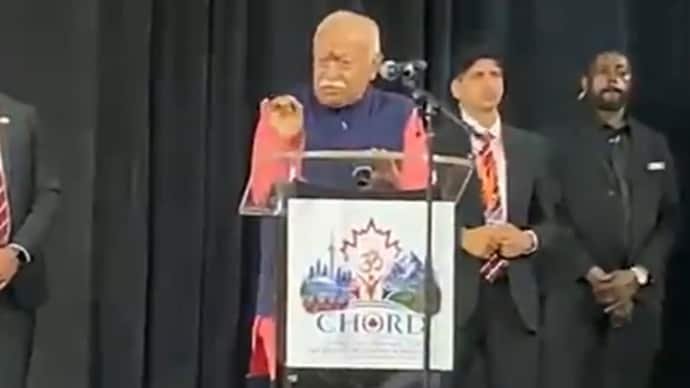
Rashtriya Swayamsevak Sangh (RSS) chief Mohan Bhagwat used a large gathering of the Indian diaspora in Toronto to present a vision of India’s rise based not primarily on economic or military power, but on service to humanity, cultural confidence and the ability to embrace diversity.
Speaking at the Hindu Vishwa Bandhu – Embrace the World in Friendship event, Bhagwat argued that India’s civilisational influence should be measured by what it contributes to humanity. He invoked the idea of Vasudhaiva Kutumbakam, or the belief that the world is one family, and described helping others as a longstanding feature of what he called the “DNA of Bharat.”
“If Hindus awaken, the world awakens,” Bhagwat said, linking what he described as Hindu civilisational values with a broader message of human unity.
His remarks came during an overseas visit that has attracted considerable attention. Before reaching Canada, Bhagwat’s appearance in New York generated protests and criticism over the RSS’s ideology and its record in debates surrounding religious pluralism in India. In Toronto, however, the emphasis of his public address was on friendship, service, diversity and India’s role in the wider world.
Bhagwat says India’s rise should mean more than becoming a superpower
One of the central themes of Bhagwat’s Toronto speech was his distinction between becoming a powerful country and becoming a source of wider human progress.
He argued that India’s rise should not be judged simply by whether it becomes a “Mahashakti”, or great power. Instead, he presented the idea of India becoming a Vishwaguru, or “world teacher”, through its conduct and service to others.
“One may call Bharat a superpower at that time, but it was not a superpower. It served the world,” Bhagwat said, arguing that India’s civilisational character had historically been associated with service rather than domination.
He connected that argument to a broader definition of national development. In this framing, India’s success would not end with stronger economic output, military capabilities or greater geopolitical influence. Its rise would also be reflected in whether it helped create what Bhagwat described as a more united and emancipated humanity.
That distinction is important because India’s growing international profile is increasingly discussed in conventional measures of national power. Economic expansion, technological capabilities, defence strength and diplomatic influence are often used to assess India’s emergence as a major global power.
Bhagwat’s message offered a different measurement: the value of India’s rise should ultimately be seen in what it gives to the world.
What Bhagwat meant by the “DNA of Bharat”
Bhagwat repeatedly returned to the idea of service as a defining characteristic of India’s civilisational outlook.
He said that when India has been asked to help in different parts of the world, its tradition has been to extend assistance rather than turn away. He described this as the “DNA of Bharat” and connected it to his statement that the awakening of Hindus would have implications beyond India.
The language was directed primarily at the Hindu diaspora, but the broader message was framed around humanity rather than a single community.
Bhagwat argued that India’s civilisational philosophy encourages people to recognize a shared humanity despite differences in physical appearance, background and identity.
That idea was expressed through the concept of Vasudhaiva Kutumbakam, a Sanskrit expression commonly translated as “the world is one family.” Bhagwat presented it as an approach that encourages people to look beyond visible differences and recognize an underlying unity.
For a diaspora audience in Canada, the message also carried a practical dimension. Indian communities abroad often maintain strong cultural connections with India while participating fully in the societies where they live. Bhagwat’s emphasis on global friendship placed that diaspora identity within a wider vision of cultural exchange and service.
Why diversity was central to Bhagwat’s Toronto message
Another major part of the speech concerned the relationship between diversity and unity.
Bhagwat argued that differences should not automatically be viewed as threats to social cohesion. Instead, he said India’s traditional outlook regards diversity as part of a larger unity.
“They have been taught to see unity in diversity,” he said, adding that diversity itself can be understood as a form of unity.
That argument is particularly relevant in a country such as India, where religion, language, ethnicity, region and cultural practices vary considerably across communities.
Bhagwat’s formulation turns the usual question of how to manage diversity into a different proposition: diversity does not necessarily need to be reduced in order for unity to exist.
He also extended the concept beyond human communities, describing an outlook in which both animate and inanimate elements are regarded as connected. The underlying message was that social harmony depends on recognizing relationships rather than focusing exclusively on differences.
Vasudhaiva Kutumbakam as the wider theme
The phrase Vasudhaiva Kutumbakam was central to the event’s broader message.
Rather than presenting Indian culture only as a national identity, Bhagwat used the concept to describe an outward-looking philosophy. If the world is understood as one family, then service to others becomes a responsibility rather than merely an act of charity.
Bhagwat said people who are open-minded and knowledgeable embrace this idea because, despite differences in physical form and appearance, humanity shares a deeper commonality.
The concept has become a familiar part of India’s cultural and diplomatic vocabulary, particularly when India seeks to emphasize cooperation and its civilisational traditions on international platforms.
In Toronto, however, Bhagwat placed the idea within the activities and identity of the Hindu diaspora, presenting it as a principle that could shape how Indian-origin communities relate to the societies around them.
Bhagwat’s account of India’s historical outreach
Bhagwat also offered a historical narrative to illustrate his argument that India’s influence was traditionally associated with knowledge-sharing rather than territorial conquest.
He referred to journeys by India’s ancestors across large parts of Asia and other regions, arguing that they travelled without the modern infrastructure available today.
He cited destinations ranging from china, Siberia and Mongolia to Southeast Asia and referred to journeys reaching as far as Mexico. His central point was that these travels, as he described them, were about sharing knowledge and cultural traditions rather than conquering countries or forcing conversions.
“They conquered no country; they converted nobody,” he said.
The historical examples served a clear purpose in the speech: they reinforced Bhagwat’s argument that India’s civilisational influence should be understood differently from conventional imperial power.
Rather than measuring influence by territory controlled, he presented knowledge, culture and service as alternative forms of influence.
Toronto gathering highlights the Canadian Hindu diaspora
The Toronto event also demonstrated the organizational strength of the Canadian Hindu community.
The programme was organised by Canadian Hindus for Outreach, Relations and Dialogue, or CHORD. Organiser Naresh Chavda said more than 2,500 people from eight Canadian provinces attended the gathering.
The event brought together members of the diaspora as well as Canadian public figures. Former Canadian Defence Minister and former Alberta Premier Jason Kenney also addressed the gathering.
Kenney welcomed what he described as renewed momentum in Canada-India relations and referred to Prime Minister Narendra Modi’s expected visit to Canada later this year.
His comments drew enthusiastic reactions from the audience, including chants of “Modi, Modi”.
The presence of a prominent Canadian political figure alongside the RSS chief gave the event a dimension beyond its cultural and religious themes. It also reflected the broader effort among parts of the Indian diaspora to strengthen public engagement between Canada and India.
Why Canada-India relations matter to the diaspora
The Toronto gathering comes against the backdrop of an important period in Canada-India relations.
For the Indian diaspora, relations between the two countries have significance beyond formal Diplomacy. Canada has a large population of people of Indian origin, making developments in bilateral relations relevant to families, businesses, students, professionals and community organizations.
A renewed political relationship can affect cooperation in areas including trade, education, investment, migration and security.
That explains why references to a future Modi visit received such a strong response at the Toronto gathering. For many members of the diaspora, the relationship is not an abstract foreign-policy issue. It intersects directly with their family, cultural and economic connections to India.
Bhagwat’s Canada message follows controversy in New York
The Toronto appearance also needs to be viewed alongside the controversy surrounding Bhagwat’s visit to the United States.
His planned appearance at Madison Square Garden in New York prompted protests from interfaith and civil rights organizations. New York Mayor Zohran Mamdani publicly opposed the event, arguing that the RSS’s ideology was exclusionary and inconsistent with the pluralistic vision of India he supports.
The RSS is closely associated ideologically with the Bharatiya Janata Party, India’s ruling party, and has long been a subject of debate over nationalism, religious identity and minority rights.
Critics of the organization have accused it and affiliated groups of contributing to an environment hostile to religious minorities. The RSS rejects such characterizations and describes itself as a cultural organization dedicated to Hindu society and national unity.
The US Commission on International Religious Freedom also called for action against RSS members and urged the Trump administration to consider revoking Bhagwat’s US visa. India rejected the commission’s criticism, with the Ministry of External Affairs describing USCIRF as biased and lacking credibility. :contentReference[oaicite:0]{index=0}
Despite the controversy, Bhagwat’s New York programme proceeded. His Toronto speech subsequently placed greater emphasis on universal human values, friendship and unity in diversity.
The significance of the contrasting messages
The contrast between the controversy surrounding Bhagwat’s US visit and the themes emphasized in Toronto is notable.
In New York, the debate focused heavily on the political and ideological identity of the RSS. Critics questioned whether the organization represents an inclusive interpretation of Indian identity, while supporters argued that criticism of the RSS unfairly targets Hindu cultural expression.
In Toronto, Bhagwat emphasized a different aspect of the organization’s worldview: service, cultural confidence and the idea that differences can coexist within a larger unity.
That does not eliminate the political debate surrounding the RSS. Instead, it highlights the different ways Bhagwat’s message is being received and presented internationally.
For supporters, the Toronto speech reinforces the idea that Hindu civilisational thought is fundamentally universal and outward-looking. For critics, questions about how those principles translate into political and social practice remain unresolved.
A message aimed at both identity and responsibility
Bhagwat’s speech can also be understood as an attempt to connect cultural identity with responsibility.
He did not frame the awakening of Hindus simply as a matter of asserting identity. Instead, he linked it to service and the welfare of humanity.
That distinction was visible throughout his remarks. The central question was not simply what Hindus should preserve, but what they should contribute.
For the Indian diaspora, this can be interpreted as an appeal to maintain cultural roots while remaining engaged with wider society.
The emphasis on friendship also fits the setting. The event was held in Canada, a multicultural country where diaspora communities maintain distinct cultural traditions while participating in a shared civic environment.
What Bhagwat’s “Vishwaguru” idea means in practice
The idea of India as a Vishwaguru is often used in discussions about India’s growing global influence, but Bhagwat’s Toronto remarks gave the concept a particular definition.
He did not describe it primarily as political dominance. Instead, he linked it to the ability to help others, share knowledge and promote a more united humanity.
That approach differs from the conventional definition of a global power, where influence is usually associated with economic size, military strength and diplomatic reach.
Bhagwat’s argument is that those capabilities alone do not determine the quality of a country’s rise.
Under his formulation, a stronger India would also have a responsibility to use its capabilities in ways that benefit others.
What the Toronto speech signals for India’s global cultural outreach
The Toronto event illustrates how India’s global engagement increasingly involves culture and diaspora communities alongside conventional diplomacy.
Indian-origin communities in North America can serve as bridges between India and their adopted countries, creating networks that extend across business, politics, education, culture and civil society.
Bhagwat’s message was directed at one part of that wider diaspora ecosystem, but its themes were deliberately global. Service, friendship and unity in diversity are concepts designed to travel beyond India’s borders.
The challenge for any such message is translating broad principles into everyday conduct. A philosophy of global friendship ultimately becomes meaningful when communities apply it through social engagement, humanitarian work and respect for differences.
The bigger message from Toronto
Mohan Bhagwat’s Toronto address was ultimately an argument about what India’s rise should represent.
He presented India not merely as a country seeking greater power, but as a civilisation whose influence should be measured by service, knowledge-sharing and its ability to recognize unity within diversity.
His repeated references to Vasudhaiva Kutumbakam and the “DNA of Bharat” were aimed at connecting the Hindu diaspora with a broader idea of India’s role in the world.
The message also came at a politically sensitive moment. His US visit had generated sharp criticism from opponents of the RSS, while supporters rallied around his appearance and rejected accusations that the organization represents exclusion.
Against that backdrop, the Toronto speech placed the spotlight on the more universal language of Bhagwat’s worldview: friendship instead of confrontation, service instead of dominance, and diversity as part of unity.
Whether that vision becomes a broader feature of India’s global cultural influence will depend not only on speeches but on how communities, institutions and governments translate those principles into practice.
For the thousands gathered in Toronto, however, the message was clear. Bhagwat argued that India’s awakening should not be understood simply as the rise of another powerful nation. In his telling, its real significance would lie in whether that rise helps create a more connected and humane world.
For breaking news and live news updates, like us on Facebook or follow us on Twitter and Instagram. Read more on Latest World on thefoxdaily.com.






COMMENTS 0