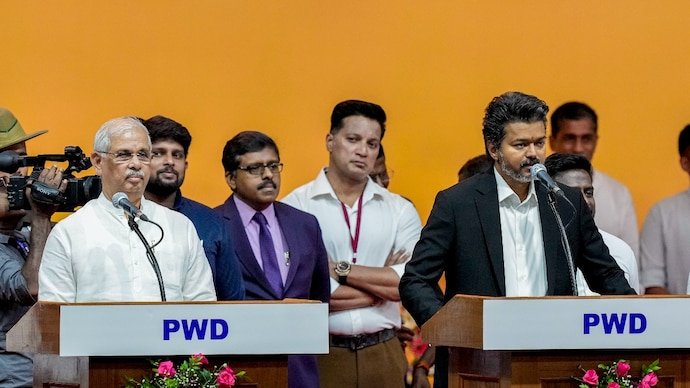
- What Exactly Happened at Vijay’s Swearing-In Ceremony?
- Why Tamil Thaai Vaazhthu Holds Special Importance in Tamil Nadu
- Why the Order of Songs Became So Controversial
- Why Vande Mataram Remains Politically Sensitive in Tamil Nadu
- The BJP Angle: Why Opponents Targeted Vijay
- TVK’s Damage Control and the Governor Controversy
- The Larger Federalism Debate Behind the Controversy
- How Previous Governors Triggered Similar Clashes
- Why This Issue Resonates Emotionally With Tamils
- What the New Union Government Circular Says
- Why Vijay’s Government Faces a Delicate Political Challenge
- The Real Reason the Controversy Matters
- Conclusion
The swearing-in ceremony of Tamil actor-turned-politician C Joseph Vijay as Chief Minister of Tamil Nadu was expected to mark the beginning of a new political chapter in the state. Instead, one ceremonial decision quickly overshadowed the event and triggered a fierce political Controversy.
At the centre of the uproar was the order in which songs were played during the official ceremony in Chennai. Traditionally, Tamil Nadu government events begin with Tamil Thaai Vaazhthu the invocation song honouring Mother Tamil and conclude with the Indian national anthem, Jana Gana Mana.
But during Vijay’s swearing-in at Chennai’s Jawaharlal Nehru Indoor Stadium, the sequence changed dramatically. Vande Mataram was played first, followed by the national anthem, while Tamil Thaai Vaazhthu was rendered third.
That single change unleashed sharp criticism from opposition parties, Tamil nationalist groups and even allies supporting Vijay’s government, exposing how deeply cultural symbolism and language politics remain embedded in Tamil Nadu’s political identity.
What Exactly Happened at Vijay’s Swearing-In Ceremony?
The controversy began almost immediately after the ceremony started.
Instead of following Tamil Nadu’s decades-old protocol, the programme reportedly followed this sequence:
| Order at Ceremony | Song Played |
|---|---|
| First | Vande Mataram |
| Second | Jana Gana Mana (National Anthem) |
| Third | Tamil Thaai Vaazhthu |
For many in Tamil Nadu, the issue was not merely procedural. It was interpreted as a symbolic downgrading of Tamil identity during an official state function.
Critics argued that Tamil Thaai Vaazhthu is not just another ceremonial song in the state. It carries deep emotional, linguistic and political significance.
Why Tamil Thaai Vaazhthu Holds Special Importance in Tamil Nadu
Tamil Thaai Vaazhthu occupies a unique position in Tamil Nadu’s public and political culture.
The song begins with the words “Neerarum Kadaludutha…” and originates from Manonmaniam, a famous Tamil literary work written by scholar P Sundaram Pillai.
Since 1970, Tamil Nadu governments have followed the practice of beginning official state functions, educational events and public programmes with the song.
In 2021, the DMK government under MK Stalin officially declared Tamil Thaai Vaazhthu the State Song of Tamil Nadu.
For many Tamils, the song symbolises:
- Tamil linguistic pride
- Cultural identity
- Regional autonomy
- Resistance to cultural homogenisation
- The preservation of Tamil heritage
That is why altering its ceremonial position immediately became politically sensitive.
Why the Order of Songs Became So Controversial
Outside Tamil Nadu, the debate may appear minor or symbolic. Inside the state, however, the order of ceremonial songs carries historical and political meaning.
The controversy touches upon a larger ideological Conflict that has shaped Tamil Nadu Politics for decades:
- Regional identity versus centralisation
- Federalism versus perceived cultural uniformity
- Tamil linguistic pride versus Hindi-Hindu nationalist narratives
Many critics viewed the decision to place Vande Mataram before Tamil Thaai Vaazhthu as a departure from Tamil Nadu’s established political culture.
The fact that the national anthem was also played before Tamil Thaai Vaazhthu intensified the backlash.
Why Vande Mataram Remains Politically Sensitive in Tamil Nadu
One major reason the controversy escalated is the historical debate surrounding Vande Mataram itself.
While the song is widely respected nationally, several political groups especially in South India have long argued that parts of it contain religious imagery that may not represent all communities equally.
Left parties and Dravidian groups in Tamil Nadu have historically maintained distance from attempts to elevate Vande Mataram to a compulsory patriotic symbol.
CPI state secretary M Veerapandian strongly criticised the sequence at Vijay’s ceremony, arguing that Vande Mataram had historically not been adopted as India’s national anthem because of its “sectarian religious character”.
That statement reflects a broader ideological position long associated with Tamil Nadu’s Dravidian political tradition.
The BJP Angle: Why Opponents Targeted Vijay
The controversy quickly acquired a national political dimension.
DMK leaders accused Vijay’s government of moving closer to the BJP and adopting practices aligned with the Union government’s cultural preferences.
DMK spokesperson TKS Elangovan alleged that the Governor had pushed for the altered sequence and claimed it showed Vijay was “going towards the BJP”.
This accusation matters politically because Vijay has carefully attempted to position himself as an independent force in Tamil Nadu politics.
Any perception that he is accommodating BJP-linked cultural narratives could complicate his appeal among voters who strongly identify with Tamil regional politics.
TVK’s Damage Control and the Governor Controversy
Facing growing backlash, the ruling Tamilaga Vettri Kazhagam (TVK) moved quickly to distance itself from the decision.
TVK leader Aadhav Arjuna publicly stated that the party did not support Tamil Thaai Vaazhthu being pushed to third place.
According to his explanation, Raj Bhavan informed the government that a new Union government circular required a different ceremonial format.
The statement was politically significant because it attempted to:
- Protect Vijay from criticism
- Shift responsibility to the Governor’s office
- Reassure Tamil nationalist sentiments
- Preserve TVK’s regional identity credentials
Arjuna also promised that future state events would revert to the traditional Tamil Nadu format.
The Larger Federalism Debate Behind the Controversy
This controversy is not happening in isolation.
It is part of a much larger and ongoing political struggle between Tamil Nadu and the Centre over issues including:
- Language policy
- NEET examinations
- Governor-state relations
- Education control
- Cultural identity
- Federal autonomy
In Tamil Nadu, cultural symbols often become political battlegrounds because they are seen as expressions of state identity.
That is why even ceremonial decisions can generate major political reactions.
How Previous Governors Triggered Similar Clashes
The current controversy also revives memories of repeated confrontations involving former Tamil Nadu Governor RN Ravi.
In both 2024 and 2025, Ravi walked out of Assembly sessions alleging disrespect to the national anthem because Tamil Thaai Vaazhthu was sung before proceedings.
The DMK government countered by arguing that Tamil Nadu had always followed its own established protocol:
- Tamil Thaai Vaazhthu at the beginning
- National anthem at the conclusion
Those disputes became symbolic of the broader tensions between Tamil Nadu’s regional political culture and the Centre’s approach to national symbolism.
Why This Issue Resonates Emotionally With Tamils
For many people in Tamil Nadu, Tamil is not viewed merely as a language.
It is tied to:
- Identity
- History
- Civilisational pride
- Literary heritage
- Political self-respect
This emotional connection explains why changes involving Tamil symbols often trigger unusually strong reactions.
To many critics, playing Tamil Thaai Vaazhthu third at the swearing-in ceremony symbolically suggested that Tamil identity had been subordinated within its own state.
Whether intentional or not, perception became politically more important than protocol.
What the New Union Government Circular Says
The controversy also drew attention to new guidelines reportedly issued earlier this year regarding ceremonial practices at official events.
According to reports, the guidelines recommended that when both Vande Mataram and Jana Gana Mana are played, Vande Mataram should precede the national anthem.
However, critics argue that the circular did not specifically require Tamil Thaai Vaazhthu to be moved after both songs during state functions.
This grey area has now become a fresh source of political friction.
Why Vijay’s Government Faces a Delicate Political Challenge
The incident presents an early political test for Vijay’s administration.
His party must now balance:
- Tamil regional identity
- Coalition management
- Relations with the Governor
- National political optics
- Administrative protocol
The controversy also reveals how closely Vijay’s every political move will be scrutinised as he transitions from cinema superstar to full-time political leader.
Unlike film narratives, political symbolism in Tamil Nadu often carries long-term consequences.
The Real Reason the Controversy Matters
At its core, the uproar is not simply about the order of songs.
It reflects a deeper question that continues shaping Tamil Nadu politics:
Who gets to define Tamil Nadu’s identity the state itself or national institutions?
That tension has existed for decades and continues resurfacing through issues involving language, education, culture and constitutional practices.
The swearing-in ceremony became the latest flashpoint because symbols often carry political meaning far beyond their ceremonial purpose.
Conclusion
The controversy surrounding Tamil Thaai Vaazhthu at Vijay’s swearing-in ceremony highlights how deeply questions of identity, federalism and cultural symbolism remain intertwined in Tamil Nadu politics.
What may appear elsewhere as a simple procedural issue quickly became a statewide debate involving history, constitutional traditions, language pride and political alignment.
For Vijay’s newly formed government, the episode serves as an early reminder that in Tamil Nadu, symbolism matters immensely and even the order of songs can reshape political narratives overnight.
As the state moves forward under a new administration, the debate also underscores a larger reality: Tamil Nadu’s political culture continues to fiercely protect its linguistic and regional identity, regardless of who occupies power.
For breaking news and live news updates, like us on Facebook or follow us on Twitter and Instagram. Read more on Latest India on thefoxdaily.com.






COMMENTS 0