
What began as a casual attempt at humour on Social Media quickly transformed into a large-scale public debate about dignity, empathy, and how society views different kinds of work.
An X user operating under the name “Gabbar” sparked outrage after posting a photograph of a lift operator alongside the caption: “Is this the dumbest job in the world?” followed by a laughing emoji.
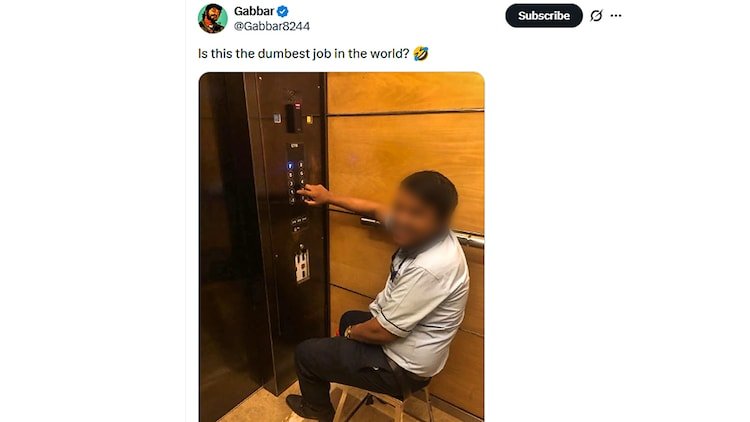
Instead of receiving support or amusement, the post triggered a fierce backlash.
Within hours, thousands of users began criticising the remark as elitist, insensitive, and deeply disrespectful toward someone earning an honest living.
The Controversy rapidly gained traction across X, where the post eventually crossed millions of views and evolved into a much larger conversation about job-shaming in the age of viral social media.
Why the Internet Reacted So Strongly
The overwhelming public reaction reflected a growing frustration with online behaviour that mocks ordinary workers for Entertainment or engagement.
Many users argued that the problem was not the lift operator’s job, but the attitude behind ridiculing someone performing honest labour.
One of the most widely shared responses pointed out that people WHO work to support themselves and their families deserve dignity regardless of profession.
Another user delivered an especially sharp rebuttal, suggesting that posting insulting content online for attention was far more meaningless than operating a lift.
The exchange highlighted a broader shift in online culture where audiences increasingly push back against content perceived as punching down at working-class individuals.
In many ways, the backlash became less about elevators and more about social respect.
The Debate Over “Dignity of Labour”

The phrase “dignity of labour” repeatedly appeared throughout the online discussion.
The concept refers to the belief that all forms of honest work deserve respect, regardless of status, salary, or social prestige.
While the idea sounds simple, modern social media often exposes how unevenly society applies that principle.
Jobs involving manual assistance, maintenance, sanitation, delivery, or public-facing service are frequently undervalued despite being essential to daily urban life.
The viral debate revealed how quickly people react when someone appears to publicly humiliate workers in these professions.
Several commenters stressed that financial survival itself gives value to work.
As one user wrote:
“When hunger hits, that is when we realise no work is small or big.”
The comment resonated widely because it reflected a reality millions understand firsthand.
Why Lift Operators Still Exist in Many Indian Buildings
One reason the original post drew criticism was because many people felt it ignored the practical realities behind employing lift operators.
While modern malls and commercial buildings increasingly use automated systems, lift operators continue to serve important functions in many parts of India.
Their responsibilities often include:
- Assisting elderly residents
- Helping children and families
- Managing crowd flow
- Preventing misuse of elevators
- Handling emergencies
- Protecting older lift systems from damage
In older residential complexes especially, elevators may require more careful handling because repairs can be expensive and technically difficult.
Some users pointed out that maintenance costs for ageing lift systems can run into lakhs annually.
Hiring an operator, therefore, may actually reduce overall building expenses by preventing overloading and misuse.
| Role of Lift Operators | Practical Benefit |
|---|---|
| Managing passenger flow | Reduces overcrowding |
| Assisting elderly people | Improves accessibility |
| Monitoring lift usage | Prevents misuse and damage |
| Emergency assistance | Improves safety response |
| Handling older systems | Reduces maintenance risks |
To many users, dismissing the role as “dumb” reflected ignorance about how shared public Infrastructure actually functions.
The Viral Kochi Mall Story Changed the Conversation
Among the most influential responses came from an X user named Manasa Manjunath, whose detailed personal experience helped shift the debate beyond simple outrage.
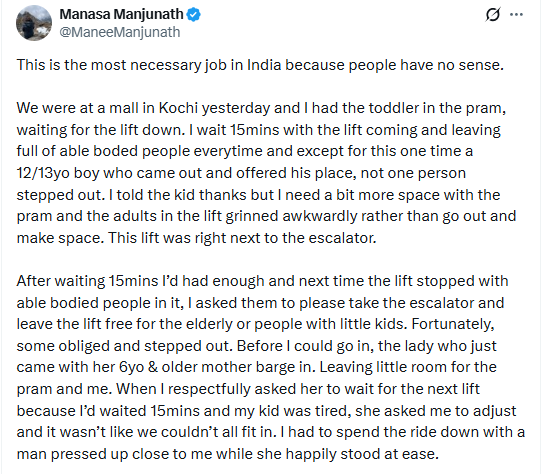
She described struggling to board an elevator at a mall in Kochi while carrying a toddler in a pram.
According to her account, fully able-bodied shoppers repeatedly occupied the lift despite nearby escalators being available.
She reportedly waited around 15 minutes while crowded lifts arrived and departed.
The story resonated because it highlighted a common problem in public spaces: lack of basic civic courtesy.
Manjunath argued that lift operators often help prioritise:
- Elderly passengers
- Parents with infants
- People with disabilities
- Individuals carrying heavy items
Her experience suggested that lift operators sometimes compensate for social behaviour that automated systems cannot regulate.
That perspective transformed the debate from “Is this job necessary?” into “What happens when public courtesy fails?”
Automation Does Not Always Replace Human Roles
The controversy also reopened a wider economic discussion about Automation and labour.
Critics of jobs like lift operation often assume automation automatically makes human involvement obsolete.
But economists and urban planners frequently point out that automation alone does not solve behavioural or operational problems.
Human supervision still matters in many environments where:
- Public discipline is inconsistent
- Infrastructure is old
- Safety risks exist
- Crowd management is necessary
- Accessibility support is required
In developing urban systems especially, many service roles survive not because machines are unavailable, but because human coordination still adds practical value.
Social Media’s Growing Problem With Job-Shaming
The backlash against the viral post reflects a broader cultural shift against job-shaming online.
Over the past decade, social media has created an environment where people increasingly turn workers into viral content without consent.
Delivery drivers, cleaners, Security guards, cashiers, and public workers are frequently photographed or recorded for:
- Humour
- Class commentary
- Viral engagement
- Public ridicule
Critics argue this behaviour often reveals hidden class biases.
Workers performing essential but low-visibility jobs become targets precisely because society tends to overlook them until someone turns them into content.
In this case, many users felt the lift operator became an unwilling symbol of a larger issue: the tendency to mock people whose work appears ordinary or repetitive.
The Psychological Impact of Public Ridicule
Public humiliation online can carry real emotional consequences, especially for workers who lack social influence or digital visibility.
Unlike celebrities or influencers, ordinary workers usually cannot control how viral narratives about them spread.
Social psychologists note that viral ridicule often reinforces:
- Class insecurity
- Workplace shame
- Social exclusion
- Loss of self-respect
Many users defending the lift operator appeared motivated not only by sympathy but by recognition that anyone performing ordinary labour could become tomorrow’s viral target.
India’s Complicated Relationship With Service Work
The debate also exposed deeper tensions in India’s relationship with service labour.
India’s urban Economy depends heavily on workers performing roles that keep daily life functioning smoothly:
- Drivers
- Housekeeping staff
- Security guards
- Maintenance workers
- Delivery personnel
- Lift operators
Yet many of these professions remain socially undervalued despite their importance.
The viral backlash suggested growing resistance to that mindset, especially among younger internet users who increasingly view respect for labour as a basic social expectation.
Why the Internet Chose Empathy Over Mockery
Interestingly, the controversy revealed something broader about changing online behaviour.
In earlier phases of social media culture, mocking ordinary workers might have generated more laughter than criticism.
But audiences today often respond differently.
Users increasingly reward:
- Empathy
- Social awareness
- Respectful humour
- Class sensitivity
Meanwhile, content perceived as humiliating ordinary people can quickly backfire.
The response to the lift operator post reflected this cultural evolution.
Rather than laughing at the worker, millions instead questioned why someone earning an honest living should become the subject of ridicule at all.
The Economics Behind “Small Jobs”
One irony highlighted repeatedly during the debate is that many jobs dismissed as “small” are actually critical to urban economic systems.
Service workers often perform low-visibility functions that prevent inconvenience, inefficiency, or safety problems.
Without such roles, cities become significantly harder to manage.
Economists frequently point out that societies tend to notice these workers most when they disappear.
The COVID-19 pandemic reinforced this reality globally.
During lockdowns, professions once considered “ordinary” suddenly became recognised as essential.
The viral debate unintentionally reopened that larger lesson.
Conclusion
The backlash against the viral X post mocking a lift operator became about far more than elevators or social media outrage.
It evolved into a broader conversation about dignity, class attitudes, empathy, and the hidden value of everyday work.
For thousands of users, the issue was simple: no honest profession deserves public humiliation.
The lift operator at the centre of the controversy may never have expected to become part of a nationwide debate, but the overwhelming public response sent a clear message.
In an economy where millions work hard in overlooked roles simply to support their families, respect itself remains one of the most meaningful forms of social recognition.
And in the eyes of much of the internet, mocking that effort said far more about the person posting than the worker being mocked.
For breaking news and live news updates, like us on Facebook or follow us on Twitter and Instagram. Read more on Latest India on thefoxdaily.com.




COMMENTS 0