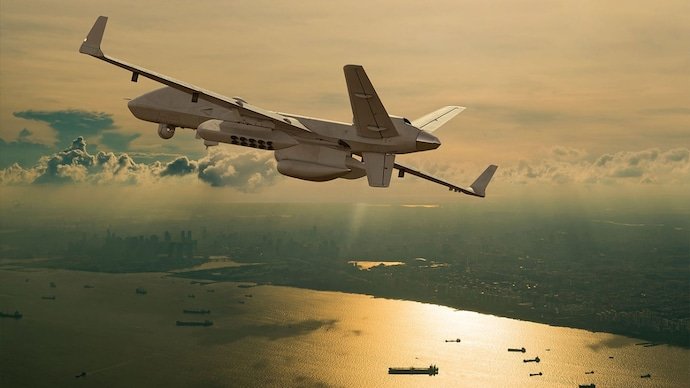
India has chosen to rent before it buys. The Ministry of Defence has signed a Rs 1,943-crore contract with US defence company General Atomics Aeronautical Systems to lease two MQ-9B Sea Guardian remotely piloted aircraft systems to the Indian Navy for 30 months.
At first glance, spending nearly Rs 2,000 crore on two leased drones may seem unusual, particularly because India has already signed a much larger deal to acquire 31 MQ-9B aircraft. But the logic is straightforward: the Navy needs the surveillance capability now, while the drones it has purchased will take years to arrive.
The new lease is therefore less about replacing India’s long-term acquisition plan and more about preventing a capability gap. The 30-month arrangement is expected to bridge the period between the Navy’s existing Sea Guardian experience and the arrival of the MQ-9B fleet ordered in 2024.
That makes the latest contract an important example of how leasing can be used in defence procurement when operational requirements move faster than traditional acquisition timelines.
Why India is leasing Sea Guardian drones again
The simplest explanation is timing.
India signed a roughly Rs 32,000-crore agreement with the United States in October 2024 for 31 MQ-9B drones. Of these, 15 are intended for the Indian Navy in the Sea Guardian configuration, while the Army and Indian Air Force are to receive 16 Sky Guardians between them.
Those aircraft represent the long-term solution. They are intended to provide India with a much larger fleet of high-altitude, long-endurance unmanned aircraft for surveillance and other missions.
The problem is that major defence purchases do not translate into immediate operational availability. Manufacturing, configuration, training, Infrastructure and other elements of a complex acquisition programme take time.
The Navy therefore faces a practical question: what does it do during the waiting period?
Leasing provides one answer.
Instead of waiting for the newly purchased aircraft, the Navy can continue operating a platform it already knows and use the interim period to maintain surveillance coverage, train personnel and develop operational experience.
In that sense, the new lease is not really a competing purchase decision. It is a bridge to the larger acquisition.
India has used leased Sea Guardians since 2020
This is also not India’s first experience with the MQ-9B Sea Guardian.
The Indian Navy inducted two Sea Guardians on lease in November 2020, during the military confrontation with china following the Galwan Valley clash. The aircraft were brought in under emergency procurement arrangements to strengthen India’s long-range surveillance capability.
The timing was significant. The Navy needed additional intelligence, surveillance and reconnaissance, or ISR, capacity without waiting for a conventional procurement programme to run its full course.
The leased drones subsequently became part of India’s broader surveillance architecture. Defence-related government material has noted that the two leased Sea Guardians were used extensively and had accumulated thousands of flying hours.
The experience also gave the Indian military an opportunity to understand how a high-altitude, long-endurance unmanned platform could complement crewed surveillance aircraft and other intelligence assets.
That operational experience matters when deciding whether to purchase a much larger fleet. India is not buying the MQ-9B entirely as an untested concept. Its Navy has already spent years operating the platform.
What makes the MQ-9B Sea Guardian different?
The Sea Guardian is the maritime-focused version of General Atomics’ MQ-9B family. It is designed for persistent intelligence, surveillance and reconnaissance over large distances, particularly in the maritime environment.
Its most important advantage is endurance.
General Atomics says the Sea Guardian is designed to fly beyond the horizon using satellite communications and can remain airborne for more than 30 hours, depending on configuration. Its mission equipment can include maritime surveillance radar, electro-optical and infrared sensors, automatic identification system capabilities and electronic support equipment.
That endurance changes how surveillance can be conducted.
A conventional crewed aircraft has to balance the duration of a mission against the physical limitations of its aircrew. A remotely piloted aircraft can remain on station for extended periods without placing an aircrew inside the aircraft.
For a country responsible for monitoring a huge maritime area, that persistence can be particularly valuable.
The Indian Ocean is the real reason endurance matters
India’s maritime surveillance challenge is not limited to the waters immediately surrounding its coastline.
The Indian Ocean Region includes major shipping routes connecting the Middle East, Africa and Asia. Commercial vessels, energy shipments, fishing activity and naval deployments move across an enormous area, while strategically important passages connect the Indian Ocean with other maritime regions.
Monitoring such a space requires a network of satellites, ships, coastal systems, submarines, crewed aircraft and unmanned platforms rather than one type of sensor.
The Sea Guardian can serve as one of the persistent airborne layers in that network.
Its value is not simply that it can see far away. The more important advantage is the ability to remain over an area for a long period, observe contacts and provide information to commanders without repeatedly cycling an aircraft back to base.
General Atomics describes the aircraft as capable of conducting long-range maritime ISR and integrating multiple maritime sensors. Depending on the configuration, the platform can also support anti-submarine warfare missions.
Sea Guardian can also contribute to submarine surveillance
One of the more technically interesting aspects of the MQ-9B family is its potential role in anti-submarine warfare.
General Atomics has demonstrated a Sea Guardian configuration capable of deploying and monitoring sonobuoys, which are expendable underwater acoustic sensors used to detect and track submarines.
In 2025, the company announced tests in which an MQ-9B Sea Guardian deployed anti-submarine sensors through sonobuoy dispensing systems and processed acoustic information from those sensors.
This does not mean every Sea Guardian operated by every customer automatically has the same anti-submarine configuration. Mission equipment depends on the customer’s requirements and configuration.
But the technology illustrates why the platform has attracted interest from maritime forces. The aircraft can potentially combine long endurance with wide-area surface surveillance and underwater sensing, creating a much broader picture of activity at sea.
For the Indian Navy, that is particularly relevant because maritime domain awareness is increasingly about detecting what is happening both on and beneath the surface.
Why leasing can make sense for military equipment
Military leasing is not quite the same as renting a commercial car or house.
Defence equipment has to be integrated into command networks, operated by trained personnel and supported with maintenance, logistics and mission infrastructure. Nevertheless, leasing can provide a faster route to an operational capability than a new procurement programme.
India formally incorporated leasing into its defence acquisition framework in recent years, providing the armed forces with another option when an immediate requirement exists.
The biggest advantage is speed.
A conventional acquisition can involve the statement of requirements, approvals, technical evaluation, commercial negotiations, contract finalisation, production and delivery. Even after a contract is signed, complex military systems may take years to enter service in meaningful numbers.
A lease can shorten that timeline when the supplier already has the equipment and support structure available.
There is another advantage: operational experience.
India’s earlier Sea Guardian lease allowed the Navy to operate the platform before committing to a large purchase. That experience can inform training, basing, maintenance and mission planning for the larger fleet.
The maintenance question is another reason to lease
Another attraction of leasing is that some support responsibilities can remain closely tied to the supplier.
That can be particularly useful with sophisticated unmanned aircraft, where availability depends not only on the airframe but also on sensors, ground control systems, communications equipment, software and specialist maintenance.
India’s earlier leased Sea Guardians provided a practical example of this arrangement. In September 2024, one of the leased aircraft was lost at sea following a technical problem, and General Atomics supplied a replacement at no additional cost, according to reporting on the incident.
Such arrangements can reduce some of the operational risk associated with maintaining a small interim fleet.
For the Navy, the objective is not simply to possess two aircraft. It is to maintain a functioning surveillance capability. If the supplier carries significant responsibility for equipment availability, the military can focus more directly on operations while the larger acquisition programme progresses.
The 2024 purchase is the long-term plan
The new lease should not be mistaken for a substitute for India’s MQ-9B purchase.
The October 2024 agreement covers 31 aircraft and represents a major expansion of India’s unmanned surveillance capability. Fifteen Sea Guardians are earmarked for the Navy, while 16 Sky Guardians are intended for the Army and Air Force.
The deal also included arrangements for maintenance, repair and overhaul capability in India, an important element when operating a sizeable fleet over many years.
The difference between the two arrangements is therefore clear:
| Arrangement | Purpose | Time horizon |
|---|---|---|
| Two Sea Guardians on new lease | Maintain and strengthen near-term Navy surveillance capability | 30 months |
| 31 MQ-9B aircraft purchased in 2024 | Build India’s larger long-term unmanned surveillance fleet | Long-term |
The 30-month lease is particularly significant because it extends into the period when deliveries from the 2024 purchase are expected to begin. That makes the arrangement look less like a new strategic direction and more like a carefully timed capability bridge.
Why two more drones matter when India is buying 31
It may seem counterintuitive that India needs to lease two aircraft when it is already acquiring 31. But the numbers tell only part of the story.
Thirty-one aircraft arriving over time cannot provide the same immediate capability as 31 aircraft available today. Even a large future fleet does not solve a current surveillance requirement.
The two leased Sea Guardians also preserve continuity.
Personnel can continue gaining experience on the MQ-9B family. Existing operating procedures can remain active. The Navy can continue developing its understanding of how long-endurance unmanned aircraft fit alongside assets such as maritime patrol aircraft and other surveillance systems.
In other words, the lease buys time.
What Sea Guardian brings to India’s maritime surveillance network
The platform should not be viewed as a replacement for India’s crewed maritime patrol aircraft. Its strength is complementarity.
A Sea Guardian can provide persistent airborne surveillance, while larger crewed aircraft can perform missions requiring different sensors, greater onboard capacity or human decision-making directly in the aircraft.
Ships and submarines provide another layer. Satellites offer yet another perspective. Coastal radar networks can monitor approaches close to land.
The real advantage emerges when these systems work together.
For example, a long-endurance unmanned aircraft can identify or maintain surveillance of a vessel of interest for an extended period. Other platforms can then be directed towards the area when closer inspection or a different mission capability is required.
That creates a more efficient use of expensive crewed aircraft and naval vessels, while extending the Navy’s ability to maintain awareness over distant waters.
What the new lease says about India’s defence procurement strategy
There is a broader lesson in India’s decision to lease the Sea Guardians again.
Modern military technology changes quickly, but defence procurement remains necessarily deliberate. Governments have to assess requirements, costs, interoperability, training, industrial support and long-term sustainment before committing large amounts of public money.
Leasing provides a middle path between doing nothing and making an immediate permanent purchase.
In India’s case, the MQ-9B programme shows how the two approaches can work together. The country first used leased aircraft to address an urgent surveillance requirement, gained years of operational experience, then moved towards a major acquisition while continuing to use leasing to cover the transition period.
That does not make leasing inherently cheaper than buying. A lease is a recurring expense and does not provide ownership of the equipment at the end of the arrangement. Its value lies primarily in availability, flexibility and the ability to meet a requirement before a long-term acquisition is ready.
What happens next for the Sea Guardian programme?
The immediate objective is straightforward: keep the Indian Navy’s long-range unmanned surveillance capability strong while the larger MQ-9B fleet moves through its delivery schedule.
The more important test will come when the purchased aircraft begin arriving. India will then have to absorb a substantially larger fleet, including aircraft for all three services, while building the maintenance, training and operational ecosystem needed to use them effectively.
The Navy’s experience with leased Sea Guardians should provide a useful foundation for that transition.
The new 30-month contract therefore has a significance beyond the two aircraft themselves. It is a way of avoiding a surveillance gap at precisely the point when India’s Maritime security responsibilities require persistent awareness across a very large operating area.
For India, the strategy is essentially simple: use the capability available today, while building the fleet required for tomorrow.
That is why the latest Sea Guardian lease matters. The country is not choosing between renting and buying. It is using both to ensure that its watch over the Indian Ocean does not weaken while its long-term drone fleet is still being built and delivered.
For breaking news and live news updates, like us on Facebook or follow us on Twitter and Instagram. Read more on Latest India on thefoxdaily.com.






COMMENTS 0