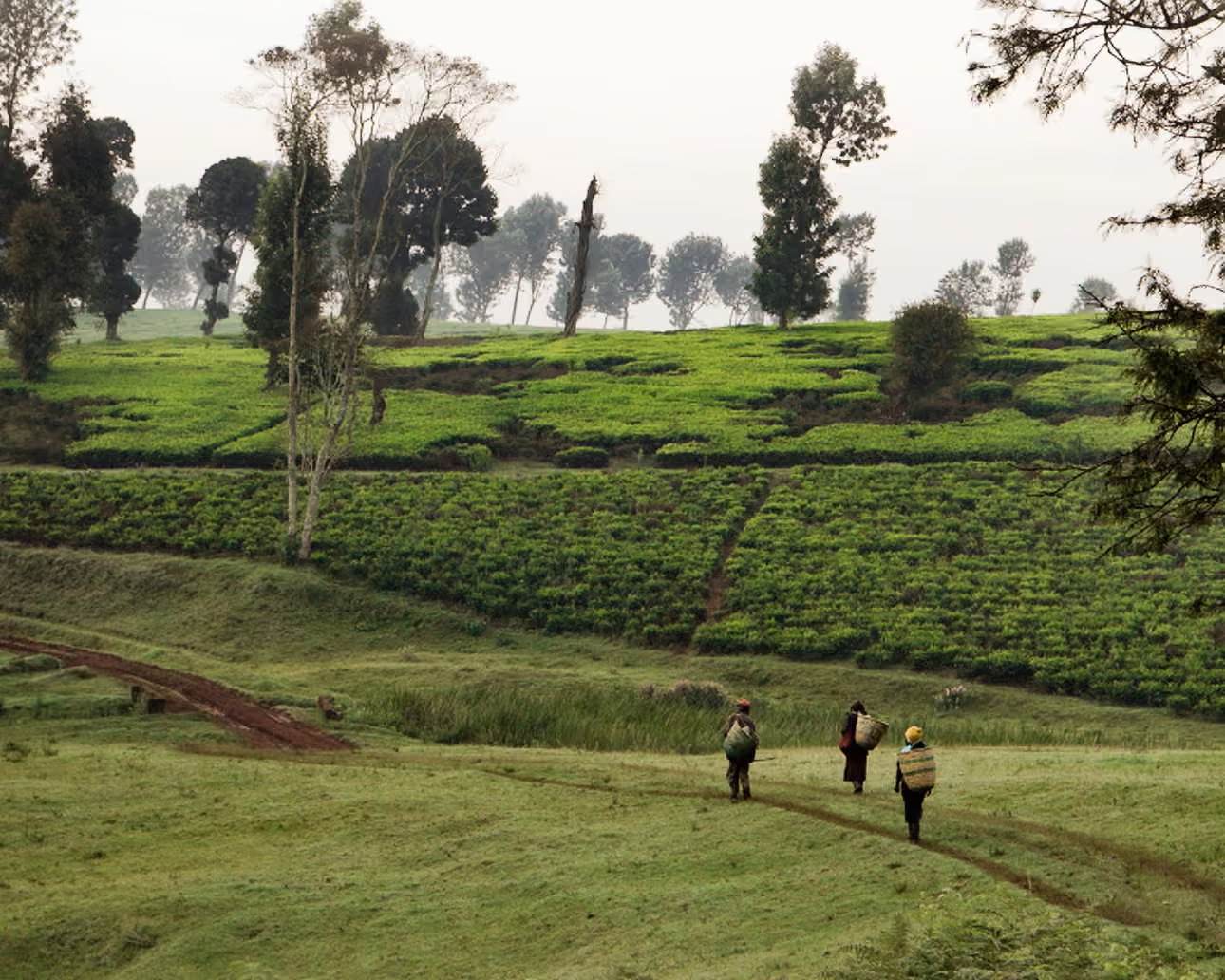
A new documentary is examining one of Kenya’s most enduring legacies of British colonial rule: the loss of ancestral land and the decades-long struggle by displaced communities and their descendants to reclaim it.
Kikuyu Land, directed by Kenyan filmmaker Bea Wangondu and American filmmaker Andrew H Brown, follows a deeply personal investigation into land ownership, Colonial History and the unresolved questions surrounding some of Kenya’s most fertile agricultural regions.
The film centres partly on Wangondu’s search for answers about her own family’s land and the story of a man named Mungai, who is attempting to reclaim land that once belonged to his ancestors. Their journeys lead into the history of the highlands that British colonial authorities transformed into areas dominated by European settlers and large agricultural estates.
The documentary is being released in UK cinemas from 2 October after premiering at the Sundance Film Festival in the United States in January and receiving its UK festival premiere at Sheffield DocFest in June. It is also scheduled to screen at the NBO Film Festival in Nairobi in October.
How Kenya’s ‘White Highlands’ were created
Under British colonial rule, some of the most fertile and agriculturally productive parts of central Kenya were designated for European settlement. The region became known as the “White Highlands”, reflecting a system that privileged white settlers while restricting African communities from land they had traditionally occupied and used.
In 1902, under Sir Charles Eliot, then commissioner of the East Africa Protectorate, Legislation classified vast areas of fertile ancestral land as Crown land. This enabled the colonial administration to sell or lease land to European settlers, encouraging farming and permanent settlement.
The system largely disregarded existing African communal approaches to land ownership. Communities that had lived on and cultivated the land were displaced, with many forced into what became known as native reserves.
These reserves were often more crowded and less productive than the lands taken for European settlement and commercial agriculture. The transformation of the landscape was therefore not simply an agricultural policy. It altered where communities could live, farm and build their economic futures.
Land became central to colonial power
Land ownership was closely connected to the wider structure of colonial rule in Kenya. European settlers gained access to valuable agricultural areas, while African communities faced restrictions on movement, ownership and employment.
The colonial Economy depended heavily on agricultural production, including crops such as tea. The concentration of fertile land in large farms and plantations created an economic structure whose effects continued long after the end of British rule.
Kenya was under British rule from 1895 until independence in 1963, first as a protectorate and later as a colony. The period was marked by racial discrimination, forced displacement, coercive labour practices and violent suppression of resistance.
For families whose ancestors were removed from their land, the consequences did not disappear when colonial rule ended. Questions over who inherited, purchased or retained former colonial estates became part of the complicated Politics of land ownership in independent Kenya.
The unfinished redistribution after independence
As independence approached, the colonial administration began a land redistribution programme intended to transfer farms in the highlands from departing white settlers to landless Kenyans.
The programme, initiated in 1962, was based largely on purchasing land from white settlers who were willing to sell and then reselling it to Kenyan families, often through credit arrangements.
By the time the programme ended in 1971, about 1.15 million acres had reportedly been purchased from 780 white farmers and transferred to approximately 35,000 Kenyan families.
Yet the redistribution did not resolve the country’s wider land question.
Much of the land remained in the hands of political elites and foreign corporate interests, including companies operating large plantations. As a result, independence brought a change in political sovereignty without necessarily reversing every economic and ownership structure established during colonial rule.
That history forms an important part of the context explored in Kikuyu Land.
A filmmaker’s personal search for answers
For Wangondu, the documentary began with a question about her own family.
As a child, she was curious about why her grandfather appeared to have a disproportionately large amount of land compared with neighbouring families. Attempts to obtain clear answers from within the family did not resolve her questions, eventually prompting her to investigate the country’s colonial history herself.
Her professional experience had already given her extensive exposure to international film companies and news organisations. But Kikuyu Land gave her an opportunity to investigate a subject that was directly connected to her own family and identity.
Wangondu has said she wanted Kenyans to tell their own stories in their own voices and according to their own understanding of the history.
She developed the documentary with Brown after the two met while working on a National Geographic production in 2021. What began as an idea about Wangondu’s family eventually expanded into a wider investigation of land, colonialism and the tea industry.
Mungai’s search for ancestral land
A central figure in the documentary is Mungai, whose effort to reclaim his family’s ancestral land becomes another route into Kenya’s colonial past.
His search takes him beyond questions of property documents and legal ownership. It also involves family memory and places where earlier generations lived, worked and were buried.
In one particularly emotional scene, Mungai crouches beneath a tree after his aunt identifies a location where their family patriarch was buried. The spot is now within the boundaries of a tea farm whose land his family is seeking to reclaim.
The moment captures one of the documentary’s central themes: the distance between a family’s memory of its ancestral home and the modern boundaries that now define the land.
For Mungai, the history is not an abstract debate about colonialism. It is connected to the lives of his relatives, the places associated with them and the land that descendants believe was taken from their family.
“They raped our country, they displaced us, they took our land and they did the unfairness they did to us,” Mungai tells Wangondu in the film.
His words reflect the anger and grief that the documentary attempts to place alongside the historical record.
Tea plantations and the legacy of displacement
Tea occupies a particularly important place in Kenya’s land history because the crop became a major part of commercial agriculture in areas where communities had previously lived.
The documentary examines the continuing presence of large tea plantations and the claims of descendants who argue that their ancestors were displaced to make way for agricultural estates.
Among the communities that have sought redress are the Kipsigis and Talai, whose ancestors were forcibly removed from land in the Rift Valley during the colonial period. The land was subsequently used for tea plantations associated with white settlers.
In 2021, United Nations special rapporteurs expressed concern about the British government’s failure to provide what they described as effective remedies and reparations for the two communities.
The issue illustrates how colonial land disputes can extend beyond Kenya’s domestic politics. Questions about restitution can also involve former colonial powers and multinational companies whose modern operations are connected to historical patterns of land ownership.
Why restitution remains difficult
Restitution is complicated by the passage of time and by the multiple transfers of land that have occurred since independence.
Land taken during colonial rule did not remain static. Some properties were sold, redistributed, inherited, consolidated or transferred into corporate ownership. In other cases, new communities settled on land that had previously belonged to different families or groups.
That means modern claims can involve competing histories and legal records, as well as questions about who should receive compensation, land or another form of remedy.
For descendants seeking restitution, however, the passage of decades does not necessarily remove the significance of ancestral dispossession. Family stories, burial sites and memories can preserve a connection to land long after formal ownership has changed.
The emotional weight of colonial history
The filmmakers also describe the emotional impact of hearing stories about people who experienced violence and suffering during the colonial period.
Joseph Njenga, one of the film’s producers, said that listening to accounts of pain and atrocities left a lasting impression on him.
The documentary therefore approaches colonial land history not only as a question of political and economic structures but also as a story about families attempting to understand what happened to previous generations.
For Wangondu, the investigation into her grandfather’s land became a way of examining how colonial history influenced her family’s circumstances and her own understanding of identity.
Brown has argued that the film’s subject extends beyond Kenya because colonial systems created patterns of land ownership, labour and political power whose effects can still be seen in different parts of the world.
From colonial estates to multinational companies
The modern presence of multinational tea companies adds another dimension to the restitution debate.
Some of the land once incorporated into colonial agricultural estates is now associated with large commercial operations. For communities pursuing ancestral claims, this creates a difficult question: how should historical dispossession be addressed when the land has become part of a modern agricultural economy involving companies, workers and supply chains?
The documentary does not treat the issue as a simple story of the past. Instead, it follows the way historical decisions continue to shape present-day Relationships between communities, landowners, corporations and governments.
The question is particularly significant in Kenya, where land has long been connected to economic opportunity, political influence and social identity.
A wider debate about colonial restitution
Kikuyu Land arrives at a time when questions about the consequences of European colonialism remain active in countries across Africa and elsewhere.
Restitution can take different forms, including the return of land, financial compensation, formal recognition, development support or other remedies. The appropriate response can be disputed, particularly when several generations have passed and ownership has changed multiple times.
For communities such as the Kipsigis and Talai, international attention has focused on whether existing mechanisms have adequately addressed the harm caused by colonial-era displacement.
The film places those broader questions alongside the experiences of individuals who are still attempting to understand their families’ histories.
Why telling the story matters to the filmmakers
For Wangondu, the documentary is also about control over historical storytelling.
She spent years working on productions created for international organisations before turning the camera toward a subject rooted in her own country and family. Her decision reflects a desire to examine Kenya’s colonial past through the experiences of people whose families lived through it.
That approach gives the film two connected perspectives. Wangondu is searching through her family’s history, while Mungai is pursuing a claim to ancestral land. Around them is the wider history of plantations, colonial administration and communities displaced from fertile regions.
The result is a documentary that connects personal memory with a much larger historical question: what happens when the consequences of colonial land policies continue to shape ownership and opportunity generations later?
Kikuyu Land brings an old dispute into the present
More than six decades after Kenyan independence, disputes over land acquired during colonial rule remain deeply connected to questions of justice, identity and economic power.
The redistribution programme that began before independence transferred more than a million acres to tens of thousands of Kenyan families, but it did not settle every historical claim. Large estates and corporate interests remained important parts of the country’s agricultural landscape, while some displaced communities continued to seek recognition and redress.
Kikuyu Land follows that unresolved history through people confronting memories that can be painful and difficult to reconcile with the modern landscape.
Its central question is not simply who owns a particular piece of land today. It is how societies deal with property systems created through colonial dispossession, particularly when those systems have survived through generations of political and economic change.
The documentary’s journey from Wangondu’s childhood questions to Mungai’s search for his family’s ancestral land reflects the personal scale of a much larger historical issue.
After its festival appearances in the United States and United Kingdom, Kikuyu Land is being released in UK cinemas from 2 October, bringing the debate over Kenya’s colonial land legacy to a wider audience.
For breaking news and live news updates, like us on Facebook or follow us on Twitter and Instagram. Read more on Latest World on thefoxdaily.com.



COMMENTS 0