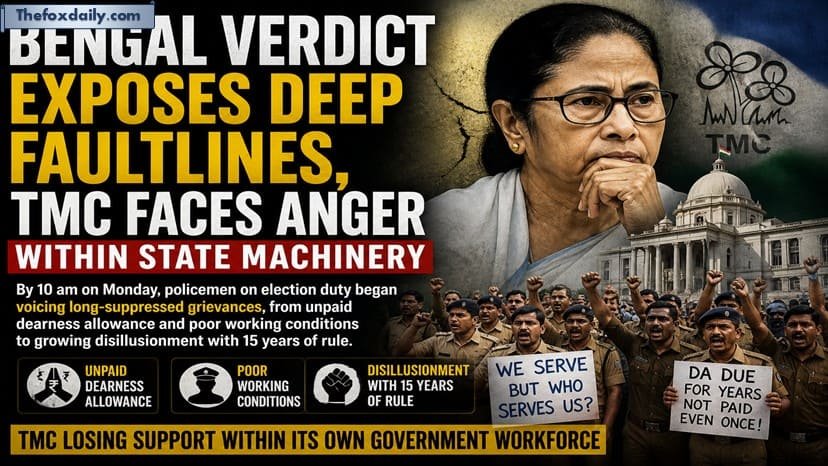
- What Happened: A Turning Point Beyond the Ballot
- The Silent Factor: Government Workforce Discontent
- Timeline: How Discontent Built Over Time
- Counting Day Tensions: A Reflection of Deeper Issues
- Why This Matters: Beyond a Single Election
- Comparison: Then vs Now
- The Youth Factor: A Changing Political Audience
- A Unique Insight: The “Invisible Voter” Within the System
- Real-World Impact: What Changes Now?
- Prediction: What Lies Ahead for West Bengal Politics
- Conclusion: A Verdict That Speaks Louder Than Numbers
The Bengal election verdict 2026 has done more than deliver a political upset it has exposed cracks that had been quietly widening within West Bengal’s governance system. While election results often focus on winners and losers, this outcome tells a more complex story: one of growing dissatisfaction inside the very machinery meant to uphold the state.
From police personnel voicing long-held grievances to administrative fatigue and political interference, the developments surrounding the verdict point to something deeper than anti-incumbency. The shift in power appears to reflect not just voter sentiment, but also a breakdown in trust within the system itself.
What Happened: A Turning Point Beyond the Ballot
As counting began, early trends suggested a decisive shift. But what stood out was not just the numbers it was the reaction from within government ranks. Officers on duty, who are typically expected to remain neutral and restrained, were unusually vocal.
Behind the scenes, conversations revealed frustration over multiple issues:
- Unresolved salary and allowance disputes
- Perceived lack of institutional autonomy
- Frequent political pressure in operational matters
- Career stagnation and controversial postings
These weren’t new complaints but the election results acted as a trigger, bringing them into the open.
The Silent Factor: Government Workforce Discontent
One of the most underreported aspects of the Bengal verdict is the role of government employees. Unlike public rallies or media debates, this influence operates quietly but can be powerful.
In many elections, administrative neutrality is assumed. However, when morale within the system declines, it can indirectly shape outcomes. In this case, dissatisfaction among police and other state employees appears to have created an Environment where the ruling party no longer enjoyed institutional comfort.
This doesn’t imply active bias but rather a withdrawal of passive support, which can be just as significant.
Timeline: How Discontent Built Over Time
| Phase | Key Developments | Impact |
|---|---|---|
| Early Years | Strong public support and administrative alignment | Stable governance environment |
| Mid-Term | Emerging complaints over pay, postings, and interference | Gradual decline in morale |
| Pre-Election Period | Legal disputes, public criticism, internal dissatisfaction | Visible cracks within state machinery |
| Election Day | Open expression of frustration by officials | Shift in narrative and perception |
Counting Day Tensions: A Reflection of Deeper Issues
The events outside counting centres clashes, heightened emotions, and rapid escalation were not isolated incidents. They reflected a politically charged environment where institutional control appeared strained.
security forces, often tasked with maintaining order, found themselves navigating not just crowd management but also political sensitivities. This dual pressure highlighted the challenges of functioning in an environment where administrative independence is questioned.
Why This Matters: Beyond a Single Election
The significance of the Bengal election verdict lies in what it reveals about governance, not just Politics.
1. Institutional Trust Is Fragile
When government employees feel unheard or constrained, it affects the efficiency and credibility of the system.
2. Political Dominance Has Limits
Long-term governance requires more than electoral success it demands sustained trust across all levels of administration.
3. Voter Sentiment Is Evolving
Issues like employment, governance quality, and accountability are increasingly outweighing traditional political narratives.
Comparison: Then vs Now
| Aspect | Earlier Elections | 2026 Verdict |
|---|---|---|
| Administrative Alignment | Strong and stable | Fragmented and strained |
| Public Narrative | Leadership-driven | Performance-driven |
| Workforce Morale | Relatively high | Noticeably low |
| Election Dynamics | Predictable patterns | Disruptive shift |
The Youth Factor: A Changing Political Audience
Another critical element in this election was the shifting mindset of younger voters. Unlike previous generations, today’s electorate is less influenced by legacy leadership and more focused on tangible outcomes.
Key expectations include:
- Job creation and economic opportunities
- Transparent governance
- Reduced political interference in institutions
This generational shift is redefining electoral strategies and forcing parties to rethink their approach.
A Unique Insight: The “Invisible Voter” Within the System
One of the most overlooked aspects of elections is the role of what can be called the “invisible voter” individuals within the system who don’t campaign, don’t speak publicly, but influence the environment in subtle ways.
In West Bengal, this group includes:
- Police personnel
- Administrative officers
- Government employees
Their collective sentiment can shape how smoothly an election is conducted and how effectively a government functions afterward.
Ignoring this segment can lead to long-term governance challenges.
Real-World Impact: What Changes Now?
The aftermath of the election is likely to bring several changes:
1. Administrative Reset
New leadership may attempt to rebuild trust within the system through reforms and policy adjustments.
2. Policy Prioritisation
Issues like salaries, working conditions, and institutional autonomy could gain more attention.
3. political strategy Shift
Parties may focus more on grassroots organisation and less on top-down narratives.
Prediction: What Lies Ahead for West Bengal Politics
If current trends continue, West Bengal could witness a more competitive and dynamic political landscape. The era of predictable outcomes may give way to issue-based politics, where performance and governance play a central role.
However, sustaining this shift will depend on whether the new leadership can address the underlying concerns that contributed to the change.
In simple terms: winning an election is one thing fixing the system is another.
Conclusion: A Verdict That Speaks Louder Than Numbers
The Bengal election verdict 2026 is not just a political milestone it is a reflection of deeper structural issues within the state. From workforce dissatisfaction to evolving voter expectations, the factors behind the outcome highlight the complexity of modern governance.
For political parties, the message is clear: electoral success must be backed by institutional trust and effective administration.
For observers, the lesson is equally important: sometimes, the most significant shifts happen not in campaign speeches, but in quiet conversations within the system.
And in this case, those conversations have changed the course of West Bengal’s political future.
For breaking news and live news updates, like us on Facebook or follow us on Twitter and Instagram. Read more on Latest India on thefoxdaily.com.






COMMENTS 0