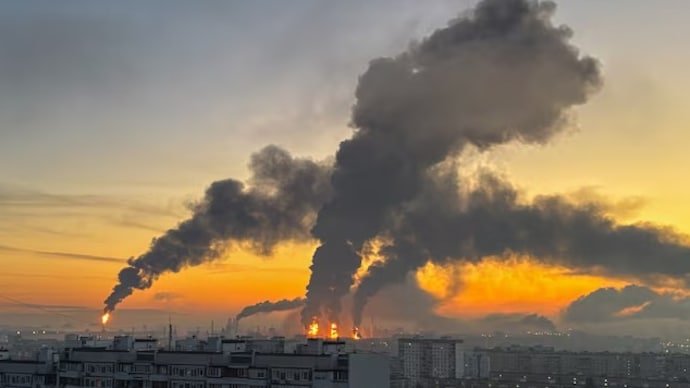
Two people were killed in one of the largest Ukrainian drone attacks on the Moscow region, while several drones reached the premises of an oil refinery in the Russian capital, according to Russian authorities. The attack came as Russia entered the final day of its parliamentary elections and despite an earlier announcement that Russia and Ukraine had agreed to pause attacks on energy infrastructure.
Moscow Mayor Sergei Sobyanin said Russian air defences had thwarted what he described as the biggest Ukrainian drone attack on the capital region. According to Sobyanin, Russian forces had downed more than 1,600 drones since Saturday, including about 450 that were heading toward Moscow.
The scale of the reported attack illustrates the continuing ability of Ukraine to strike deep inside Russian territory, while also highlighting the vulnerability of strategically important energy infrastructure. The Moscow refinery has been targeted several times during the war and plays a significant role in supplying refined petroleum products.
Russia said the attack did not prevent the parliamentary elections from continuing. Sobyanin described the strikes as an attempt to disrupt voting, while saying the alleged objective had not been achieved.
Oil Refinery Hit During Massive Drone Attack
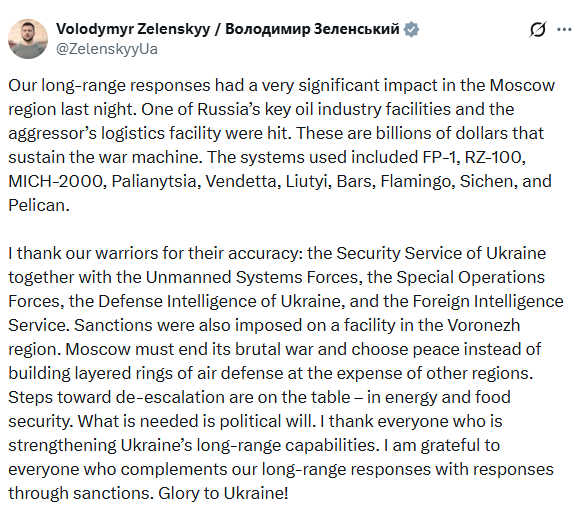
Several drones reached the premises of the Moscow oil refinery during the attack, according to Sobyanin. Reuters witnesses reported hearing explosions in Moscow and seeing plumes of smoke rising from the direction of the refinery.
The immediate extent of the damage to the facility was not known. Authorities did not provide a detailed assessment of whether processing units, storage facilities or other critical parts of the refinery had been damaged.
The refinery is strategically important because it processes crude oil into products used across the Moscow region and surrounding areas. Disruption at a major refinery can have effects beyond the facility itself because refined fuels must be distributed to filling stations, businesses, transport operators and other consumers.
The latest available data showed that the Moscow plant processed 11.6 million metric tons of crude oil in 2024. It produced approximately 2.9 million tons of gasoline and 3.2 million tons of diesel during the year.
Those figures illustrate why attacks on major refining facilities have become an important part of the wider conflict. Damage to individual plants can reduce the amount of fuel available for domestic consumption even when crude oil production itself continues.
Two People Killed in Wider Moscow Region
The most serious reported casualties occurred outside Moscow city in the wider Moscow region. Governor Andrei Vorobyov said two people were killed during the attacks.
About 400 people, including 70 children, were evacuated from a 21-storey apartment building in the Ramenskoye district, according to Vorobyov. Several homes were also damaged.
The reported evacuation highlights the broader consequences of the drone campaign. Although the primary targets described by Russian authorities included military or strategic infrastructure, falling drone debris and explosions can affect residential areas far from the intended target.
Russian and Ukrainian authorities have repeatedly said that they do not target civilians. However, attacks using long-range drones can create risks for people living near infrastructure or along flight paths, particularly when air-defence systems intercept drones over populated areas.
The deaths reported in the Moscow region make the latest attack one of the more significant incidents affecting civilians in the Russian capital’s surrounding areas.
Russia Says More Than 450 Drones Were Headed for Moscow
Sobyanin said approximately 450 of the drones Russia reported intercepting were headed toward Moscow. The figure represents a substantial concentration of the reported drone assault around the capital.
Russia has developed extensive air-defence systems around Moscow because of the city’s political, economic and military importance. Despite those defences, authorities have periodically reported drones reaching or approaching important sites in and around the capital.
The sheer number of drones reported in the latest attack presents a different challenge from isolated strikes. Large drone swarms can force air-defence systems to respond simultaneously across multiple locations, potentially increasing the difficulty of identifying, tracking and intercepting every aircraft.
It is not independently clear from the available information how many drones actually penetrated Russian air defences, how many were destroyed before reaching their intended targets or how many caused damage. Russian authorities’ figures describe drones that were downed, while Ukrainian officials did not immediately provide a matching account in the supplied report.
Attack Comes During Final Day of Russian Elections
The timing of the strikes added a political dimension to the incident. Russia was entering the final day of parliamentary elections when the drone attacks took place.
Sobyanin said the attack had been deliberately planned to disrupt the elections. He said the alleged objective had failed because voting continued.
The claim about the attackers’ intentions came from the Moscow mayor and represents the Russian authorities’ interpretation of the timing of the strikes. The available information did not independently establish the motive behind the attack.
Large-scale attacks during an election period can nevertheless create significant security and logistical challenges. Authorities may need to evacuate buildings, close roads, restrict access to affected areas and redirect emergency services while voting continues elsewhere.
The Kremlin and Russian regional authorities have previously presented Ukraine’s long-range drone campaign as an attempt to create fear and disrupt daily life. Ukraine, meanwhile, has repeatedly argued that attacks on Russian military and energy infrastructure are part of its effort to weaken Moscow’s ability to sustain the war.
Energy Attack Pause Comes Under Pressure
The latest strikes also occurred despite an earlier announcement concerning attacks on energy infrastructure.
US President Donald Trump said on Monday that Russia and Ukraine had agreed to stop attacking each other’s energy infrastructure. However, attacks involving energy facilities have continued, highlighting the difficulty of translating political announcements into a sustained reduction in hostilities.
The Moscow refinery strike demonstrates how complicated any proposed pause can be. Energy infrastructure is spread across large areas and includes oil refineries, pipelines, storage facilities, power plants and other installations that can have direct relevance to a country’s ability to sustain military and civilian activity.
Both Russia and Ukraine have previously accused the other side of attacking energy infrastructure. The continuation of such strikes can complicate broader diplomatic efforts because each side has incentives to preserve pressure on the other’s energy system while seeking to protect its own.
The reported attack therefore raises questions about whether the proposed energy pause can be implemented consistently and verified in practice.
Ukraine Has Targeted Russian Refining Capacity
Ukrainian drone strikes against Russian energy infrastructure have become a recurring feature of the war. Refinery attacks have attracted particular attention because they can affect the supply of gasoline, diesel and other refined products even when crude production remains intact.
Ukraine’s campaign has reportedly knocked out a significant portion of Russia’s oil-refining capacity at various points. The resulting disruptions have contributed to shortages of some oil products, higher fuel prices and long queues at filling stations in parts of the country.
Russia is one of the world’s major oil producers, but producing crude oil is only one part of the fuel supply chain. Crude must be transported to refineries, processed into usable products and then distributed to consumers.
A refinery outage can therefore create localized shortages even when a country has abundant crude oil reserves and continues producing large quantities of petroleum.
Why the Moscow Refinery Matters
The Moscow refinery’s location makes it particularly important to the Russian capital and surrounding region. Its proximity to one of the country’s largest population centres means disruption can have immediate consequences for fuel distribution.
The plant processed 11.6 million metric tons of oil in 2024, according to the latest available data cited in the report. Its production included 2.9 million tons of gasoline and 3.2 million tons of diesel.
Gasoline is essential for private vehicles, commercial transport and emergency services, while diesel is widely used by trucks, industrial equipment and other heavy-duty vehicles. Sustained disruption to either product can affect economic activity well beyond the refinery itself.
The facility has been targeted multiple times during the conflict, making its continued operation an important issue for Russian energy planners.
Any significant damage would need to be assessed not only in terms of immediate physical destruction but also in terms of how long individual processing units could remain offline. Refinery repairs can take time, particularly when specialized equipment is required.
Drone Warfare Is Expanding the Geographic Reach of the War
The latest attack also demonstrates how drones have changed the geographic character of the Russia-Ukraine conflict.
For much of the war, the most intense fighting remained concentrated in Ukraine. Long-range drone campaigns have increasingly brought the effects of the conflict to locations deep inside Russia, including areas far from the front lines.
Drones can be significantly less expensive to produce than many conventional missiles, allowing large numbers to be deployed in coordinated attacks. Their use has created a continuing challenge for air-defence systems and has forced both countries to invest heavily in interception and counter-drone technologies.
Ukraine has used drones to target Russian military facilities, fuel infrastructure and other strategic sites, while Russia has launched large-scale drone attacks against Ukrainian cities and infrastructure.
The resulting contest increasingly involves not only the destruction of individual targets but also the ability to sustain production, repair damaged facilities and maintain air-defence coverage over large territories.
Civilian Areas Remain Vulnerable
The evacuation of hundreds of residents from the Ramenskoye apartment building shows the risks associated with large-scale drone attacks even when authorities say strategic infrastructure is the primary target.
Air-defence interceptions can produce falling debris, while drones that reach their targets can cause explosions and fires. Residential buildings near infrastructure can consequently become exposed to secondary risks.
The reported deaths and property damage in the Moscow region are a reminder that the geographic expansion of Drone Warfare can have direct consequences for civilians.
Both sides have stated that they do not deliberately target civilians. Nevertheless, the continued use of long-range weapons near populated areas has repeatedly resulted in civilian casualties and damage to homes and public infrastructure.
Russia and Ukraine Continue to Target Energy Infrastructure
Energy infrastructure remains strategically important because it connects the military and economic dimensions of the conflict.
For Russia, oil production and refining generate significant economic value and provide fuel for domestic transportation and military operations. For Ukraine, disrupting Russian energy infrastructure can be viewed as a way to impose economic costs and potentially reduce Moscow’s capacity to sustain its war effort.
For both sides, however, energy facilities are also essential to the functioning of civilian economies. Attacks can therefore create shortages and price pressures that extend beyond the immediate military objectives.
The latest strike against the Moscow refinery illustrates that tension. While the facility has strategic importance, disruption can also affect ordinary consumers through fuel availability and prices.
What the Latest Attack Means for the Conflict
The reported scale of the drone attack represents another escalation in the long-range campaign between Russia and Ukraine. The concentration of hundreds of drones toward Moscow and the reported impact on a major refinery demonstrate Ukraine’s ability to direct significant numbers of unmanned aircraft toward targets far from the battlefield.
For Russia, the challenge is to protect major cities and strategic infrastructure while maintaining air-defence coverage across a vast territory. For Ukraine, sustaining such attacks requires significant production capacity, intelligence and the ability to overcome Russian defensive systems.
The attack also comes at a sensitive diplomatic moment because of the previously announced pause on attacks against energy infrastructure. Continued strikes could complicate attempts to establish broader agreements aimed at reducing attacks on critical facilities.
Energy Security and the Next Phase of the War
The effects of the latest attack will depend heavily on the actual extent of damage at the Moscow refinery and whether other energy facilities were affected. If major refining capacity is forced offline for an extended period, pressure on fuel supplies could increase in the Moscow region and elsewhere.
Russia has previously responded to refinery disruptions by relying on other facilities and adjusting fuel distribution. The country’s large geographic size provides some flexibility, although moving refined products over long distances can add costs and create logistical challenges.
For Ukraine, the continued targeting of Russian energy infrastructure offers a way to apply pressure without relying exclusively on conventional battlefield operations. For Russia, protecting refineries and other critical infrastructure has become an increasingly important part of the country’s wider wartime security strategy.
The reported deaths in the Moscow region and the evacuation of hundreds of residents also underscore the human cost of this expanding campaign.
A Major Drone Attack With Wider Consequences
The reported Ukrainian drone assault on the Moscow region was significant because it combined scale, geographic reach and an attack on a strategically important refinery. Russian authorities said more than 1,600 drones had been downed since Saturday, including hundreds heading toward Moscow, while witnesses reported explosions and smoke near the refinery.
Two people were killed in the wider Moscow region, according to regional authorities, and hundreds of residents were evacuated from a high-rise apartment building. Several homes were also reported damaged.
The attack occurred as Russia entered the final day of parliamentary elections and amid claims of an agreement to pause attacks on energy infrastructure. Moscow authorities said the strikes were intended to disrupt the election, while the wider pattern of attacks shows that energy facilities remain deeply connected to the military and economic dimensions of the conflict.
With both Russia and Ukraine continuing to use drones against strategic targets, energy infrastructure is likely to remain an important part of the conflict. The latest attack demonstrates how the war’s effects continue to reach far beyond the front lines, bringing military risks, economic pressure and civilian disruption into major population centres.
For breaking news and live news updates, like us on Facebook or follow us on Twitter and Instagram. Read more on Latest World on thefoxdaily.com.






COMMENTS 0