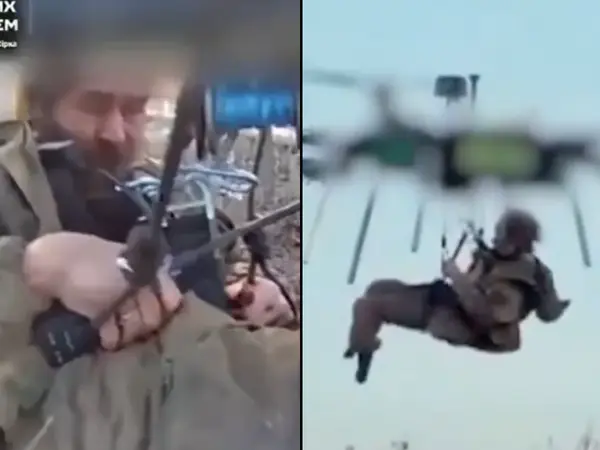
Ukrainian soldier Kostiantyn Vlasenko endured 491 days trapped in a drone-filled combat zone, facing months of isolation and an uncertain future after a Russian attack left him without both feet. His extraordinary ordeal ended when his military unit sent a giant drone to carry him approximately 15 kilometres to safety in what was described as the first known rescue of its kind in the war.
Vlasenko’s story highlights the dangers faced by soldiers operating along the front lines of the Russia-Ukraine War, where the widespread use of drones has transformed the battlefield. Surveillance and attack drones can make movement across exposed terrain extremely dangerous, turning areas near the front into what soldiers describe as a “kill zone.” For Vlasenko, surviving for more than a year in these conditions became a test of endurance, determination and hope.
According to Reuters correspondent Max Hunder, the soldier’s ordeal involved a prolonged period trapped in the drone-filled zone, followed by months spent hiding in a hole after losing both feet in a Russian attack. When he had almost given up hope of being rescued, his unit arranged an unconventional evacuation using a giant drone capable of transporting him away from the battlefield.
Who Is Kostiantyn Vlasenko?
Kostiantyn Vlasenko is a Ukrainian soldier whose survival story illustrates the extreme risks faced by military personnel in drone-dominated combat environments. His experience involved 491 days trapped in a dangerous area near the front line, where the threat of drones made escape difficult.
The account provided by Reuters focuses on his prolonged struggle to survive, the serious injuries he suffered and the unusual method ultimately used to evacuate him. After a Russian attack left him without both feet, Vlasenko spent months hiding in a hole while waiting for a chance to reach safety.
His circumstances made evacuation especially challenging. Losing both feet would severely limit a person’s ability to move independently, particularly in a combat zone where travelling across open ground could expose someone to further attacks. The continuing presence of drones added another layer of danger to an already desperate situation.
Despite these challenges, Vlasenko survived until his unit was able to organise a rescue. The operation relied on a giant drone to transport him away from the area, covering a distance of approximately 15 kilometres.
491 Days Trapped in a Drone-Filled ‘Kill Zone’
One of the most striking details of Vlasenko’s story is the length of time he remained trapped in the combat zone. According to the supplied Reuters account, he spent 491 days in an area filled with drones, where movement and survival presented extraordinary challenges.
Modern battlefields increasingly rely on unmanned aerial vehicles for surveillance, reconnaissance and attacks. These systems can observe movements across exposed terrain and threaten troops attempting to move between positions. As a result, even travelling a relatively short distance can become dangerous when drones are operating overhead.
The term “kill zone” reflects the severe threat associated with these exposed areas. Soldiers moving through such locations may be vulnerable to detection and attack, while damaged roads, unstable front lines and the proximity of opposing forces can make conventional evacuation difficult.
For Vlasenko, remaining in the area for 491 days meant enduring an extended period of danger and uncertainty. The supplied report does not provide a complete day-by-day account of his experience, but it establishes that he remained trapped for an extraordinary length of time before his eventual rescue.
His story illustrates how Drone Warfare can affect not only active combat operations but also the ability to retrieve injured personnel. A battlefield that is continuously monitored or threatened by aerial systems can complicate efforts to reach soldiers who cannot move to safety on their own.
A Russian Attack Left Him Without Both Feet
Vlasenko’s ordeal became even more difficult after a Russian attack left him without both feet. The injuries significantly complicated his situation, leaving him with limited mobility in an environment where reaching safety already presented substantial risks.
The supplied account says he spent months hiding in a hole after the attack. The location offered him a place to remain while he faced the challenges of surviving in the combat zone, but it did not provide a straightforward route to evacuation.
For an injured soldier, escape from a dangerous front-line position can depend on the availability of assistance, access to a safe route and the ability of rescuers to approach without being detected or attacked. Vlasenko’s injuries made independent movement particularly difficult, while the threat from drones complicated the prospect of a conventional rescue.
The report does not specify the exact medical treatment he received during this period or provide detailed information about his daily living conditions. However, the account makes clear that he spent months hiding after the attack before his unit eventually arranged a way to transport him to safety.
His survival under these circumstances forms the central part of the story. It also underscores the importance of evacuation options for injured personnel who remain in areas where traditional rescue methods may be difficult or dangerous to carry out.
Months of Hiding and the Loss of Hope
Being trapped in a combat zone for an extended period can bring physical and psychological challenges. For Vlasenko, the combination of severe injuries, prolonged isolation and the threat of drones made the prospect of reaching safety increasingly uncertain.
According to Reuters correspondent Max Hunder, Vlasenko had reached a point where he had given up hope just before the rescue was arranged. The detail highlights the uncertainty surrounding his situation after months spent hiding and a total of 491 days trapped in the dangerous area.
His experience also demonstrates how the challenges of modern warfare extend beyond direct exchanges of fire. Soldiers who become isolated or seriously injured may face long periods without a clear route to evacuation, particularly when surveillance drones and attack systems make movement hazardous.
The account does not provide enough information to reconstruct every stage of Vlasenko’s isolation or to establish the precise circumstances in which contact with his unit was maintained. What it does reveal is that his eventual rescue came after a prolonged period of danger and uncertainty.
The turning point came when his unit sent a giant drone to carry him out of the area. Rather than requiring him to make the journey on his own, the operation used an aerial platform to transport him to safety.
How a Giant Drone Carried Him 15 Kilometres to Safety
Vlasenko’s rescue stands out because of the method used to evacuate him. According to the supplied report, his unit dispatched a giant drone capable of carrying him approximately 15 kilometres away from the dangerous area.
The operation offered an alternative to a conventional ground evacuation. For a soldier who had lost both feet and remained trapped in a drone-filled combat zone, travelling overland could have been exceptionally difficult. The use of a large drone provided a way to transport him without requiring him to cross the distance independently.
The supplied account describes the mission as the first known rescue of its kind in the war. That description is significant because it suggests that the operation represented an unusual application of drone technology in military evacuation.
However, the source material does not provide technical specifications for the drone, identify its manufacturer or explain exactly how Vlasenko was secured during the flight. It also does not detail the route, flight duration or the precise conditions under which the rescue took place.
What the report establishes is that the drone carried him for around 15 kilometres, allowing him to reach safety after a prolonged period trapped near the front line. The operation transformed an otherwise difficult evacuation into a mission that could be carried out using an unmanned aerial platform.
Why Drone Warfare Has Changed Front-Line Rescue Operations
Drones have become an important feature of the Russia-Ukraine war. Their use has affected reconnaissance, targeting and the movement of troops across contested areas. The same technology that creates dangers for soldiers can also offer new possibilities for military logistics and evacuation.
In areas where surveillance and attack drones threaten exposed movements, conventional rescue teams may struggle to reach injured personnel. Vehicles and personnel travelling along predictable routes can be vulnerable, while the condition of the terrain and the proximity of opposing forces can further complicate operations.
Unmanned systems can potentially provide alternative ways to deliver supplies, observe conditions or move equipment. Larger platforms may also be capable of carrying heavier loads than smaller reconnaissance drones, although their suitability for transporting people depends on their design, capacity and operating conditions.
Vlasenko’s evacuation illustrates one possible use of such technology: transporting a person who cannot safely move across the battlefield under their own power. In this case, the drone provided a means of covering a 15-kilometre distance to safety.
The rescue does not, by itself, establish how frequently this approach can be used or whether it would be suitable in other situations. The supplied report does not describe the drone’s technical capabilities or identify the operational limitations encountered during the mission.
Nevertheless, the account demonstrates how military units may seek unconventional solutions when conventional evacuation becomes difficult. In a battlefield shaped by persistent drone activity, the technology can function both as a source of danger and as a potential tool for rescue.
Why Vlasenko’s Rescue Is Significant
The reported rescue is notable for the combination of circumstances surrounding it. Vlasenko had been trapped for 491 days, suffered injuries that left him without both feet and spent months hiding in a hole before his unit arranged his evacuation.
The use of a giant drone to transport him approximately 15 kilometres represents the most unusual element of the operation. According to the supplied account, it was the first known rescue of its kind during the war.
The description highlights the growing importance of adapting military operations to changing battlefield conditions. When drones make it dangerous for people to move across exposed areas, an aerial platform may offer an alternative way to reach or evacuate someone in need of assistance.
At the same time, the significance of the rescue should not obscure the limits of the available information. The supplied report does not establish whether the method has since been repeated, how much it cost or how it compares with other evacuation techniques.
What makes the story compelling is the contrast between the length of Vlasenko’s ordeal and the unconventional operation that finally brought him to safety. After months of hiding and a period in which he had lost hope, the arrival of the drone created an opportunity for evacuation.
The Human Cost of the Russia-Ukraine War
Vlasenko’s story offers a personal perspective on the human consequences of the war. While military developments are often reported through territorial changes, weapons systems and battlefield operations, the experience of an injured soldier reveals the prolonged uncertainty that individuals can face in combat.
His injuries and extended isolation illustrate the challenges confronting personnel who are unable to leave dangerous positions without assistance. For those who lose mobility, access to rescue and medical support can become especially important.
The report does not provide details about Vlasenko’s subsequent medical treatment, rehabilitation or long-term recovery. It therefore cannot establish what support he received after reaching safety or how his condition developed following the evacuation.
Even with those details unavailable, the account highlights the importance of retrieving injured personnel from areas where they remain exposed to further danger. It also shows why military units may explore new technologies to overcome obstacles that prevent conventional rescue operations.
The rescue was not simply a demonstration of a drone’s carrying capability. It was also the culmination of a prolonged struggle by a soldier who had remained trapped despite severe injuries and difficult conditions.
Reuters’ Immersive Account of the Front-Line Ordeal
Reuters correspondent Max Hunder explains the sequence of events behind Vlasenko’s survival and rescue. The report presents the story as an account of a soldier’s prolonged experience in a drone-filled combat zone and the unusual operation that eventually brought him to safety.
The accompanying presentation was described as featuring immersive graphics that explore the infantryman’s front-line ordeal and dramatic rescue. Such visual storytelling can help audiences understand the challenges of moving through dangerous terrain and the role that drones played in the operation.
The supplied text does not include the full visual report or its graphics, so the specific details of the presentation cannot be described here. The available account centres on the key facts: 491 days trapped in the kill zone, the loss of both feet following a Russian attack, months of hiding and the drone evacuation covering approximately 15 kilometres.
Conclusion: A Survival Story Shaped by Drone Warfare
Kostiantyn Vlasenko’s experience captures the severe dangers of fighting in a battlefield where drones can make movement across exposed areas extremely hazardous. The Ukrainian soldier spent 491 days trapped in a drone-filled “kill zone” and endured months hiding in a hole after a Russian attack left him without both feet.
When he had given up hope, his unit sent a giant drone to carry him approximately 15 kilometres to safety. According to the supplied Reuters account, the operation was the first known rescue of its kind in the war.
The story highlights the changing role of drones in modern combat. Although such systems can threaten troops and complicate evacuation, the technology can also provide unconventional options for transporting injured personnel when conventional routes are too dangerous or difficult to use.
Important details about the drone, the precise circumstances of the mission and Vlasenko’s subsequent recovery are not included in the supplied material. Even so, the reported rescue stands as an example of how military units are adapting to battlefield conditions while attempting to save lives.
Above all, Vlasenko’s story is one of survival after a prolonged and dangerous ordeal. His evacuation demonstrates the potential of unconventional rescue methods in drone-dominated warfare and draws attention to the human experiences behind the changing technology of the Russia-Ukraine conflict.
For breaking news and live news updates, like us on Facebook or follow us on Twitter and Instagram. Read more on Latest World on thefoxdaily.com.





COMMENTS 0