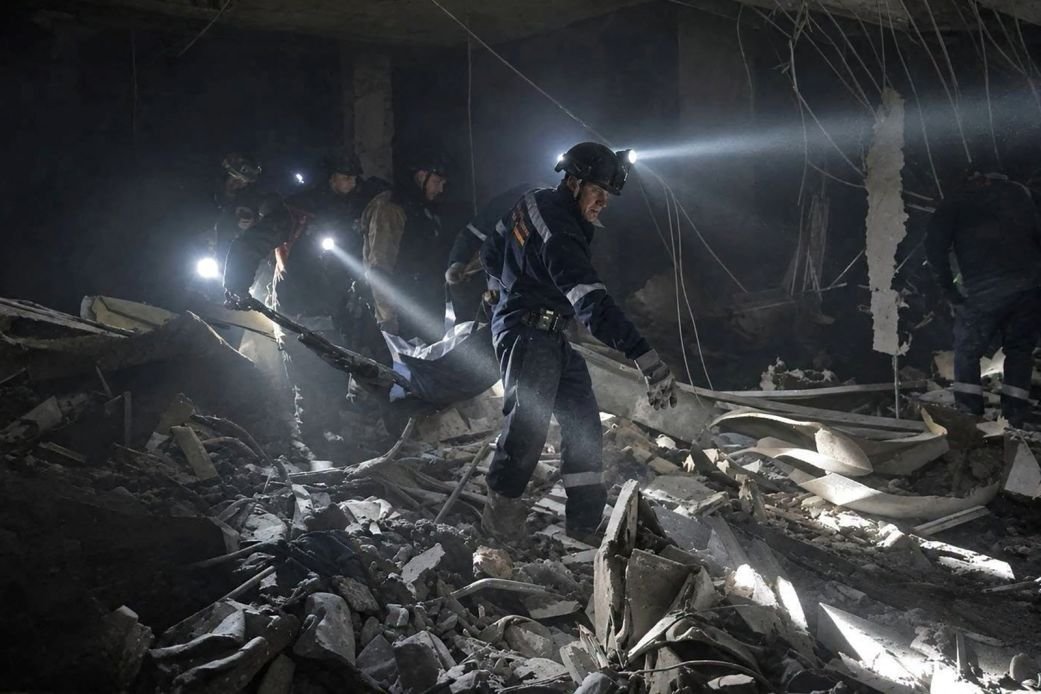
New footage obtained from Ukrainian authorities has revealed further details of a devastating Russian airstrike that destroyed an underground shelter in the frontline village of Komyshuvakha, southeastern Ukraine. The November 2 attack killed more than 50 people, making it the deadliest Russian strike in Ukraine in 2026, according to the information provided by Ukrainian authorities.
The victims had gathered at a former underground school that had been converted into a community centre and humanitarian distribution point. Many residents had sought shelter there after an earlier airstrike damaged the site and left people in need of assistance.
An investigation by CNN, based on police bodycam recordings, eyewitness accounts, geolocated videos and recovered weapon fragments, indicates that a second strike hit the location after emergency workers and villagers had arrived. The sequence has raised serious questions about the targeting of a site where humanitarian aid was being distributed and civilians were taking cover.
Ukrainian authorities identified the bomb that directly struck the underground shelter as a FAB-3000, a large Russian aerial bomb fitted with a guidance system. The attack also killed four police officers, including two community officers whose body cameras captured the final moments before the bunker collapsed.
Komyshuvakha Strike: Key Details
- More than 50 people were killed in the November 2 attack on an underground shelter in Komyshuvakha, according to the supplied report.
- The shelter had been converted from an underground school into a humanitarian and community centre.
- Police bodycam footage shows rescuers working at the site before a second airstrike struck at approximately 10:35 a.m.
- Ukraine’s Defense Intelligence identified the bomb that directly hit the bunker as a FAB-3000 weighing more than 6,000 pounds.
- Four police officers were killed, and authorities were still searching for around 19 people believed trapped beneath the rubble on November 9.
Humanitarian Aid Distribution Turned Into a Rescue Operation
Komyshuvakha had become an important support centre for residents who remained in the village despite its proximity to the frontline. Located roughly 10 miles from Russian positions, the community had limited access to essential services and depended heavily on humanitarian assistance.
The underground school served several purposes. It was used to distribute food and hygiene supplies, provide medical and social services, and offer residents a place to sleep during periods of danger.
On the day before the attack, the Komyshuvakha village council announced through two Telegram posts that residents could collect bread and hygiene kits at the school between 10 a.m. and noon on November 2.
For the remaining residents, many of whom were elderly, the distribution was an important opportunity to obtain basic necessities. The village had already lost most of its pre-war population, and those who stayed relied on aid deliveries and the support of local volunteers.
The first explosions struck the school grounds between approximately 9:45 and 9:50 a.m., according to Ukrainian authorities. Preliminary reports indicated that one woman was killed and another was trapped beneath a concrete slab, injured but alive.
What followed was an emergency rescue operation. Police officers, firefighters and other responders arrived to help those affected by the initial attack. Some residents who had come to collect aid were also still at the location.
Police Bodycam Footage Reconstructs the Attack
The newly obtained police recordings provide an unusually detailed account of the events between the first and second strikes. Ukraine’s Interior Ministry and national police gave CNN access to timestamped bodycam footage recorded by community police officers Mykhailo Romanov and Dmytro Besedin.
The recordings were reviewed with a representative of Ukraine’s Interior Ministry. Although most of the footage was not published because of concerns for the victims’ families, police released a short edited section from Romanov’s body camera.
Besedin’s recording begins at approximately 10:15 a.m. It shows heavily damaged buildings, debris scattered across the ground and rescuers trying to reach a woman trapped beneath a concrete slab. A fire truck remains visible in the courtyard.
About 14 minutes later, Romanov’s bodycam shows elderly residents gathered outside the damaged site. A bicycle with a full basket suggests that some people had already collected humanitarian supplies. One man tells a police officer that he is prepared to evacuate the village.
At approximately 10:32 a.m., a warning arrives over Romanov’s police radio that another airstrike is approaching. Emergency workers now face a difficult decision: continue trying to rescue the woman trapped beneath the concrete or move to a safer location.
A further warning tells residents to take cover. Romanov and Besedin join local people and descend three flights of stairs into the underground school. They enter a room used by local police, where several people have gathered for protection.
Second Airstrike Hits the Underground Shelter at 10:35 a.m.
At approximately 10:35 a.m., both police body cameras record the sound of a powerful explosion. An orange flash fills the screens before the images turn black.
The recordings capture the final moments of Romanov and Besedin, who had both served as community police officers for more than a decade. Ukrainian police confirmed that the two officers were killed alongside two other officers, Mykhailo Buzhenko and Mykola Balanda.
The audio from the recordings includes the sounds of people groaning after the explosion. The bunker subsequently collapsed, according to Ukraine’s Defense Intelligence service.
The service also reported that six additional airstrikes hit the site shortly after the initial bunker strike. The repeated attacks made the rescue and recovery operation even more dangerous.
The sequence documented by the body cameras is central to the allegation that the site was hit in a so-called double-tap attack. This term describes a pattern in which a second strike follows an initial attack, potentially hitting people who have arrived to provide assistance or civilians who have gathered to help those affected.
The recordings show that rescuers were already working at the site and civilians had gathered nearby before the second explosion. The footage therefore provides important evidence about the timing of the attack, although investigators will still need to establish the circumstances surrounding the targeting decision.
Video Evidence Shows Damage After Multiple Waves of Strikes
CNN reviewed dozens of videos to reconstruct the attack and independently corroborate accounts of multiple waves of strikes. Comparisons between footage recorded before and after the second explosion show a significant change in the condition of buildings around the underground school.
In the police bodycam recordings, a yellow building used as an entrance to the underground school appears to remain largely undamaged after the first attack, despite destruction in the surrounding area.
Footage recorded after the bunker was struck shows the same building heavily damaged and marked by numerous impact points. The comparison supports the account that a later strike caused further destruction at the location.
Trevor Ball, a weapons technical analyst at Armament Research Services who reviewed footage for CNN, said damage visible around the site before the second strike could have been caused by smaller Russian bombs, including weapons such as the FAB-500.
The bodycam recordings also show that the second strike occurred after emergency responders had arrived. Two first responders were killed in Komyshuvakha, according to officials.
Ukraine Identifies FAB-3000 as the Bomb That Hit the Bunker
Ukraine’s Defense Intelligence service identified the munition that directly struck the underground shelter as a FAB-3000 aerial bomb. The weapon weighs more than 6,000 pounds and carries over 3,000 pounds of explosives.
The FAB-3000 belongs to a class of large aerial bombs developed for destructive attacks against substantial targets. Russia has modernised some of these weapons by fitting them with guidance kits, allowing bombs that were originally unguided to operate as precision-guided glide bombs.
The guidance systems help direct the bombs towards selected targets after release from aircraft. The FAB-3000 is designed to strike heavily fortified structures, including underground bunkers.
Videos recorded after the Komyshuvakha attack show extensive destruction around the former school. A large crater is visible between the underground shelter’s two entrances, with smoke continuing to rise from the area hours after the explosion.
Other footage appears to show the blast’s epicentre and a path of destruction through multiple layers of concrete leading into the underground structure. The damage suggests that the explosion penetrated the shelter’s protective construction.
Recovered Munition Fragments Support the FAB-3000 Identification
Images and videos obtained from Ukraine’s Security Service, known as the SBU, show a bomb disposal team collecting munition fragments from the site after the attack.
According to the SBU footage, the crater measured approximately 30 metres by 20 metres, or around 98 feet by 67 feet. CNN said it could not independently measure the crater because satellite imagery was unavailable.
Two munitions experts who examined the footage said the crater’s reported dimensions and the destruction were consistent with a large bomb weighing approximately 6,000 pounds, such as the FAB-3000.
Explosive munitions expert Chris Cobb-Smith and weapons analyst Trevor Ball also examined the images of recovered fragments. Among the pieces, they identified a wing from a Russian UMPK glide bomb guidance kit, a component consistent with systems attached to FAB-3000 bombs.
CNN separately compared the fragment with publicly available photographs of similar guidance kits and reported that the piece matched their appearance.
The recovered fragments provide another important source of evidence alongside the crater, structural damage and bodycam recordings. However, the full investigation will need to consider all available material before reaching final conclusions about the weapon and the circumstances of its use.
UN Human Rights Official Condemns the Attack
The attack has drawn criticism from the United Nations Human Rights Monitoring Mission in Ukraine. Danielle Bell, the mission’s head, condemned the strike and highlighted the fact that the humanitarian distribution had been publicly announced before the bombing.
Bell said the timing and location of the aid distribution were widely publicised. She questioned whether Russian forces knew about the humanitarian activity or had failed to take basic steps to determine what was happening in the village before carrying out the attack.
She argued that either possibility raised serious concerns about compliance with international humanitarian law, which includes protections for civilians and humanitarian activities during armed conflict.
International humanitarian law requires parties to a conflict to distinguish between civilians and combatants and to take precautions to protect civilian populations. Humanitarian facilities and people providing assistance are also subject to protections under applicable rules of armed conflict.
The exact legal assessment of the Komyshuvakha attack will depend on the circumstances, including the intended target, information available to the forces involved and the precautions taken before the strike. The UN official’s remarks reflect the seriousness of the concerns raised by the reported sequence of events.
Russia Has Not Commented Directly on the Shelter Strike
Russia, which has repeatedly denied deliberately targeting civilians, had not commented directly on the November 2 strike in the information provided. In a statement to Russian state media, the Russian Defence Ministry said its forces had attacked Ukrainian military units in the area that day.
The statement did not specifically address the destruction of the underground school or the deaths of civilians gathered to receive humanitarian assistance.
Ukraine’s authorities, meanwhile, have described the attack as a major strike against a civilian shelter and are investigating the circumstances surrounding it. The bodycam footage, recovered munition fragments and eyewitness accounts are expected to form part of the evidence examined by Ukrainian investigators.
The presence of a military commander and a military paramedic among those killed has also become part of the investigation. Ukrainian officials have said both were at the site, but their accounts indicate that their presence was connected to events unfolding around the humanitarian distribution point.
Rescuers Faced More Attacks While Recovering Victims
The destruction of the underground shelter did not end the danger for emergency workers. Volunteer first responder Vladyslav Makhovsky arrived within hours of the strikes and shared videos showing the devastation with CNN.
The footage showed a destroyed fire truck, damaged bicycles and extensive debris scattered across the area. The bicycles appeared to have been left by residents who had come to collect humanitarian supplies before the attack.
One video showed a victim receiving cardiopulmonary resuscitation, while other footage captured people carrying away the bodies of those killed.
Makhovsky described a scene of widespread destruction, with emergency vehicles burned and people screaming as rescuers attempted to pull victims from the rubble. He also described a badly injured woman whose arm had been torn off.
Smoke was still rising from the entrance to the underground school, he said. Rescuers were attempting to enter the damaged structure using breathing apparatus.
Makhovsky said a huge crater had formed where the school stood, with concrete floor slabs visible around the blast’s epicentre. He said the crater appeared to be directly above the underground school.
The volunteer also told CNN that Russian drones remained active over the area for days after the bombing, disrupting rescue and recovery work.
Drone Targets Rescue Workers Again on November 8
The danger to emergency personnel continued several days after the main attack. On November 8, a drone again targeted people working at the school, according to Ukraine’s State Emergency Service.
No one was injured in that incident, but rescue equipment was damaged. The incident highlighted the difficulties facing emergency teams working in a frontline village where aerial threats remained active.
Rescue operations in such conditions require workers to balance the urgency of reaching survivors with the risk of further attacks. Damage to vehicles and equipment can also slow the recovery process and limit the resources available to search through collapsed structures.
By November 9, rescuers were still digging through the wreckage in an effort to locate people believed to be trapped beneath the debris.
Underground School Had Become a Lifeline for Frontline Residents
The building destroyed in the attack was originally constructed as an underground school with funding from the European Union. It replaced a school that had been destroyed in a Russian airstrike in July 2023.
The new facility opened in October 2025 and was intended to allow children to continue their education despite the dangers of the war. Videos recorded inside the building showed colourful classrooms and a room fitted with beds where young children could rest.
However, the security situation deteriorated within months of its opening. Near-constant shelling forced children to leave the village, and the school eventually closed as an educational facility.
Local authorities then repurposed the underground structure as an administrative centre and humanitarian hub. It became a place where residents could collect essential supplies, access services and seek protection during attacks.
Makhovsky told CNN that, to his knowledge, the facility had never been used for military purposes.
Footage reviewed by CNN from before and after the strikes did not show visible military infrastructure at the site. However, Ukrainian authorities confirmed that a military commander and a military paramedic were among those killed.
A spokesperson for Ukraine’s Southern Operational Command said Major Vitalii Bevz arrived at the aid distribution point after the first explosions and was killed during the repeat strikes.
Oleksandr Zalishchuk, the military paramedic, was reportedly at the scene by chance and began helping civilians, according to a statement from his brigade.
Komyshuvakha Had Already Experienced Attacks on Humanitarian Activity
The November bombing was not the first reported attack affecting people involved in civilian assistance in Komyshuvakha. Local media reported that five Russian first-person-view drones attacked construction workers in June while they were distributing building materials to residents whose homes had been damaged by shelling.
The incident illustrates the difficult conditions facing people trying to maintain basic services and support residents in frontline communities.
Komyshuvakha has suffered extensive damage during the war. Many buildings have been hit by shelling, and most of the village’s pre-war population of approximately 5,000 people have left.
Around 200 residents, mostly elderly people, remained in the village, according to the supplied report. Their access to essential supplies depended heavily on humanitarian deliveries and the work of local police officers and volunteers.
Some volunteers and remaining police officers carried rifles to defend themselves against first-person-view drones, which had become a persistent threat in the area.
The village’s location near the frontline made routine activities, including collecting food and receiving medical assistance, increasingly dangerous. The underground school had therefore become a vital community facility for those who could not or did not want to evacuate.
Why Komyshuvakha Is Strategically Important
Komyshuvakha lies in a part of southern Ukraine that has experienced significant fighting throughout the war. In 2023, the area was central to Ukraine’s counteroffensive, which aimed to cut Russia’s land bridge connecting Crimea with the Donbas region.
The counteroffensive failed to achieve its main objective. Russia made smaller advances in subsequent years but repeatedly failed to capture Orikhiv, an important Ukrainian stronghold located less than 20 miles south of Komyshuvakha.
The continued fighting has left villages in the region exposed to shelling, drone attacks and other military operations. Communities near the frontline often face severe population loss, damaged infrastructure and limited access to public services.
For residents who remain, humanitarian centres can become essential to daily survival. The destruction of the underground school therefore represents not only the loss of a building but also the destruction of a facility that had supported the remaining civilian population.
Rescuers Search for Missing People as DNA Samples Are Collected
As of November 9, rescue teams were still searching through the rubble for approximately 19 people whom authorities believed could be trapped beneath the wreckage.
Ukraine’s Defense Intelligence service said DNA samples had been collected from relatives of missing people to help identify bodies recovered from the site.
DNA identification can be particularly important after large explosions and structural collapses, when victims may be difficult to identify through visual examination. Matching recovered biological material with samples from relatives can help authorities establish identities and provide families with information.
The search has been complicated by the scale of the destruction, the collapsed underground structure and the continued security risks in the area.
The recovery operation also carries significant emotional consequences for families waiting for information about missing relatives. Until the rubble has been fully examined and recovered remains identified, the final number and identities of those killed may remain uncertain.
Four Ukrainian Police Officers Killed in the Attack
The November 2 strike killed four police officers: Mykhailo Romanov, Dmytro Besedin, Mykhailo Buzhenko and Mykola Balanda.
Romanov and Besedin were community police officers who had served for more than a decade. Their body cameras captured the events leading up to the second strike, including their decision to take shelter underground with residents and other emergency personnel.
The two officers were buried on Saturday alongside Buzhenko and Balanda. Their deaths have added to the toll among local officials and emergency personnel working in communities close to the frontline.
Their recordings have also become important evidence in the Ukrainian investigation into the attack. The footage documents the warnings, the movement of rescuers and civilians into the shelter, and the explosion that destroyed the underground facility.
What the Evidence Could Mean for the Investigation
The available evidence provides investigators with several different ways to reconstruct the November 2 attack. Police bodycam footage establishes the sequence of events before the second explosion, while witness videos show the destruction afterwards.
Recovered munition fragments may help establish the type of weapon used. The crater and structural damage provide additional information about the explosion’s power and location, while eyewitness accounts describe the conditions faced by rescuers and survivors.
Investigators will also need to examine the timing of the humanitarian distribution announcements and the circumstances surrounding the presence of civilians at the shelter. These details could be relevant to assessing whether the location was known to be serving a humanitarian purpose when it was attacked.
The presence of military personnel at the site will also require careful examination. Ukrainian officials say the commander arrived after the first explosions and the paramedic was helping civilians. Establishing the circumstances of their presence and the intended target of the strike will be important to any legal assessment.
The footage and recovered fragments may strengthen the evidentiary record, but they do not independently answer every question about responsibility, targeting decisions or compliance with international humanitarian law.
Komyshuvakha Attack Highlights the Risks Facing Ukrainian Civilians
The destruction of the underground school in Komyshuvakha demonstrates how frontline civilians can remain exposed even when they seek protection in facilities designed to provide shelter and essential services.
The building had been constructed to keep children safe and allow education to continue during the war. After the children were evacuated, it became a humanitarian centre for elderly residents and others who had few remaining sources of support.
On November 2, people gathered there to collect bread and hygiene supplies. After the first explosions, rescuers arrived to help the injured, while civilians moved underground in response to warnings of another attack.
The second strike destroyed the shelter and killed more than 50 people, according to the supplied report. The police bodycam footage now provides a record of the moments leading up to the explosion, while the search for missing residents continues.
The attack has prompted serious questions about the safety of humanitarian facilities, the protection of emergency workers and the obligations of military forces operating near civilian populations. As Ukrainian investigators continue examining the evidence, the recordings of Romanov and Besedin remain a particularly significant part of the effort to establish how a shelter intended to protect civilians became the site of a mass-casualty attack.
For breaking news and live news updates, like us on Facebook or follow us on Twitter and Instagram. Read more on Latest World on thefoxdaily.com.






COMMENTS 0