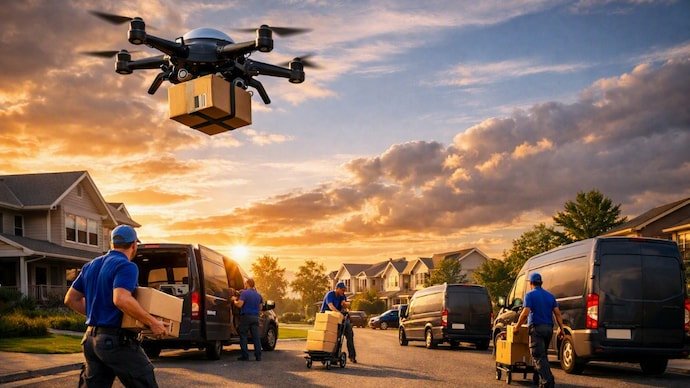
Amazon is preparing to take its drone-delivery experiment much closer to the mainstream. The company plans to expand its Prime Air service to nearly 500 cities and towns across the United States by the end of 2026, a dramatic increase from its current footprint.
The ambition is significant because Amazon has spent more than a decade trying to turn autonomous package delivery from a futuristic idea into an everyday service. The company says its drones are now completing thousands of deliveries each day, with hundreds of thousands of deliveries made this year.
But the expansion is about more than faster shopping. It raises a practical question for one of the world’s largest delivery operations: what role will human delivery workers have if drones begin handling more packages?
The answer, at least for now, is not as simple as drones replacing drivers. Prime Air has important limitations. The aircraft are designed for relatively small packages, short-distance trips and specific delivery locations. Human drivers remain far more flexible, particularly when orders contain larger items or multiple packages destined for different addresses.
Still, Amazon’s strategy could change the economics and organisation of last-mile delivery if drone operations become reliable and widespread.
Amazon’s drone delivery plan marks a major expansion
Amazon’s current Prime Air network remains relatively small compared with its overall delivery operation. The company currently operates the service across 11 US metropolitan areas, with six additional locations expected to come online soon.
The planned expansion to nearly 500 cities and towns would therefore represent a major increase in geographic coverage.
The idea itself is not new. Amazon founder Jeff Bezos publicly unveiled the company’s drone-delivery concept more than a decade ago, imagining small packages travelling through the air and arriving at customers’ homes within minutes.
Turning that vision into a functioning commercial network has proved considerably harder.
Regulatory requirements, technical challenges, operational issues, staffing changes and community concerns have all affected the development of Prime Air. Drones have to operate safely around buildings, people, vehicles, aircraft and other obstacles, while Amazon must also satisfy aviation authorities and local requirements.
The latest expansion suggests the company believes the technology has progressed far enough to support a much larger commercial operation.
How Amazon Prime Air drone delivery works
Prime Air is designed around a relatively straightforward concept: instead of sending a delivery vehicle along roads for a small package, Amazon sends an autonomous aircraft directly toward the customer’s location.
Amazon says its current drones can carry packages weighing up to 5 pounds and operate within a radius of approximately 7.5 miles from their delivery facilities.
That operating range immediately explains why drones are unlikely to replace conventional delivery vehicles across Amazon’s entire network.
A driver can leave a delivery station with a large number of packages and travel through a broad area, making stops at dozens of addresses. A drone is better suited to a specific type of order: a relatively light package, travelling a relatively short distance, to a location where an autonomous aircraft can safely complete the delivery.
The technology is therefore more likely to complement Amazon’s delivery network than eliminate it altogether.
From package drop to controlled delivery
Amazon is also working on improving how packages reach the ground.
The company has been developing a system involving a retractable tether that can lower a package gently rather than releasing it from roughly 13 feet above the ground.
That could broaden the range of products suitable for drone delivery. A simple drop may be acceptable for some packaged goods, but fragile products require greater control.
If the tether system performs reliably, Amazon could potentially deliver more delicate items, including products such as eggs and other perishables.
That would matter because the usefulness of drone delivery depends not only on how far a drone can fly, but also on how many types of orders it can safely carry.
Why Amazon wants drones for last-mile delivery
The strongest argument for drones is speed.
Amazon has spent years conditioning customers to expect increasingly fast delivery. Prime helped establish two-day shipping as a major selling point, while the company later expanded one-day and same-day delivery options in eligible locations.
Drone delivery takes that strategy in a different direction.
Amazon says most Prime Air deliveries currently reach customers in around an hour, although some orders have reportedly arrived within minutes of checkout.
For products that are small, urgently needed and stored near a customer, the advantage is obvious. A drone does not have to deal with road traffic, parking or the sequence of stops required by a delivery van.
That could make aerial delivery particularly useful for time-sensitive purchases and small items.
There is also a potential operational benefit. A conventional delivery vehicle has to move along a road network. A drone can travel more directly between its launch location and delivery destination, provided the route is legally and technically approved.
But speed alone will not determine whether Prime Air succeeds. Reliability, safety, operating costs, weather performance, regulatory approval and customer acceptance will all matter.
Will Amazon drones replace delivery drivers?
Not immediately.
The current capabilities of Prime Air make a complete replacement of human delivery workers unrealistic.
Drones are limited by package weight, flight range and the locations where they can safely land or lower packages. Delivery workers, by contrast, can transport heavier and more varied orders and serve addresses across much larger geographic areas.
A single human driver can also combine many deliveries into one route. That remains an important advantage for conventional logistics.
However, saying that drones will not replace all drivers does not mean they will have no effect on delivery jobs.
The more realistic possibility is that drones gradually take over a portion of the simplest last-mile deliveries.
Consider a small package weighing less than five pounds and going to a home within a few miles of a drone facility. That type of delivery is much closer to Prime Air’s intended operating model than a large household shipment travelling a long distance.
If Amazon can reliably automate enough of those trips, human drivers could spend more of their time handling deliveries that drones cannot perform.
The delivery job could change even without mass layoffs
This distinction is important when discussing automation.
Technology does not always eliminate an entire occupation. It can instead remove specific tasks within that occupation.
For delivery workers, drones could gradually reduce the number of short, lightweight, straightforward stops that require a vehicle and a human driver. Drivers could consequently become more focused on larger shipments, complex routes, multi-package deliveries and locations outside drone operating zones.
That would represent a change in the Nature of the work rather than an immediate disappearance of the job.
The eventual employment impact would depend on how quickly drone capacity grows, how much demand Amazon assigns to Prime Air and whether the company uses automation to handle additional package volume or to reduce conventional delivery capacity.
The available information does not establish that Amazon plans to eliminate a specific number of delivery jobs as a result of the expansion.
Amazon is not alone in the drone-delivery race
Amazon is also entering a market where other companies have already built substantial commercial drone operations.
Alphabet’s Wing has crossed 1 million commercial drone deliveries and operates in 20 US markets, according to the supplied information. Zipline has completed 2 million deliveries across four continents.
These numbers matter because they show that commercial drone delivery is no longer limited to demonstrations and pilot projects.
At the same time, different companies are targeting different types of deliveries and operating environments. A successful delivery count does not by itself show that one Business model will work everywhere.
Amazon’s challenge is to integrate drones into a much larger retail and logistics system while maintaining the reliability customers expect from Prime.
Prime Air still faces safety and technical challenges
The rapid expansion of any autonomous aviation system brings questions about safety and reliability.
Prime Air has already experienced incidents that demonstrate why large-scale deployment is complicated.
Two Amazon drones collided with a crane in Arizona last October, triggering investigations by US authorities. A separate drone reportedly damaged an internet cable in Texas, while a Prime Air drone crash in England has also been under investigation.
These incidents do not by themselves establish that Prime Air is unsafe as a whole. They do, however, highlight the kinds of problems Amazon must solve before autonomous aircraft can operate at much greater scale.
A delivery network involving hundreds of cities would potentially mean far more aircraft, routes and interactions with the surrounding environment. Managing that network safely will require reliable aircraft, sophisticated flight systems and effective oversight.
Privacy and noise could become bigger issues
Technical performance is only one part of the challenge.
Communities also have to accept drones flying above or near residential areas. Noise and privacy concerns have already been associated with Amazon’s drone ambitions, and wider deployment could bring those issues into more neighbourhoods.
A customer waiting for a package may appreciate a delivery arriving in minutes. A neighbour WHO hears frequent aircraft overhead may have a very different view.
That means public acceptance could become an important factor in determining where drone delivery can expand.
The technology may be commercially attractive, but large-scale deployment still has to fit within aviation rules and local expectations.
Could Amazon bring drone delivery to India?
India could eventually become an important market for drone delivery, but replicating Amazon’s planned US expansion would involve significant challenges.
India already has experience with drone-based delivery projects. Drone technology has been tested for Healthcare, medical supplies and e-commerce applications, including pilots involving Flipkart in Telangana.
However, moving from limited pilots to large-scale consumer delivery would require more than aircraft capable of carrying packages.
Companies would need to work within India’s aviation regulations and local restrictions while also dealing with dense urban neighbourhoods, complex buildings, crowded streets and privacy concerns.
Airspace management would become particularly important if large numbers of autonomous aircraft were operating simultaneously over populated areas.
For Amazon, the US market provides an opportunity to develop the technology, operational systems and regulatory experience needed for broader expansion. Whether those lessons can eventually be transferred to India would depend on local regulations, Infrastructure and the economics of drone delivery.
What Amazon’s drone expansion could mean for shoppers
For consumers, the most immediate potential benefit is faster delivery for eligible products.
Instead of waiting for a vehicle to arrive through conventional routes, customers could receive certain lightweight items by air, potentially within an hour or less.
But drone delivery will not make every Amazon order faster. The service is constrained by package size, weight, distance and the availability of suitable drone facilities.
Weather and operating conditions may also affect whether a drone can complete a particular delivery, meaning conventional delivery options will remain important.
The more significant long-term change could be the way Amazon divides its delivery network between automated and human-operated systems.
The bigger question is not drones versus workers
Amazon’s planned expansion is often framed as a question of whether drones will take delivery jobs. A more useful way to look at it is to ask which deliveries are most economical to automate.
A drone is not a direct substitute for a delivery van. It is a different tool designed for a narrower category of shipment.
If Prime Air succeeds, Amazon could use drones for small, nearby packages while reserving human-driven vehicles for heavier, longer-distance and more complicated deliveries. Over time, that could reshape routes, workloads and the skills required in last-mile logistics.
The impact on workers will therefore depend on how Amazon chooses to deploy the technology, not simply on how many drones it puts into the sky.
What happens next for Amazon Prime Air?
The next major test will be whether Amazon can turn its current drone operations into a dependable network across hundreds of locations.
The planned expansion will put greater pressure on the company’s technology, safety systems and ability to operate within different communities and regulatory environments.
If Amazon can demonstrate that drones can deliver small packages safely, reliably and at a competitive cost, Prime Air could become a meaningful part of its logistics network rather than a niche service.
For delivery workers, that could mean gradual changes rather than an overnight replacement. Some routine short-distance deliveries may increasingly move into the air, while people remain responsible for the much broader range of shipments that autonomous aircraft cannot yet handle.
The real story, then, is not simply that Amazon is putting drones into the sky. It is that the company is testing whether the last mile of e-commerce can be divided between machines and people, with each handling the type of delivery it is best equipped to perform.
For breaking news and live news updates, like us on Facebook or follow us on Twitter and Instagram. Read more on Latest Technology on thefoxdaily.com.






COMMENTS 0