Search intent: Informational — readers want to understand who created the 2027 Pirelli Calendar, why India was chosen, how Avani Rai, Sølve Sundsbø and Raghu Rai shaped the project, which women feature in it, and why this edition represents a significant change in the history of The Cal™.
Related keywords: Pirelli Calendar 2027 India, Avani Rai Pirelli Calendar, Sølve Sundsbø Pirelli Calendar, Raghu Rai, Indian women Pirelli Calendar, Pirelli Calendar India, The Cal 2027, Indian photography, contemporary Indian women, Pirelli Calendar history
What happens when a global fashion institution known for decades of iconic photography tries to photograph a country as vast and layered as India? The answer, in the case of the 2027 Pirelli Calendar, is surprisingly simple: one camera could never be enough.
For its 2027 edition, The Cal™ turns to India for the first time, bringing together the work of Norwegian photographer Sølve Sundsbø and the late Indian photography master Raghu Rai. After Rai’s death in April 2026, his daughter, photographer Avani Rai, stepped in to carry forward his intended contribution.
The result is more than a fashion calendar. It is an unusual photographic conversation between generations, cultures and approaches to seeing. Sundsbø photographs contemporary Indian women through an intimate portrait-driven lens, while Avani Rai returns to locations her father photographed decades earlier, placing his images within the India of today.
That distinction is crucial. The 2027 Pirelli Calendar does not appear to be asking, “What does India look like?” Instead, it asks a more interesting question: whose India are we looking at?
Why the 2027 Pirelli Calendar matters
The Pirelli Calendar has occupied a peculiar place in visual culture since its launch in 1964. Although originally associated strongly with fashion, glamour and sensual imagery, The Cal™ has increasingly become a platform for photographers to experiment with celebrity portraiture, identity, beauty and cultural storytelling.
The 2027 edition represents another evolution. India is not simply being used as an exotic backdrop for international fashion photography. The country itself becomes the central subject, while the photographers are deliberately given different positions from which to observe it.
That approach is particularly important because India resists simple visual definitions. A photograph of Jaipur cannot stand for Mumbai; a portrait in Old Delhi cannot explain rural Rajasthan; a celebrity cannot represent the experiences of millions of Indian women.
The creative structure of the calendar acknowledges that complexity rather than attempting to erase it.
The first Pirelli Calendar focused entirely on India
Pirelli announced in May 2026 that the 2027 calendar would focus on India. It was also announced as the first edition in The Cal’s history to feature the work of two distinct photographers: Sundsbø and Raghu Rai. Rai had been developing his contribution before his death at the age of 83.
His passing fundamentally changed the project without ending it.
Avani Rai was subsequently entrusted with realising her father’s intentions. Rather than attempting to imitate his photography, she approached the unfinished project as a dialogue between his archive and the present-day India surrounding it.
This creates one of the calendar’s most compelling ideas: photography becomes a conversation across time.
Raghu Rai’s India: a lifetime behind the camera
Raghu Rai began photographing India in 1965 and spent more than six decades documenting its people, cities, public life and contradictions. His work became closely associated with Indian photojournalism and with a style capable of finding extraordinary moments in ordinary surroundings.
For the Pirelli project, Rai had planned to bring photographs from his archive into conversation with contemporary India. His concept therefore contained an important tension: the country he had photographed throughout his career was still recognisable, but it was also constantly changing.
After his death, Avani took that idea into the streets.
Avani Rai turns an archive into a living conversation
Avani’s contribution is arguably the most emotionally layered part of the 2027 Pirelli Calendar.
Instead of recreating her father’s photographs exactly, she returned to places where he had worked, including parts of Old Delhi such as Kinari Bazar and Yamuna Ghat. She then photographed the original images within the environments as they exist today.
The technique produces a striking visual proposition. The older photograph remains visible, but it is surrounded by people and circumstances belonging to another generation.
In this construction, the past is not presented as something that disappeared. It becomes part of the present.
More than 200 people reportedly appear within the new frames, including residents, performers, dancers, artisans and members of the Rai family. Their presence changes the meaning of the archival photographs: instead of being museum pieces, they become active participants in a living city.
Why this approach is more powerful than simply recreating old photographs
A straightforward recreation would have focused on visual similarity: same location, similar composition, perhaps similar subjects. Avani’s method does something more sophisticated.
It asks viewers to notice the differences.
What has disappeared? What has survived? What has changed because of technology, urban development, economics or social transformation? And what remains surprisingly familiar?
That makes the project relevant beyond fashion. It becomes a visual record of how India changes while carrying its past forward.
Sølve Sundsbø takes a different route
If Avani Rai looks across decades, Sølve Sundsbø moves closer to the individual.
The Norwegian photographer, who also worked on the 2026 Pirelli Calendar, approached the India project with an awareness that an outsider’s perspective has limits. Rather than pretending to provide a complete portrait of the country, he collaborated with Indian photographic voices and concentrated on individual people.
His contribution focuses on nine contemporary women connected with different areas of Indian cultural and creative life.
The featured names include Aditi Rao Hydari, Avantika Vandanapu, Freida Pinto, Anoushka Shankar, Rupi Kaur, Lakshmi Menon, Bhavitha Mandava, Padma Lakshmi and Avani Rai.
They represent different professions and public identities: actresses, musicians, poets, models, writers, producers and creative figures.
That diversity is significant because the calendar avoids presenting a single definition of Indian womanhood.
Who are the women in the 2027 Pirelli Calendar?
| Woman | Creative field | What her inclusion adds |
|---|---|---|
| Aditi Rao Hydari | Acting | A contemporary Indian screen presence and cultural identity |
| Avantika Vandanapu | Acting | A younger generation of Indian talent working across markets |
| Freida Pinto | Acting and production | A globally recognised Indian-origin creative career |
| Anoushka Shankar | Music | The continuing global influence of Indian musical traditions |
| Rupi Kaur | Poetry and performance | A contemporary literary voice with an international audience |
| Lakshmi Menon | Modelling | A connection between Indian fashion and global fashion culture |
| Bhavitha Mandava | Modelling | A younger Indian fashion presence on the international stage |
| Padma Lakshmi | Writing, television and production | A multidimensional Indian-origin global media career |
| Avani Rai | Photography | A direct bridge between Indian photographic history and its present |
The deeper shift: from “Indian beauty” to individual identity
One of the most important differences between this calendar and older representations of India is the decision not to make every woman carry the symbolic burden of representing an entire nation.
That distinction can easily be missed.
India’s visual representation in international fashion has sometimes relied on familiar shorthand: ornate architecture, traditional clothing, saturated colours, jewellery and recognisable cultural motifs. These elements are real parts of Indian life, but they can become limiting when they are treated as the complete story.
The 2027 project takes a broader route. The women are presented as individuals with their own professions, histories and personalities.
India consequently enters the photographs through people rather than through decoration alone.
Old Delhi and Rajasthan become more than backdrops
The locations also matter.
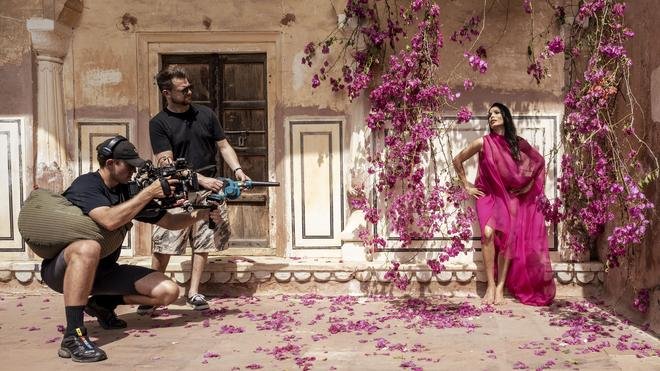
Avani’s work takes viewers into Old Delhi, including places associated with her father’s photographic history. Sundsbø’s portraits include locations such as Jaigarh Fort in Jaipur and Ajabgarh in Rajasthan.
These places offer visual character, but the creative strategy is not simply to use monuments as picturesque scenery. Location becomes part of the relationship between subject and photographer.
That is particularly evident in Sundsbø’s approach to natural light. His photographs for this edition relied almost entirely on daylight, with the shooting schedule organised around the position and quality of the sun.
It is a deceptively simple technique. Natural light does not automatically produce authentic photography. It requires patience, timing and a willingness to let the environment influence the image.
Why the women, rather than India as a landscape, are central
The choice to focus heavily on women gives the calendar another layer.
India is frequently represented through its monuments, festivals, food, spirituality or landscapes. Those subjects can communicate cultural richness, but they can also turn a complex society into a collection of visual symbols.
People are harder to reduce to symbols.
A musician, poet, actress, model, photographer or producer carries an individual history. Their work also demonstrates that contemporary Indian identity is being shaped not only by inherited traditions but by global networks, new media, fashion, literature, cinema and music.
This makes the portraits less about “Indian beauty” in the conventional fashion sense and more about Indian agency.
The most important story may be the three photographic voices
There is an interesting creative triangle at the heart of the 2027 Pirelli Calendar.
Raghu Rai represents an extraordinary historical relationship with India. Avani Rai represents both inheritance and reinterpretation. Sundsbø represents an international photographer deliberately recognising that India requires a perspective beyond his own.
These are not interchangeable viewpoints.
That is precisely why the collaboration works as an idea.
Raghu Rai: the long view
Rai’s photographs emerge from decades of observation. His India is one encountered through repeated visits, changing streets and accumulated memory.
Avani Rai: memory in the present tense
Avani occupies the unusual position of being both photographer and daughter. Her work does not merely inherit an archive; it tests what that archive means when placed inside contemporary life.
Sølve Sundsbø: the close encounter
Sundsbø approaches India from outside, but instead of hiding that distance, he uses collaboration and portraiture to acknowledge it. His focus on individual women makes the work less about claiming knowledge of India and more about encountering people within it.
A unique comparison: 2027 versus the traditional Pirelli Calendar
The significance of the 2027 edition becomes clearer when it is compared with the cultural identity traditionally associated with The Cal™.
| Traditional perception of The Cal™ | 2027 Pirelli Calendar |
|---|---|
| Strong association with glamour and fashion | Combines fashion with documentary and cultural photography |
| Often shaped around a dominant photographic vision | Built around multiple photographic perspectives |
| Models and celebrities can function as visual subjects | Women are presented through individual creative identities |
| Locations can serve as visual settings | Locations contribute history and context |
| Focus often falls on the finished image | The dialogue between past, present and photographer becomes part of the story |
The overlooked implication: this is also a story about photographic inheritance
The most distinctive aspect of the project may not be its celebrity cast or fashion credentials. It is the question of what happens when a photographer inherits another photographer’s unfinished idea.
Avani Rai was not simply completing a commercial assignment. She was negotiating authorship.
Should she reproduce her father’s visual language? Should she deliberately reject it? Or could she stand close enough to understand his intention while remaining far enough away to make the work her own?
The answer appears to be the third option.
That makes the project an unusually personal meditation on artistic inheritance. A photographic archive is not fixed forever. Every new generation can change the meaning of the images that came before.
What the calendar says about India’s changing global image
The project also has implications beyond photography and fashion.
International cultural institutions have increasingly sought to engage with India as a source of contemporary creativity rather than simply as a market or visual theme. The Pirelli Calendar’s decision to place India at the centre of its 2027 edition contributes to that broader shift.
But the more interesting point is how India is being presented.
The country is not reduced to one city, one industry or one aesthetic. Instead, the project moves between archival street photography, contemporary portraiture, Indian creative talent and historic locations.
That approach can influence how international audiences understand Indian culture because it replaces the idea of one definitive image with multiple overlapping ones.
Prediction: the 2027 edition could become a reference point for cultural fashion photography
If the project succeeds critically, its influence could extend beyond the calendar itself.
The strongest future trend may be a move toward collaborative cultural photography, where international photographers work alongside photographers who possess a deeper relationship with the location being photographed.
This model offers an alternative to the old idea that an internationally famous photographer can arrive somewhere and independently define its visual identity.
For countries as culturally complex as India, collaboration may become not just an ethical consideration but an artistic advantage.
Why the 2027 Pirelli Calendar is more than a fashion story
The calendar’s importance ultimately comes from the collision of three timelines.
There is Raghu Rai’s India, built through more than six decades of photography. There is Avani Rai’s India, where those images meet the streets and people of the present. And there is Sundsbø’s India, encountered through contemporary portraits and the perspective of an international photographer.
None completely defines the country.
That is the point.
The project recognises something that photographs often struggle to communicate: India is not a finished subject. It is continuously changing, while carrying enormous amounts of memory with it.
Conclusion: Whose India does the 2027 Pirelli Calendar chronicle?
The answer is deliberately plural.
The 2027 Pirelli Calendar chronicles Raghu Rai’s remembered India, Avani Rai’s inherited and contemporary India, and Sølve Sundsbø’s India discovered through individual encounters. Around them are women whose careers span cinema, fashion, music, poetry, television and photography.
Its most important achievement may therefore be refusing to offer a single definitive picture.
Instead, the calendar turns photography into a conversation between generations, cultures and ways of seeing. The archive speaks to the street. The international photographer meets the local perspective. The famous face remains an individual rather than becoming a national stereotype.
For a publication with such a long history of defining beauty through photography, that is a meaningful evolution.
And perhaps the strongest image of India’s place in the 2027 Pirelli Calendar is not a monument, a costume or a landscape at all. It is the idea that the country can be photographed from many directions—and that every new perspective reveals something while leaving something else just beyond the frame.
For breaking news and live news updates, like us on Facebook or follow us on Twitter and Instagram. Read more on Latest Lifestyle on thefoxdaily.com.

COMMENTS 0