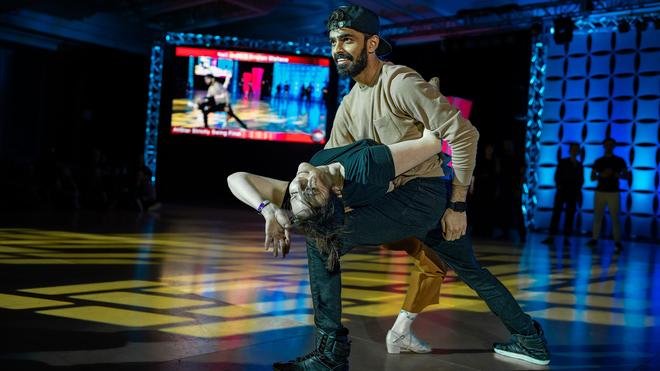
Golden Bird Open 2026
Search intent: Informational — readers want to know what Golden Bird Open 2026 is, who is organising it, what West Coast Swing and Social Jive mean, what Lourd Vijay and LVDS are contributing, and why the event matters to Bengaluru’s wider dance community.
Related keywords: Golden Bird Open Bengaluru, West Coast Swing India, Social Jive Bengaluru, Lourd Vijay, Lourd Vijay’s Dance Studio, LVDS, dance festivals in Bengaluru, swing dancing India, social dance culture India, Bengaluru dance community
Bengaluru is usually described through the language of technology: startups, software companies, engineering campuses and a fast-moving professional population. But another culture has been quietly developing alongside that familiar identity — one built around music, movement, partnership and social connection.
Golden Bird Open 2026 aims to put that culture in the spotlight.
The Bengaluru event, centred on West Coast Swing and Social Jive, is being led by Lourd Vijay of Lourd Vijay’s Dance Studio (LVDS), who serves as festival director. The gathering is designed not simply as a competition but as a wider celebration of dance, bringing together learning, performance, social dancing and opportunities for dancers to engage with a larger community.
Its importance extends beyond the dance floor. For Bengaluru, the festival offers a glimpse of how a niche artistic interest can evolve into a sustained community — and potentially into a more organised creative ecosystem.
What is Golden Bird Open 2026?
Golden Bird Open 2026 is a dance festival in Bengaluru focused particularly on West Coast Swing and Social Jive. Its programme brings together different aspects of dance culture rather than treating competition as the only objective.
The distinction matters because social dance works differently from a conventional stage performance.
A performance can be rehearsed repeatedly until every movement is fixed. Social dance requires dancers to listen to music, respond to a partner and make decisions in real time. The relationship between technique and improvisation is therefore central to the experience.
Golden Bird Open places that broader culture at the centre of its festival format.
Why West Coast Swing is at the heart of the event
West Coast Swing is a partnered dance form that developed from the swing tradition and is particularly known for its adaptability to contemporary music. Unlike dance styles built around one fixed choreography, West Coast Swing gives partners significant scope for interpretation and improvisation.
The dance therefore requires more than memorising steps.
Dancers develop skills in timing, connection, musicality, body movement and communication with a partner. Those qualities make West Coast Swing particularly suited to a festival where learning and social interaction are as important as formal competition.
For audiences unfamiliar with the form, this can be one of its most interesting characteristics: two dancers may hear the same song and create something noticeably different while still sharing the underlying structure of the dance.
What makes Social Jive different?
Social Jive is also rooted in the idea that dance is an interaction rather than simply a performance for an audience.
The emphasis on social dancing changes the atmosphere of an event. A participant does not necessarily need to arrive with a prepared routine or a professional background. The dance floor becomes a place where people learn by participating.
This creates a different kind of community from a conventional performing-arts event.
The audience is not always separate from the performers. A beginner can watch an experienced dancer, take a class, practise a movement and eventually participate in the same social environment.
That permeability between spectator and participant is one reason social-dance festivals can become important community-building spaces.
Lourd Vijay and the growth of India’s partner-dance culture
Lourd Vijay has been associated with the development and teaching of Latin and swing dance forms in India for decades. Through Lourd Vijay’s Dance Studio, he has helped create a structured environment in which dancers can learn styles that once had relatively limited visibility in the country.
His role in Golden Bird Open 2026 therefore represents more than festival administration.
It reflects a longer process of building infrastructure around dance: studios where people can learn, teachers who can develop expertise, communities where dancers can practise, and events where that community can eventually meet others.
That infrastructure is easy to overlook because it is less visible than a major stage performance. Yet it is often what determines whether a dance form survives as a temporary trend or develops into a sustainable culture.
From classes to community: why festivals matter
A dance class can teach technique. A festival can create belonging.
That difference is central to understanding why an event such as Golden Bird Open can matter to Bengaluru’s dance ecosystem.
Regular classes provide the foundation, but festivals create moments when separate groups of dancers can meet. They also give teachers, performers and students a reason to travel, collaborate and compare different approaches.
Over time, those interactions can have a multiplier effect.
- Dancers gain exposure to different teaching methods.
- Teachers encounter new approaches to technique and musicality.
- Beginners receive a clearer pathway into the community.
- Experienced dancers gain opportunities to test themselves outside their regular classes.
- Studios can build connections with dancers from other cities and countries.
In that sense, the festival is not just an event on a calendar. It can function as a meeting point for an ecosystem.
The Bengaluru advantage
Bengaluru has several characteristics that make it particularly receptive to niche cultural communities.
It has a large young and mobile population, a strong international connection through the technology industry, a history of independent cultural spaces and an audience accustomed to trying new activities.
That does not automatically guarantee success for every artistic form. But it creates favourable conditions for communities built around specialised interests.
Dance is particularly well suited to this environment because participation can begin casually. Someone may discover a class through friends, attend a workshop and eventually become part of a regular social group.
Golden Bird Open 2026 enters this existing environment rather than creating it from scratch.
Competition is only one part of the story
The word “Open” may suggest a conventional competitive event, but focusing only on competition would miss the larger purpose of a festival built around social dance.
Competitions provide measurable challenges. Social dancing provides repetition and experimentation. Workshops provide structured learning. Performances provide inspiration.
Together, those elements create a learning cycle:
Learn → practise → socialise → perform or compete → receive feedback → learn again.
That cycle is particularly valuable for dance forms where progress depends on both technical knowledge and experience with different partners and musical situations.
Why musicality matters in West Coast Swing
One of the most interesting concepts for newcomers to West Coast Swing is musicality.
Musicality is not simply dancing faster when a song becomes faster. It involves recognising musical phrasing, rhythm, accents, pauses and changes in energy, then translating those elements into movement.
Because West Coast Swing can be danced to a wide range of contemporary music, dancers need to develop an adaptable relationship with the soundtrack.
This also explains why social dancing can remain challenging even after someone has learned the basic patterns. Knowing the steps is only the beginning. The dancer must learn how to make those steps communicate with the music and with another person.
A unique angle: Golden Bird Open represents the professionalisation of a niche
The bigger story behind Golden Bird Open may be the gradual professionalisation of India’s social-dance ecosystem.
When a dance style is relatively new to a market, its early growth often depends on enthusiastic individuals and informal communities. As participation increases, however, the ecosystem starts requiring more structure.
Studios need qualified teachers. Dancers need pathways to improve. Events need reliable judging and organisation. Communities need opportunities to meet. International connections become increasingly important.
A festival such as Golden Bird Open sits at the intersection of these needs.
This is a useful way to understand its potential significance: it is not merely importing an international dance format into Bengaluru. It is contributing to the infrastructure required for that format to develop locally.
How Bengaluru’s dance ecosystem could benefit
The impact of an event like this cannot be measured only by attendance.
Its longer-term value could be visible in what happens after the festival ends. Participants may return to their local studios with new ideas. Teachers may introduce new exercises. Dancers may form new practice groups. Newcomers may discover a dance style they had never encountered before.
Those secondary effects are often more important than the headline event itself.
| Festival element | Potential ecosystem impact |
|---|---|
| Workshops | Build technical knowledge and expose dancers to different teaching approaches |
| Social dancing | Strengthens relationships between dancers and encourages regular participation |
| Competitions | Creates goals and benchmarks for dancers seeking to improve |
| Performances | Inspires audiences and demonstrates the possibilities of the dance forms |
| International participation | Connects India’s dance community with wider global networks |
| Local hosting | Strengthens Bengaluru’s identity as a city for contemporary cultural events |
The social side may be more important than the spectacle
There is a tendency to judge cultural festivals through their most visible moments: large performances, famous instructors or competitive results.
For social dance, however, some of the most meaningful moments happen away from the spotlight.
A beginner successfully completing a pattern with a new partner can be as important to the health of a dance community as a spectacular competition performance.
That is because communities grow through repeated low-pressure interactions. People return because they know others will be there. They improve because they have people to practise with. They become teachers because they once received encouragement themselves.
Golden Bird Open’s emphasis on social dancing therefore has an important ecosystem function: it encourages people to see dance not only as something to watch but as something to participate in.
Why Bengaluru’s technology identity is actually relevant
At first glance, Bengaluru’s technology reputation and a swing-dance festival might appear unrelated. In reality, they can complement each other.
A city with a large population of professionals from different parts of India and the world naturally develops communities around specialised interests. The same international mobility that supports the technology economy can also help cultural practices travel.
People arrive in Bengaluru carrying interests from other cities and countries. They find local communities, introduce new ideas and build networks.
Dance benefits from precisely this kind of exchange.
The result is a city where cultural identity is increasingly difficult to describe through a single label. Bengaluru can be a technology hub and a live-music city, a theatre centre and a dance community, sometimes within the same neighbourhood.
Comparison: social dance festival versus conventional dance competition
| Conventional competition | Social-dance festival |
|---|---|
| Primarily focused on judged performance | Balances competition with participation |
| Audience and performers are clearly separated | Participants can move between watching and dancing |
| Preparation may centre on choreography | Improvisation and partner communication can be central |
| Success is often measured through results | Success can include learning and community-building |
| Often centred on stage presentation | Extends from classrooms to social dance floors |
What Golden Bird Open could mean for the next generation
The long-term opportunity is perhaps the most interesting part of the festival.
India’s dance landscape is already enormous, encompassing classical traditions, folk forms, Bollywood choreography, contemporary dance, ballroom styles, street dance and many international forms.
West Coast Swing and Social Jive occupy a comparatively specialised space within that landscape.
For younger dancers, however, the boundaries between dance categories can be increasingly fluid. Someone may learn one style for its technique, another for its music and a third because of the community surrounding it.
Festivals can accelerate that cross-pollination.
Golden Bird Open could therefore help create dancers who are not only technically stronger in West Coast Swing or Social Jive but also more aware of India’s wider partner-dance culture.
Prediction: India’s social-dance scene is likely to become more interconnected
If events such as Golden Bird Open continue to develop, the next stage of India’s social-dance culture is likely to be greater connectivity between cities.
Bengaluru, Mumbai, Delhi, Chennai, Hyderabad and other urban centres already have communities interested in different forms of partner and social dance. Larger festivals can provide opportunities for those communities to interact instead of developing independently.
That could eventually lead to a more recognisable national circuit of workshops, socials and competitions.
The important word is eventually. Building a sustainable ecosystem takes years, not one successful festival. But major gatherings can provide the connective tissue needed for that growth.
The bigger cultural story behind Golden Bird Open 2026
Dance festivals are sometimes described as entertainment events, but that definition is too narrow for social dance.
They are also community institutions.
They teach people how to communicate without words, create friendships between strangers and bring together participants who might otherwise have little reason to meet. They can also create small but meaningful economic opportunities for teachers, performers, event professionals, venues and other creative workers.
For Bengaluru, that matters because the city’s cultural economy is becoming increasingly diverse.
Golden Bird Open 2026 sits within that wider transformation. Its focus on West Coast Swing and Social Jive may be specialised, but the questions it raises are broad: How do niche art forms build sustainable communities? How can Indian dancers connect with international scenes without losing their own local identity? And what happens when a city becomes known not just for what people work on, but for what they do together after work?
Conclusion: More than a dance competition
Golden Bird Open 2026 arrives at an interesting moment for Bengaluru’s cultural landscape. With Lourd Vijay serving as festival director and LVDS bringing its experience in dance education and community-building to the event, the festival has an opportunity to showcase West Coast Swing and Social Jive while strengthening the networks around them.
The most significant outcome may not be a trophy or a winning performance.
It may be the dancer who discovers a new style, the beginner who finds a community, the teacher who brings a new idea back to a studio, or the participant who returns to Bengaluru for another event and brings someone else along.
That is how dance ecosystems grow: not overnight, but one connection at a time.
And if Golden Bird Open 2026 succeeds in creating those connections, Bengaluru’s dance floor could become a much bigger part of the city’s cultural story than its size might suggest.
For breaking news and live news updates, like us on Facebook or follow us on Twitter and Instagram. Read more on Latest Lifestyle on thefoxdaily.com.

COMMENTS 0