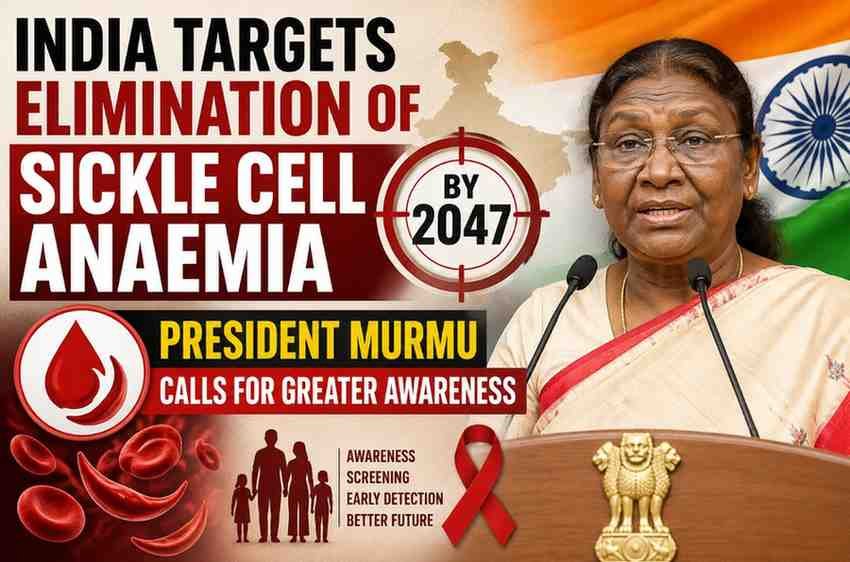
President Droupadi Murmu has reaffirmed India’s ambition to eliminate sickle cell anaemia before 2047, emphasizing that achieving the target would require sustained efforts from governments, healthcare institutions, and communities across the country.
Addressing the issue, the President urged States not to treat the disease lightly and stressed the importance of raising awareness, especially among tribal populations where the inherited blood disorder is more prevalent.
The goal aligns with India’s broader vision for 2047, marking 100 years of independence, and reflects growing recognition of sickle cell disease as a major public health concern.
What Is Sickle Cell Anaemia?
Sickle cell anaemia is a hereditary blood disorder caused by abnormal haemoglobin, the protein responsible for carrying oxygen in red blood cells.
The condition causes red blood cells to assume a sickle or crescent shape, leading to:
- Chronic anaemia.
- Episodes of severe pain.
- Increased risk of infections.
- Damage to organs and tissues.
- Reduced quality of life.
Because it is inherited, early detection and genetic counselling play an important role in disease management and prevention.
Why Tribal Communities Are Particularly Vulnerable
Sickle cell disease disproportionately affects certain tribal populations in India.
States with significant tribal populations have reported a higher burden of the disorder.
Experts say several factors contribute to this challenge, including:
- Limited access to healthcare.
- Delayed diagnosis.
- Lack of awareness.
- Inadequate screening programs.
- Social stigma associated with genetic disorders.
Improving healthcare infrastructure and awareness remains critical for reducing the disease burden.
President Murmu Calls for Collective Action
The President emphasized that eliminating sickle cell anaemia requires cooperation among:
- State governments.
- Healthcare workers.
- Educational institutions.
- Community leaders.
- Civil society organizations.
She stressed that awareness campaigns and early screening programs are essential to achieving the 2047 target.
| Sickle Cell Disease: Key Facts | Details |
|---|---|
| Nature of Disease | Inherited blood disorder |
| Main Problem | Abnormal sickle-shaped red blood cells |
| Major Symptoms | Anaemia, pain crises, infections |
| Most Vulnerable Groups | Tribal populations in several States |
| National Goal | Elimination before 2047 |
| Key Strategy | Awareness, screening and early intervention |
An Overlooked Challenge: Awareness Can Be as Important as Treatment
While advances in treatment have improved outcomes, experts note that many patients remain undiagnosed for years.
Lack of awareness often results in:
- Delayed medical care.
- Preventable complications.
- Missed opportunities for screening.
- Limited access to counselling.
- Poor disease management.
Community-based awareness programs can therefore be just as important as medical interventions.
India’s Elimination Strategy
The country has increasingly focused on:
- Mass screening initiatives.
- Genetic counselling.
- Early diagnosis.
- Strengthening primary healthcare systems.
- Expanding access to treatment and follow-up care.
Experts believe these measures can significantly reduce the disease burden if implemented consistently.
Why the 2047 Goal Matters
Eliminating sickle cell anaemia would not only improve health outcomes but also enhance the social and economic well-being of affected communities.
Reducing complications associated with the disease could:
- Improve life expectancy.
- Lower healthcare costs.
- Enhance educational opportunities.
- Increase productivity.
- Strengthen overall public health.
Conclusion
President Droupadi Murmu’s call to eliminate sickle cell anaemia before 2047 highlights the urgency of tackling a disease that continues to affect vulnerable communities, particularly tribal populations. Achieving this ambitious target will require not only medical interventions but also widespread awareness, early screening, and collective action across society.
If sustained efforts continue, India’s centenary year could mark not just a symbolic milestone, but a transformative victory in public health and genetic disease prevention.
For breaking news and live news updates, like us on Facebook or follow us on Twitter and Instagram. Read more on Latest Health on thefoxdaily.com.





COMMENTS 0