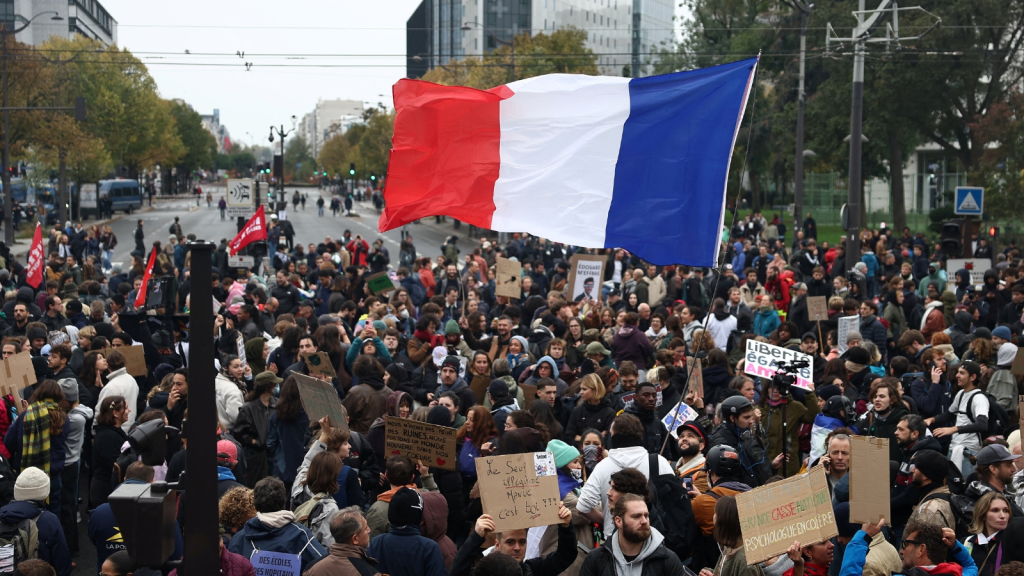
France deployed up to 70,000 police officers nationwide on Saturday as fresh demonstrations over the cost of living, school conditions and public services prompted heightened security measures. Police fired tear gas at protesters in the southeastern city of Lyon, while shopkeepers boarded up storefronts and several major Paris museums closed amid fears of renewed violence.
The demonstrations followed looting and street violence reported during the previous weekend. Authorities stepped up security across the country, deploying helicopters, armoured vehicles and water cannons as officials warned of possible unrest and calls for violence circulating on social media.
The protests reflect growing public dissatisfaction with household expenses, conditions in schools and universities, and proposed spending cuts affecting public services. Students, teachers and labour unions have joined the wider movement, which is unfolding months before France’s next presidential election.
Police Fire Tear Gas at Protesters in Lyon
French police fired tear gas at demonstrators in Lyon on Saturday as officers attempted to disperse a group near the city centre, according to Agence France-Presse (AFP). An AFP journalist reported seeing police use tear gas against around 150 protesters after they briefly tried to block a road in an area where demonstrations had been prohibited.
The incident came as authorities prepared for demonstrations in multiple French cities. Some rallies, including those planned in Lyon, Nice and Montpellier, had been banned by local authorities amid concerns about public order.
Interior Minister Laurent Nuñez said up to 70,000 officers would be deployed across France. The security operation was backed by helicopters, armoured vehicles and water cannons, according to the Associated Press (AP).
Nuñez had warned that calls encouraging violence and looting were circulating on social media. On Friday, he issued a firm warning to potential troublemakers, saying, “We will not tolerate any unrest.”
The scale of the deployment highlights the government’s concern about a repeat of the previous weekend’s disturbances. Police faced the challenge of securing demonstration routes, protecting businesses and public buildings, and responding to possible clashes while managing protests over issues ranging from household finances to education.
Shopkeepers Board Up Businesses Ahead of Demonstrations
Businesses in Paris took precautionary measures ahead of the planned marches, with many retailers covering their windows with wooden boards to protect their premises against possible damage.
Near the capital’s Bastille neighbourhood, a clothing shop had removed merchandise from its shelves before the demonstrations. A nearby restaurant was boarded up but displayed signs indicating that it remained open, according to the supplied AFP report.
AP also reported that shopkeepers across Paris were boarding up storefronts. Near Saint-Lazare train station, 34-year-old contractor Akram Ahmed was installing protective boards over an optician’s shop after receiving an urgent request from its owner.
“I got the call last night,” Ahmed said. “The owner seemed desperate. He said I was saving his life.”
The preparations reflected concerns among business owners about the possibility of vandalism and looting during the demonstrations. For small businesses, damage to storefronts or merchandise can mean costly repairs and interruptions to normal trading.
However, the precautionary measures did not mean that every demonstration was expected to turn violent. The protests also involved organised marches by unions and student groups, some of which called for peaceful participation.
Major Paris Museums Close as Security Concerns Grow
Security concerns also affected cultural institutions in the French capital. Major museums, including the Louvre, the Orsay Museum, the Picasso Museum and the Grand Palais, were closed on Saturday, according to AP.
The closures added to the disruption caused by the security preparations, as authorities and institutions sought to limit risks during a day of planned demonstrations.
Art Basel Paris, which opened to the public on Friday, cancelled its weekend programme amid fears of unrest. The decision affected one of the city’s prominent art events and underscored how concerns about public disorder were extending beyond commercial streets and transport areas.
Police also changed the planned route of the Paris march. Instead of proceeding from Bastille to Nation, demonstrators were directed to a route between Porte d’Italie and Porte de Vincennes, AP reported.
At Bastille, where the march was originally scheduled to begin, police used a megaphone to instruct people to leave the area or face a fine of 135 euros.
The changes illustrated the balance authorities were attempting to strike between allowing public demonstrations and preventing incidents in areas considered vulnerable to disorder.
Why France Is Protesting
The demonstrations have developed from school blockades near Paris in September into a broader movement involving concerns about education, household costs and the future of public services.
What began with school-related grievances has expanded into nationwide marches involving students, teachers, unions and other protesters. The issues differ across groups, but the wider movement reflects dissatisfaction with the pressures facing households and the condition of essential public institutions.
School Conditions and Staff Shortages
Conditions in schools have been a central concern for students and teachers. Protesters have highlighted staff shortages, overcrowded classrooms and deteriorating school buildings.
Some classrooms reportedly accommodate more than 40 students, making it harder for teachers to provide individual attention and manage lessons effectively. Concerns have also been raised about the physical condition of school buildings and whether they provide suitable learning environments.
Heat has added to the concerns. One Paris teacher described classrooms reaching temperatures of 35 to 40 degrees Celsius during the year’s heatwave.
These grievances have helped bring students and education workers into the broader protest movement. For those involved, the issue is not limited to immediate classroom problems but also concerns the resources available to public education and the government’s priorities for future spending.
University Access and Admissions
Higher education is another focus of the demonstrations. Student organisations and unions are demanding 250,000 additional university places and changes to Parcoursup, France’s national higher education admissions platform.
The demand reflects concerns about access to university places and the process through which students seek admission to higher education institutions.
Higher Education Minister Philippe Baptiste has criticised calls to abolish Parcoursup, describing such a move as “pure demagogy”, while indicating that he is open to “profound changes”.
The disagreement highlights a broader debate over how France should manage university admissions and respond to students seeking more opportunities to continue their education.
Cost of Living and Household Budgets
The high cost of living has also brought demonstrators onto the streets. Nationwide marches organised by groups including labour unions targeted rising household expenses and what protesters describe as the government’s failure to respond adequately to public anger.
Concerns centre on energy, fuel and housing costs, as well as falling purchasing power. These pressures can affect households across income groups, particularly when essential expenses absorb a growing share of available budgets.
The cost-of-living protests have widened the movement beyond schools and universities. By joining education-related demonstrations, unions and other groups have connected household financial pressures with broader questions about public spending and social support.
Unions Mobilise Against Budget Cuts
Teachers’ unions and other labour organisations have joined the protests amid concerns about proposed cost-cutting measures in France’s 2027 budget and the strain on public services such as schools and hospitals.
France’s main unions have called a nationwide cross-sector strike over the planned budget cuts. The CGT, the country’s largest union, urged its members to participate peacefully in Saturday’s marches.
The unions’ involvement has given the demonstrations a broader economic and political dimension. Their concerns extend beyond individual school grievances to the resources available for public services and the potential effects of spending reductions on workers and communities.
Public services have become a significant point of contention because budget decisions can affect staffing, access to services and working conditions. Protesters argue that the government needs to address these pressures rather than overlook public dissatisfaction.
The government’s handling of the demonstrations also faces scrutiny over restrictions on rallies. Some local authorities banned planned gatherings, prompting criticism from trade unions that said the measures infringed on the constitutional right to freedom of expression.
The disagreement illustrates the competing demands facing authorities: maintaining public order following previous violence while protecting the right to peaceful protest.
Police Restrictions Draw Criticism From Trade Unions
Restrictions on demonstrations in Lyon, Nice and Montpellier have raised concerns among unions about the limits placed on public protest.
Local authorities imposed bans on some rallies as security preparations intensified. Trade unions criticised the restrictions, arguing that they violated the right to freedom of expression protected by the French Constitution.
Authorities, meanwhile, have emphasised the need to prevent a repeat of the looting and street violence reported during the previous weekend. The deployment of tens of thousands of officers and the use of barriers and route changes reflect the priority placed on managing potential disorder.
The situation presents a difficult question for public authorities: how to respond to credible security concerns without unnecessarily restricting peaceful demonstrations.
The reported incidents in Lyon and the closure of major cultural institutions show the practical effects of the heightened security measures. At the same time, the union criticism indicates that the handling of the protests has become another point of contention between demonstrators and the authorities.
Protests Unfold Ahead of France’s Presidential Election
The demonstrations are taking place months before France’s next presidential election, with the first round scheduled for next April, according to the supplied report.
The political backdrop adds significance to the protests, which bring together concerns about public services, education and household finances. These issues could feature prominently in the political debate as parties and candidates seek to respond to public dissatisfaction.
Marine Le Pen’s National Rally was scheduled to launch its campaign in Orléans over the weekend, while thousands of counter-protesters were expected to march against her and President Emmanuel Macron.
Macron cannot run for another term, and his government lacks a parliamentary majority, making major reforms more difficult to pass. The political constraints could complicate efforts to respond to the concerns raised by demonstrators.
Macron was due to meet high school student representatives on Friday in what the supplied report described as his first talks with them. Students said they wanted “promises backed by results”, indicating that they expected concrete responses to their concerns rather than assurances alone.
The protests therefore come at a sensitive time for the French government, as it faces pressure over public spending and services while the country moves closer to a presidential election campaign.
Security Measures Reflect Fears of Renewed Violence
The deployment of up to 70,000 officers, supported by specialised equipment, reflects the authorities’ efforts to prevent a repeat of the previous weekend’s looting and street violence.
Police have been tasked with securing demonstration routes, protecting businesses and public buildings, and responding to potential clashes. The tear-gas incident in Lyon demonstrates how quickly tensions can escalate when protesters gather in areas where demonstrations have been banned.
At the same time, the widespread boarding up of shops and the closure of museums and cultural events show how security concerns can disrupt everyday commercial and cultural activities even before violence occurs.
The demonstrations are driven by several grievances, including school conditions, university access, the cost of living and proposed budget cuts. The involvement of students and unions means the movement spans both immediate concerns about education and wider debates over the direction of public policy.
Whether the protests lead to policy changes remains uncertain. The supplied information does not establish how the government will respond to the demands or whether the demonstrations will continue at the same scale.
France Faces Pressure to Address Public Anger
France’s latest demonstrations highlight the challenge of responding to public dissatisfaction while maintaining security. The deployment of tens of thousands of officers and the closure of major venues reflect serious concerns about disorder, while the participation of students, teachers and unions points to grievances that extend beyond street violence.
Protesters are demanding improvements in school conditions, greater access to higher education and action on the cost of living. Unions are also challenging proposed budget cuts and warning about the impact on public services.
Authorities have focused on preventing renewed unrest, but restrictions on some rallies have prompted criticism over the right to peaceful protest. The debate over security and civil liberties is unfolding alongside the wider dispute over economic pressures and public spending.
With the presidential election approaching next April, the demonstrations could add to political pressure on the government. For now, France faces both an immediate public-order challenge and a broader debate over education, household finances and the future of its public services.
For breaking news and live news updates, like us on Facebook or follow us on Twitter and Instagram. Read more on Latest World on thefoxdaily.com.





COMMENTS 0