Foreign ministers of India, the United States, Japan and Australia have pledged more than $85 million in technical and financial assistance to expand access to trusted Artificial Intelligence across the Indo-Pacific, while raising concerns about economic coercion, arbitrary export restrictions and vulnerabilities in critical supply chains.
The announcements followed a Quad Foreign Ministers’ Meeting in Atlanta on Saturday, October 31, 2026, where the four countries reaffirmed their commitment to a free and open Indo-Pacific. The discussions focused on economic security, emerging technologies, Critical Minerals, maritime cooperation and action against cyber scams and transnational criminal networks.
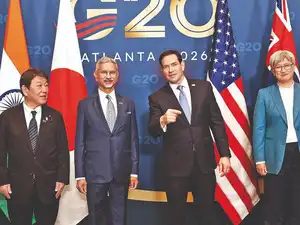
The meeting brought together Indian External Affairs Minister S Jaishankar, US Secretary of State Marco Rubio, Japanese Foreign Minister Toshimitsu Motegi and Australian Foreign Minister Penny Wong on the sidelines of the G20 Foreign Ministers’ Meeting.
Quad Announces More Than $85 Million for Trusted AI Access
One of the key outcomes was the Quad’s plan to provide more than $85 million in technical and financial assistance to support access to trusted artificial intelligence across the Indo-Pacific region. The initiative will include support through the Quad AI Accelerator.
The joint statement highlighted the importance of artificial intelligence and initiatives such as Pax Silica in driving future economic growth. The partners said they wanted to encourage the adoption and development of trusted AI technologies while strengthening the region’s technological capabilities.
The statement used the term “Super Intelligence” (SI), with a footnote clarifying that it refers to artificial intelligence in the context of India, Australia and Japan. The announcement did not specify how the total assistance would be divided among participating countries or provide a detailed distribution schedule.
Expanding access to trusted AI is significant for countries seeking to develop digital infrastructure, improve productivity and strengthen their technological independence. Cooperation could also help Indo-Pacific economies gain access to advanced technologies without becoming overly dependent on a limited number of providers.
Quad Raises Concerns Over Economic Coercion and Export Restrictions
Economic security emerged as another central issue during the Atlanta meeting. The four foreign ministers expressed grave concerns about economic coercion, including arbitrary export restrictions and non-market policies that create excess industrial capacity and disrupt supply chains in critical industries.
Although the joint statement did not name any country, its language reflected concerns among Quad members about vulnerabilities linked to concentrated manufacturing and critical mineral supply chains.
Export restrictions can affect the availability and cost of essential materials used in electronics, batteries, semiconductors, renewable energy systems and other strategic industries. When production or processing is concentrated in a small number of countries, disruptions can have consequences far beyond the country imposing the restrictions.
The ministers reiterated their commitment to building reliable and open global supply chains and developing trusted, resilient infrastructure. Their position reflects the Quad’s broader effort to reduce excessive dependence on individual suppliers and strengthen economic choices across the Indo-Pacific.
US Commits $10 Million for Critical Minerals Recycling
Critical minerals were another important part of the discussions. The United States committed $10 million towards supporting infrastructure and facilities in India and ASEAN countries to recover critical minerals from electronic waste and scrap.
The initiative is intended to strengthen recycling and recovery networks and reduce dependence on any single supplier. Recovering materials from discarded electronics and industrial scrap could help create additional sources of minerals needed for advanced manufacturing and clean-energy technologies.
The funding is not earmarked exclusively for India. Instead, it is intended to support facilities and related infrastructure across India and countries in the Association of Southeast Asian Nations (ASEAN).
The ministers also supported exploring simpler procedures for moving recyclable materials across borders. Better coordination could help countries make more effective use of discarded electronics and other materials that contain valuable minerals.
The announcement builds on the Quad’s wider critical minerals cooperation, which aims to diversify supply chains through investment, recycling, recovery and coordination with the private sector.
Quad Expands Cooperation on Maritime Security
Maritime cooperation also featured prominently in the joint statement. The four countries reiterated the importance of protecting freedom of navigation and navigational rights in strategically important waterways, including the Strait of Hormuz, the Red Sea and the Bab el-Mandeb Strait, in accordance with international law and the United Nations Convention on the Law of the Sea (UNCLOS).
The ministers highlighted progress under the Indo-Pacific Maritime Surveillance Collaboration initiative. Representatives from the four countries completed a joint voyage aboard an Indian Coast Guard offshore patrol vessel from Chennai to Perth between September 25 and October 7.
The partners are also preparing for their first exercise under the maritime surveillance initiative at Sea Dragon 2027. A maritime domain awareness symposium is planned for early next year to support further coordination and information-sharing.
These efforts are aimed at improving maritime awareness and cooperation in a region where shipping routes, ports and sea lanes are essential to international trade and economic activity.
Quad Pledges Action Against Cyber Scams and Human Trafficking
The ministers expressed concern about the growing spread of online and cyber scams, describing them as a threat to national and international security. They condemned criminal groups operating scam networks and trafficking people before forcing them to defraud individuals across borders.
The joint statement highlighted the financial damage caused by such operations, which steal billions of dollars from citizens. The four countries committed to working together to dismantle scam operations and hold transnational criminal networks accountable.
Cooperation against these networks is particularly important because their activities frequently cross national borders. Investigations may involve victims, financial transactions, digital infrastructure and criminal operators located in different countries.
The Quad’s commitment signals an effort to strengthen law-enforcement coordination alongside its broader economic and security agenda.
Quad Announces First Business Leaders’ Forum
The Atlanta meeting also produced an announcement of the first Quad Business Leaders’ Forum. The platform is intended to strengthen connections between the public and private sectors and encourage commercial opportunities in strategic industries.
The initiative is expected to support business engagement in areas linked to economic security, advanced technology and supply-chain resilience. Greater private-sector participation could help translate government-level agreements into investment and commercial projects.
The Quad export credit agencies are also scheduled to meet in Tokyo on November 18 to identify opportunities for practical cooperation. Export credit agencies can support international trade and investment by providing financing assistance and managing certain risks associated with overseas business activity.
Jaishankar Highlights Freedom of Choice and Resilient Supply Chains
Following the meeting, External Affairs Minister S Jaishankar highlighted stability, prosperity and freedom of choice as continuing priorities for the Quad in the Indo-Pacific.
In a post on social media, Jaishankar said he had emphasised the need for stronger supply-chain resilience and greater security in technology, critical minerals and energy. He also called for action against non-market practices and increasing economic pressures in the region.
His remarks reflected India’s interest in strengthening economic partnerships while maintaining strategic flexibility. For New Delhi, reliable access to technology, energy and essential materials is closely connected to economic growth and national security.
The meeting also provided an opportunity to advance cooperation on counterterrorism, maritime security and capacity-building initiatives.
Third Quad Foreign Ministers’ Meeting of 2026
The Atlanta gathering was the third Quad Foreign Ministers’ Meeting held in 2026, following earlier meetings in New Delhi in May and Manila in July. The latest discussions demonstrated the grouping’s effort to move beyond traditional security cooperation and develop a broader agenda covering economic resilience and emerging technologies.
The Quad, comprising India, the United States, Japan and Australia, is a diplomatic partnership focused on a free and open Indo-Pacific. Its cooperation covers maritime and transnational security, economic prosperity, critical and emerging technologies, and humanitarian assistance and disaster response.
The ministers said they looked forward to the next Quad Leaders’ Summit and another foreign ministers’ meeting. Preparations are also underway for a leaders’ gathering hosted by US President Donald Trump on the sidelines of the ASEAN and East Asia summits in November.
What the Atlanta Meeting Means for the Indo-Pacific
The announcements from Atlanta underline how the Quad is increasingly treating economic security and technological cooperation as essential parts of regional stability. The proposed AI assistance, critical minerals funding, business forum and maritime initiatives are intended to strengthen practical cooperation among the four partners and support wider regional resilience.
However, the effectiveness of these commitments will depend on how quickly they translate into projects, investment and access to technology. The $85 million-plus AI assistance announcement does not yet provide a detailed allocation plan, while the critical minerals initiative will require facilities, cross-border coordination and private-sector participation.
By raising concerns about economic coercion and supply-chain disruptions without explicitly naming a country, the Quad has also sought to communicate its position while keeping its agenda focused on cooperation and regional stability.
The Atlanta meeting therefore marks another step in the grouping’s effort to build a more connected and resilient Indo-Pacific, with technology, trade, maritime security and action against transnational crime forming key parts of its expanding agenda.
:chatgpt-content-reference{index=”0″}
For breaking news and live news updates, like us on Facebook or follow us on Twitter and Instagram. Read more on Latest World on thefoxdaily.com.





COMMENTS 0