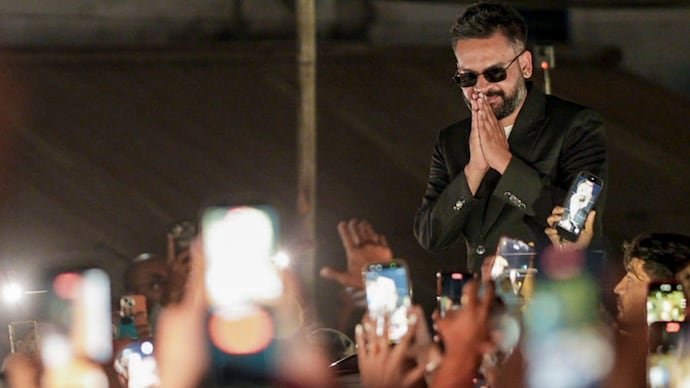
When Balendra “Balen” Shah took the oath as Nepal’s prime minister on March 27, 2026, he represented almost everything the country’s political establishment had struggled to become: young, unconventional, impatient with bureaucracy and closely identified with a generation demanding accountability.
Five months later, the political mood around him is markedly more complicated.
Shah has faced a succession of challenges that have exposed the gap between being an effective outsider and governing from the centre of the state. A controversial customs crackdown along the open Nepal-India border angered ordinary shoppers. Remarks on Nepal’s territorial dispute with India created a diplomatic and parliamentary storm. His government was later confronted by protests following the death of ride-hailing driver Ganesh Nepali, demonstrations over evictions and, in late July, deadly sectarian violence in southeastern Nepal.
At the same time, questions have grown over Shah’s engagement with Parliament and the Rastriya Swatantra Party (RSP), the political organisation that carried him into office.
The significance of the first 150 days is therefore not simply that a popular leader has encountered difficulties. It is that Shah’s strongest political asset, his outsider image, is being tested by the very institutions and responsibilities that come with power.
From Kathmandu mayor to prime minister with a huge mandate
Shah’s rise was unusually rapid. Before entering national Politics, he was known as a rapper, structural engineer and independent mayor of Kathmandu. His mayoral tenure turned him into a prominent anti-establishment figure, particularly among younger Nepalis frustrated with the country’s long-running cycle of political instability.
That appeal translated into national politics.
In the March 5 parliamentary election, Shah won Jhapa-5, defeating former prime minister KP Sharma Oli. The RSP emerged as the largest force in the 275-member House of Representatives with 182 seats, giving the party a near two-thirds majority and a powerful mandate to form a government.
Shah was sworn in on March 27. At 35, he became Nepal’s youngest prime minister and the first democratically elected prime minister to take office after the political upheaval that had followed the youth-led Gen Z protests of the previous year.
The political promise was straightforward: replace a political culture associated with established parties and revolving-door governments with a more accountable and results-oriented administration.
That promise also created an unusually high expectation. Shah was not elected merely as another party politician. Much of his appeal rested on the belief that he would govern differently.
That distinction matters because governing differently is not always the same as governing effectively.
The first warning came from the Nepal-India border
One of Shah’s earliest tests involved something far more consequential than a routine administrative decision: the daily economic reality of Nepal’s open border with India.
In April, the government began strictly enforcing customs duties on goods worth more than 100 Nepali rupees brought across the land border. The rule itself was not new, but enforcement had previously been comparatively loose. Under the new approach, shoppers carrying everyday goods from Indian markets faced tighter checks and possible taxation.
The measure had a clear policy rationale. Nepal wanted to curb informal trade, reduce revenue leakage and protect domestic businesses. But the practical consequences were immediate in communities where crossing into India is part of everyday life.
Residents in border areas routinely depend on Indian markets for items including Food, household goods and medicines. Tighter checks therefore affected people WHO did not necessarily view themselves as smugglers or commercial traders.
The result was public anger and disruption in several border markets. The episode illustrated a problem that would recur during Shah’s first months: a policy can be defensible in principle while still becoming politically damaging if its implementation collides with everyday economic realities.
For an administration built around efficiency and decisive action, the customs controversy was an early lesson that speed is not a substitute for political consultation.
Why Balen Shah’s India diplomacy became a political problem
The more serious challenge came in May, when Shah’s comments during a parliamentary discussion on the Nepal-India boundary dispute triggered criticism.
The dispute concerns areas including Kalapani, Lipulekh and Limpiyadhura, which Nepal claims but which India regards as part of its territory. Shah suggested that the historical dimensions of the dispute could involve the United Kingdom because of its connection to the 1816 Sugauli Treaty.
The remarks produced an uncomfortable response. Nepal’s territorial claims are deeply sensitive, and India has consistently maintained that outstanding boundary issues should be handled bilaterally.
Shah’s comments therefore gave opponents an opportunity to portray him as mishandling a subject that has long been central to Nepali nationalism. Parliamentary proceedings were disrupted and the issue became a domestic political controversy rather than simply a diplomatic disagreement.
There was another complication: Shah had adopted an unusual approach to diplomacy after taking office. Rather than holding routine one-on-one meetings with individual foreign ambassadors, he initially preferred collective meetings with diplomats.
The approach had a logic. It projected the idea that Nepal would treat major powers and neighbouring countries on an equal footing. But diplomacy also depends heavily on personal communication, flexibility and the ability to manage sensitive issues privately.
By August 10, Shah had abandoned the group-only approach. He met Indian Ambassador Naveen Srivastava and Chinese Ambassador Zhang Maoming separately in Kathmandu. The shift did not amount to a policy reversal on Nepal’s foreign relations, but it showed that the practical demands of governing had begun to outweigh one of his early symbolic positions.
India had already formally invited Shah to visit the country. The challenge for the Nepalese prime minister was therefore not whether to engage India, but how to balance national sovereignty concerns with the economic, social, security and people-to-people ties created by the open border.
Rabi Lamichhane’s India outreach added another layer
The diplomatic story became more politically sensitive when RSP chairman Rabi Lamichhane travelled to India and received a high-profile reception, including meetings with senior Indian political leaders.
Lamichhane’s position inside the RSP is important. He is the party chairman, while Shah heads the government. That division of political and governmental authority was part of the arrangement that preceded the election.
Lamichhane’s outreach therefore created an obvious contrast. While Shah had initially maintained distance from individual foreign officials, the RSP chairman was actively engaging Indian political circles.
That does not by itself demonstrate a split between the two leaders. But it highlighted a structural issue inside the ruling party: the person who holds the prime minister’s office and the person who controls the party organisation are not the same individual.
That distinction becomes increasingly important when the government encounters political pressure.
The Ganesh Nepali case exposed the cost of confrontational governance
The most painful domestic episode of Shah’s first 150 days came in July.
Ganesh Nepali, a 25-year-old ride-hailing driver from Mugu, died after setting himself on fire outside Kathmandu’s Department of Passports. The incident followed a confrontation involving Kathmandu Metropolitan City police and the wheel-locking of his motorcycle.
Nepali’s death triggered protests at Maitighar Mandala and drew participation from ride-hailing workers, people from his home district and members of the Gen Z movement.
The political symbolism was difficult for Shah to escape.
The prime minister had built his reputation partly on the idea that government should enforce rules and confront entrenched problems. But when a young worker died after a dispute with municipal authorities, the same image of uncompromising enforcement could be interpreted very differently by people who had once regarded Shah as their representative.
The government subsequently agreed with Nepali’s family on measures including an independent inquiry, financial assistance and support for his family. A separate high-level probe committee was later established to investigate the circumstances surrounding his death.
The deeper issue, however, was not only the investigation.
The case brought attention to the relationship between citizens and government agencies. For informal workers and people dependent on motorcycles and ride-hailing platforms for income, enforcement decisions can have immediate economic consequences.
That is where the political risk lies. A government that campaigns on discipline must also demonstrate that enforcement is predictable, proportionate and sensitive to ordinary people’s circumstances.
Evictions created another test of the outsider image
Shah’s government also faced criticism over the treatment of landless squatters and informal settlements.
Eviction is a complicated issue in Kathmandu and elsewhere because it involves competing claims: the protection of public land, urban planning, environmental concerns and the basic need for shelter.
For a government determined to restore order, clearing informal settlements may appear administratively straightforward. For families facing displacement without adequate rehabilitation, it can feel like the state is simply transferring the burden of urban problems onto people with the least political power.
The protests that followed added to the sense that Shah’s government was discovering a difficult truth of executive power: the people who applaud decisive action from the outside may demand consultation, compensation and safeguards once that action affects their own lives.
Communal violence forced Shah into a different kind of leadership
Then came the crisis that tested the government’s ability to manage social tensions.
In late July, sectarian violence broke out in southeastern Nepal following a dispute involving Hindus and Muslims over loud music and religious flags during a Hindu event. The unrest began in Sunsari and spread into other areas, including Siraha.
At least three people were killed and 25 injured, according to reports at the time. Authorities imposed curfews in several towns as tensions continued.
The crisis required a very different political style from the one that had made Shah famous.
There was no single infrastructure project to complete and no municipal rule to enforce. The government had to manage fear, competing community narratives, policing, political mobilisation and the risk of further violence.
Shah addressed the nation, appealed for calm and promised a fair investigation.
The response also exposed an important distinction between campaigning and governing. An outsider can gain popularity by confronting institutions. A prime minister has to keep institutions functioning when society itself becomes divided.
The Parliament problem may be Shah’s biggest political vulnerability
Perhaps the most consequential question surrounding Shah is now inside Nepal’s own political system.
The prime minister’s attendance in Parliament has become a subject of open criticism. According to reports, Shah had attended only five of the 39 parliamentary sittings since becoming prime minister.
That record matters because Parliament is not simply another political arena. It is where the executive is questioned, legislation is debated and the government is expected to explain controversial decisions.
Nepal’s Speaker has now directed Shah to appear before the House for a question-and-answer session on August 26. Opposition lawmakers have repeatedly demanded his presence, particularly over issues including his comments on the India-Nepal border.
For a leader elected on a promise of accountability, avoiding the institution designed to demand accountability creates an obvious political contradiction.
Shah’s supporters may argue that executive work requires time outside the chamber. That is reasonable. But the larger problem is perception: if citizens see a prime minister as inaccessible to Parliament, his outsider identity can begin to look less like independence and more like detachment.
Distance from the RSP could become an even bigger problem
The tension is not confined to Parliament.
Reports have also highlighted Shah’s limited participation in RSP meetings. He reportedly skipped a key central committee meeting on August 21 as the party discussed preparations for local-level elections, travelling instead to Pokhara and Mustang.
There have also been reports of disagreements within the ruling party over political credit for the RSP’s sweeping election victory and over the relationship between Shah and Lamichhane.
The significance should not be overstated. Absence from a party meeting does not automatically mean a political split.
But the institutional structure of the RSP makes internal coordination especially important. Shah’s government depends on a party that won a commanding parliamentary mandate, while Lamichhane remains the party’s chairman.
If the relationship between government leadership and party leadership becomes strained, decisions on appointments, legislation, diplomacy and election strategy could become harder to coordinate.
The ambassadorial appointment process already offers one example. Disagreements between Shah and Lamichhane have reportedly delayed decisions on several ambassadorial nominations.
The real problem is not one crisis, but the accumulation of them
None of these episodes alone proves that Shah’s government has failed.
The customs controversy could be interpreted as an attempt to enforce an existing rule. The border dispute involves a long-standing national issue that has challenged successive governments. The Ganesh Nepali case is still subject to investigation. Communal violence is difficult for any government to control once tensions spread. And diplomatic engagement inevitably requires adjustments.
The more revealing issue is the pattern.
In just five months, Shah has been forced to respond to crises involving economic policy, policing, foreign relations, communal harmony, Parliament and party management.
That is precisely where the transformation from mayor to prime minister becomes visible.
As Kathmandu mayor, Shah could build his reputation around visible action in a relatively defined jurisdiction. As prime minister, almost every decision sits inside a web of institutions, constitutional responsibilities, diplomatic sensitivities and competing political interests.
The job rewards not only decisiveness but also negotiation.
What happens to Balen Shah next?
The next phase of Shah’s premiership will be less about recreating the excitement of his election campaign and more about demonstrating institutional competence.
His appearance in Parliament will be closely watched. So will the relationship between Shah and Lamichhane, particularly as the RSP prepares for future elections and manages appointments inside government.
foreign policy will remain another important test. Nepal cannot afford unnecessary friction with either India or china, while its relationship with India has an unusually large economic and social dimension because of the open border and long-standing people-to-people connections.
Domestically, the government will also need to show that Law Enforcement and urban policies can be firm without appearing indifferent to the people affected by them.
There is still a significant political asset available to Shah: the size of the mandate he received. The RSP’s parliamentary strength gives the government room to pursue its agenda.
But a large mandate is not permanent political insurance.
Shah’s first 150 days show how quickly the expectations attached to a political outsider can change once that outsider becomes responsible for the state itself. His challenge is no longer convincing Nepal that he is different from the old guard. It is proving that being different can also produce stable, accountable and effective government.
That distinction could determine whether the Balen Shah phenomenon becomes the beginning of a durable political transformation in Nepal or simply another dramatic chapter in the country’s long history of political disappointment.
For breaking news and live news updates, like us on Facebook or follow us on Twitter and Instagram. Read more on Latest World on thefoxdaily.com.




COMMENTS 0