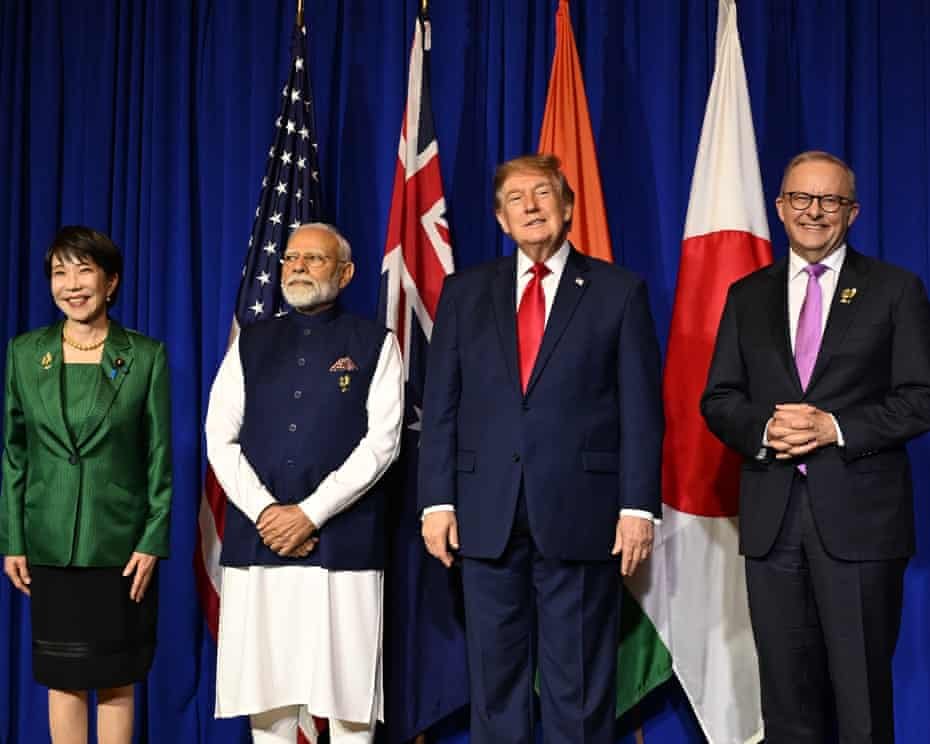
Leaders of the four Quad countries have pledged to deepen cooperation on regional security, economic resilience and emerging technologies, with US President Donald Trump announcing plans for new joint military exercises involving maritime patrol aircraft.
Trump, Australian Prime Minister Anthony Albanese, Indian Prime Minister Narendra Modi and Japanese Prime Minister Sanae Takaichi met in Manila on Tuesday for the first Quad leaders’ meeting since 2024. The gathering took place alongside the ASEAN and East Asia summits in the philippines.
Trump described the four countries as important global partners and presented the grouping as a foundation for a free, open, stable and prosperous Indo-Pacific. He said closer coordination would help protect regional peace through strength.
Albanese welcomed the renewed engagement and highlighted the potential economic benefits of cooperation. He also promoted a new Quad business forum planned for 2027, which he said could support economic growth across the region.
The meeting brought together four countries seeking stronger coordination in a region where China’s military expansion, influence over supply chains and growing technological capabilities remain important strategic considerations.
Trump Announces New Quad Military Exercises
One of the most significant announcements from the Manila meeting was Trump’s statement that the Quad would conduct an exercise involving US maritime patrol aircraft. He said the initiative would help protect peace through strength.
Maritime patrol aircraft are used to monitor activity over seas and oceans, including the movement of vessels and potential security threats. Their surveillance capabilities can support maritime domain awareness, anti-submarine operations and coordination between defence forces.
The proposed exercise would expand the Quad’s security cooperation beyond diplomatic discussions and existing military engagements. It is expected to build on the recent Malabar naval exercise near Japan, where participating forces conducted anti-submarine and anti-surface warfare drills.
The announcement is significant because maritime security has become a central concern for countries across the Indo-Pacific. Important international shipping routes pass through the region, making freedom of navigation and the protection of commercial vessels essential to global trade and energy supplies.
Although Quad members describe the grouping as a partnership for regional stability rather than an alliance directed against a specific country, its expanding security activities are likely to attract criticism from Beijing.
Quad Leaders Discuss China’s Growing Influence in the Indo-Pacific
The Quad brings together India, the United States, Japan and Australia. Its members have repeatedly emphasised their commitment to a free and open Indo-Pacific, while seeking stronger cooperation on maritime security, economic resilience and regional development.
The grouping’s activities have gained importance as China has expanded its military capabilities and strengthened its influence across the region. Disputes in the South China Sea and East China Sea have also increased concerns among countries that rely on open maritime routes and respect for international rules.
The four leaders did not present the Manila meeting as a formal anti-China alliance. However, their discussions on maritime security, critical minerals, advanced technologies and supply-chain resilience reflect areas where their interests overlap amid strategic competition with Beijing.
For India, the Quad provides a platform to work with major partners on maritime security and trusted supply chains while maintaining its own regional diplomatic priorities. For Australia and Japan, cooperation with the United States and India is also important to their broader security and economic strategies.
Takaichi Calls for a Free and Open Indo-Pacific
Japanese Prime Minister Sanae Takaichi said the Quad could help shape the future of the Indo-Pacific by strengthening the resilience of countries across the region.
She highlighted the importance of allowing countries to make independent decisions across several areas, including maritime security, economic security, energy and critical and emerging technologies.
Her remarks reflected Japan’s interest in a regional environment where countries can protect their economic and security interests without facing coercion or excessive dependence on a single power.
Takaichi’s emphasis on resilience also connects the Quad’s security agenda with its economic priorities. Reliable access to energy, technology and essential industrial materials has become increasingly important as geopolitical tensions affect global supply chains.
Modi Describes Quad as a Trusted Partnership
Prime Minister Narendra Modi described the Quad as a constructive and trusted partnership for India. He said the four countries had been working to provide practical solutions in areas such as maritime security, trusted supply chains, new technologies and disaster response.
Modi also expressed confidence that the Manila meeting would help establish concrete goals for the next phase of cooperation.
India’s approach to the Quad has focused on practical collaboration while maintaining its broader commitment to strategic autonomy. New Delhi sees the grouping as a platform to strengthen its maritime capabilities, improve economic security and work with partners on emerging technologies.
The meeting also gave Modi an opportunity to engage directly with Trump, Albanese and Takaichi on shared regional priorities. Trump’s public remarks during the gathering included praise for Modi and Takaichi, whom he described as tough leaders.
The Quad’s focus on trusted supply chains is particularly relevant for India as it seeks to expand domestic manufacturing, attract investment in advanced industries and reduce vulnerabilities in critical sectors.
Critical Minerals and Rare Earths Become Key Priorities
Critical minerals and rare earth elements featured prominently in the discussions, reflecting the importance of these resources to modern manufacturing and national security.
Rare earths and other critical minerals are used in electric vehicles, renewable energy systems, electronics, defence equipment and advanced industrial technologies. Their availability is therefore closely linked to economic competitiveness and technological development.
China has a dominant position in several parts of the global critical-minerals supply chain, particularly processing and refining. This concentration has encouraged other countries to explore alternative sources, develop domestic processing capacity and diversify international partnerships.
Trump said the United States was making rapid progress in rare-earth production and could catch up with China within 10 months. He also pointed to developments in Australia, Japan and India, suggesting that all four countries were working to expand their capabilities.
His statement represents an ambitious target rather than a confirmed outcome. Building competitive supply chains requires more than identifying mineral deposits. Countries also need investment in extraction, processing, refining, transport infrastructure and environmental safeguards.
Closer Quad cooperation could help countries share expertise, coordinate investment and reduce the risks associated with dependence on concentrated supply chains.
AI and Infrastructure Cooperation Expand the Quad Agenda
Artificial intelligence was another major subject at the Manila meeting. The leaders discussed ways to strengthen cooperation in advanced technologies and the infrastructure needed to support their development.
AI increasingly depends on access to powerful computing systems, semiconductors, data centres, reliable electricity and secure digital networks. These requirements make technology supply chains an important part of economic and national security planning.
Trump described artificial intelligence as one of the greatest opportunities for economic growth since the Industrial Revolution. The leaders’ discussions reflected a shared interest in ensuring that their countries can participate in the development and deployment of advanced technologies.
Albanese has also called for stronger protections around AI, arguing that governments and societies should shape the technology rather than allow it to shape them. His comments at the East Asia Summit highlighted the need for responsible development alongside economic opportunity.
For the Quad, cooperation on AI could involve research, infrastructure investment, technology standards and more reliable access to essential components. It could also create opportunities for businesses and research institutions across the four countries.
Albanese Promotes a Quad Business Forum for 2027
Albanese said a new Quad business forum planned for 2027 could help translate diplomatic cooperation into commercial opportunities.
Business participation is important because many of the Quad’s priorities depend on private investment. Critical-mineral projects, semiconductor manufacturing, digital infrastructure and energy systems require substantial capital and long-term commercial partnerships.
A business forum could provide companies with opportunities to identify investment priorities, discuss supply-chain challenges and explore partnerships across the four economies.
For Australia, cooperation with India, Japan and the United States offers opportunities to strengthen its position as a supplier of resources and a partner in regional infrastructure and technology projects.
The proposed forum also reflects the Quad’s broader shift towards economic security. The grouping is increasingly concerned not only with military cooperation but also with the industrial and technological foundations that support national resilience.
Quad Meeting Comes Ahead of Trump, Xi and Putin Talks
The Manila meeting took place ahead of Trump’s planned engagements with Chinese President Xi Jinping and Russian President Vladimir Putin in Shenzhen later in the week, on the sidelines of the Asia-Pacific Economic Cooperation (APEC) gathering.
Albanese is also scheduled to visit China and meet Xi on Friday. These diplomatic engagements place the Quad meeting within a wider period of high-level discussions involving major global powers.
Trump said he wanted to meet North Korean leader Kim Jong-un but acknowledged that arranging such a meeting would depend on an invitation from the Chinese side. He also said he could hold a separate meeting with Putin if an opportunity arose.
The timing of the Quad summit is important because it allows the four countries to demonstrate continued coordination before their leaders engage with Beijing. The discussions also come amid tensions over trade, technology restrictions, maritime disputes and critical-mineral supply chains.
For the Quad members, maintaining cooperation while managing relations with China remains a central diplomatic challenge. All four countries have economic interests connected to China, even as they seek to reduce strategic vulnerabilities.
Trump Highlights AUKUS and US-Australia Defence Cooperation
Trump also spoke about the AUKUS security partnership between Australia, the United Kingdom and the United States. The arrangement includes cooperation on nuclear-powered submarines and advanced defence technologies.
He praised US submarine manufacturing capabilities and said Washington was working with Australia and other partners on the programme.
AUKUS is separate from the Quad, although both arrangements reflect closer security cooperation among Indo-Pacific partners. While the Quad includes India and Japan and focuses on a broad range of regional issues, AUKUS is a defence partnership centred on Australia, the UK and the US.
For Australia, the two arrangements serve different purposes. AUKUS focuses on defence capabilities and advanced military technology, while the Quad provides a wider diplomatic and economic framework for cooperation with India and Japan.
Iran War and Regional Security Also Feature in Albanese’s Agenda
Before the meeting, Albanese said he intended to raise the issue of ending the war in Iran with Trump. The conflict has contributed to global energy market disruption and created economic pressure for countries that depend on international fuel supplies.
Australia has been affected by the wider energy shock, making the issue an important part of Albanese’s international discussions.
Energy security is also connected to the Quad’s wider agenda. Disruptions to maritime routes and energy supplies can affect prices, industrial production and economic stability across the Indo-Pacific.
The four countries have an interest in keeping commercial shipping routes secure and ensuring that regional tensions do not create wider disruptions to trade.
What the Manila Summit Means for the Future of the Quad
The Manila meeting marks an important moment for the Quad because it brings together the four leaders for the first time since 2024. It also provides an opportunity to set priorities for the next phase of cooperation under Trump’s current presidency.
The announcement of new military exercises involving maritime patrol aircraft gives the grouping a more visible security agenda. At the same time, discussions on AI, critical minerals, infrastructure and business cooperation show that the Quad is seeking to expand its role beyond traditional defence-related concerns.
However, the effectiveness of these initiatives will depend on implementation. Joint exercises require operational coordination, while critical-mineral and AI projects need investment, technology partnerships and long-term policy commitments.
The four countries also need to balance their shared strategic interests with their different economic relationships and diplomatic approaches towards China. Their ability to cooperate without undermining regional stability will remain an important test of the grouping.
For now, the Manila summit has reaffirmed the Quad’s commitment to a free, open and stable Indo-Pacific. Whether its new proposals produce lasting changes will depend on how consistently India, the United States, Japan and Australia turn their announcements into practical cooperation.
For breaking news and live news updates, like us on Facebook or follow us on Twitter and Instagram. Read more on Latest World on thefoxdaily.com.






COMMENTS 0