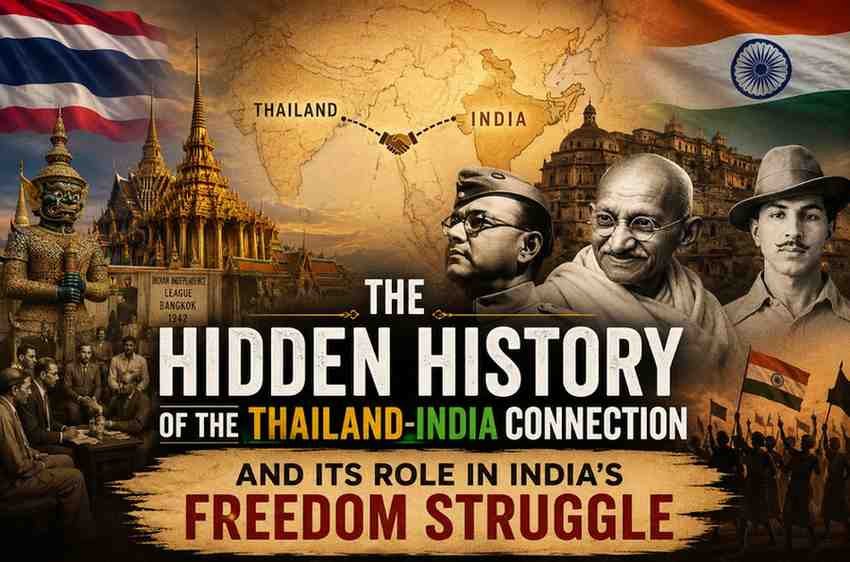
When people think about India’s freedom struggle, cities such as Delhi, Kolkata and Mumbai naturally come to mind. Yet some of the story unfolded far beyond India’s borders. One of the lesser-known chapters involves Thailand, where a vibrant Indian community and a web of cultural connections became intertwined with the quest for independence.
The relationship between India and Thailand stretches back thousands of years, rooted in religion, trade, language and art. But during the turbulent decades of the twentieth century, these ties took on a new significance, as Southeast Asia emerged as a theatre of anti-colonial activism and nationalist aspirations.
Today, as both countries strengthen economic and strategic cooperation, revisiting this shared history reveals that the India-Thailand partnership is built on much more than contemporary interests—it is founded on centuries of interconnected civilizations.
Ancient Roots: A Relationship Older Than Modern Nations
The connection between India and Thailand predates the formation of both modern states. Indian influences reached Southeast Asia through maritime trade networks, bringing Hinduism, Buddhism, language, literature and artistic traditions.
Several aspects of Thai culture bear traces of Indian heritage:
- Buddhism, which arrived through Indian traditions.
- Sanskrit and Pali influences in language.
- The Ramayana’s adaptation into Thailand’s Ramakien.
- Shared architectural and artistic motifs.
- Religious ceremonies and royal customs.
These exchanges occurred through peaceful interaction rather than conquest, creating one of Asia’s most enduring cultural relationships.
The Indian Diaspora in Thailand
Indian traders and migrants established communities across Thailand over generations. By the early twentieth century, these communities had become economically active and culturally influential.
Many members of the Indian diaspora maintained strong emotional and political connections with their homeland.
As India’s struggle against British colonial rule intensified, Southeast Asia—including Thailand—became an important hub for nationalist activities and networking.
Thailand and the Indian Independence Movement
One of the most fascinating aspects of the Thailand-India connection lies in its association with India’s fight for freedom.
During World War II, Southeast Asia emerged as a crucial region for Indian nationalist efforts. Indian communities across the region supported political movements seeking independence from British rule.
Thailand’s strategic location made it an important point of contact for Indian revolutionaries and organizations connected with the broader independence movement.
Indian expatriates living in Thailand contributed resources, support and organizational networks that helped sustain nationalist aspirations during difficult times.
Subhas Chandra Bose and Southeast Asia’s Importance
No discussion of the region’s role in India’s independence struggle is complete without mentioning the significance of Southeast Asia in the activities associated with Netaji Subhas Chandra Bose and the Indian National Army (INA).
Communities across countries such as Thailand, Singapore and Myanmar played vital roles in mobilizing support.
Fundraising efforts, community networks and patriotic sentiment among overseas Indians became important components of the larger movement.
Though India’s independence ultimately came through multiple forces and decades of struggle, the contributions made by Indians abroad remain an integral part of that story.
Comparison: Ancient Cultural Links vs Modern Strategic Partnership
| Historical Relationship | Contemporary Relationship |
|---|---|
| Buddhism and spirituality | Trade and investment |
| Maritime commerce | Economic cooperation |
| Cultural exchange | Tourism and connectivity |
| Shared mythology and traditions | Strategic partnerships |
| Support during independence movement | Indo-Pacific cooperation |
An Insight Competitors Often Miss: India’s Freedom Movement Was Truly Global
Popular narratives often portray India’s independence struggle as a movement confined within the subcontinent. In reality, it had a distinctly international dimension.
Indian communities in Southeast Asia, Africa, Europe and North America contributed financially, politically and intellectually to the cause.
The story of Thailand’s connection reminds us that independence movements are rarely isolated. They are sustained by networks of people bound together by shared aspirations, even across oceans and borders.
Understanding these transnational connections offers a richer and more inclusive picture of history.
Why Buddhism Strengthened the Bond
Buddhism remains one of the strongest cultural bridges between India and Thailand.
Thailand regards India as the birthplace of Buddhism, and pilgrimage to sites such as Bodh Gaya, Sarnath and Kushinagar holds deep spiritual significance for Thai Buddhists.
These shared traditions have fostered goodwill and people-to-people connections for centuries.
Unlike many international relationships driven purely by economics, the India-Thailand bond also carries emotional and spiritual dimensions.
Modern Relations: From Culture to Commerce
Today, India and Thailand enjoy expanding cooperation across multiple sectors.
- Trade and investment.
- Maritime security.
- Tourism and aviation.
- Education and technology.
- Regional connectivity projects.
- Indo-Pacific cooperation.
Thailand occupies an important position in India’s Act East policy, while India represents a major partner for Thailand’s engagement with South Asia.
The Growing Importance of the Bay of Bengal
The Bay of Bengal is once again emerging as a strategic and economic corridor connecting South and Southeast Asia.
Infrastructure initiatives and regional partnerships are reviving ancient maritime routes that once facilitated cultural and commercial exchange between India and Thailand.
In some ways, history appears to be coming full circle.
Prediction: India-Thailand Ties Will Become Even Stronger
As geopolitical realities evolve, the relationship between India and Thailand is likely to deepen further.
Areas expected to see greater cooperation include:
- Digital economy.
- Supply chain resilience.
- Tourism.
- Defense cooperation.
- Renewable energy.
- Cultural diplomacy.
The foundation for this partnership is strengthened by centuries of trust and shared heritage.
Why This Hidden History Matters Today
Historical memory shapes modern relationships.
Remembering Thailand’s role in supporting Indian communities and nationalist aspirations during the freedom struggle highlights the importance of diaspora networks and international solidarity.
It also reminds us that history is rarely confined within national borders.
The ties between nations are often built not only through treaties and diplomacy, but through culture, faith and the collective dreams of ordinary people.
Conclusion
The story of the Thailand-India connection is one of remarkable continuity. From ancient cultural exchanges and Buddhist traditions to support during India’s independence movement and today’s strategic partnership, the relationship spans centuries rather than decades.
While much attention is paid to contemporary diplomacy, the deeper story lies in the enduring human connections that have linked the two civilizations for generations.
Long before globalization became a buzzword, India and Thailand were already connected by faith, trade and shared aspirations—a reminder that some partnerships are not created by history, but carried through it.
For breaking news and live news updates, like us on Facebook or follow us on Twitter and Instagram. Read more on Latest Entertainment on thefoxdaily.com.

COMMENTS 0