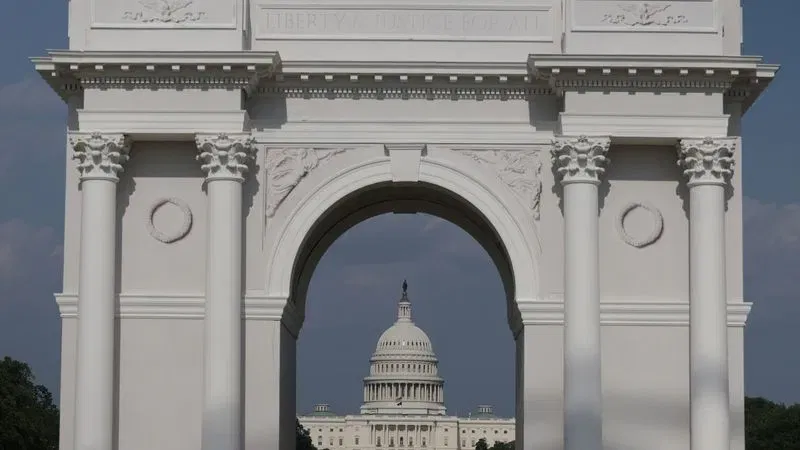
President Donald Trump‘s proposed 250-foot Triumphal Arch in Washington, D.C., is approaching a critical approval stage, with the National Capital Planning Commission expected to vote on the controversial monument on November 5, 2026. The project could move towards construction almost immediately after receiving the necessary federal approvals, although a separate legal battle could still prevent work from beginning.
The proposed monument would stand at Memorial Circle, near Arlington Memorial Bridge, between the Lincoln Memorial and Arlington National Cemetery. Trump has presented the structure as a landmark celebrating America’s 250th anniversary, but the proposal has attracted opposition from local governments, military veterans, historic preservationists and residents concerned about its size, location and legal authorisation.
One particularly notable detail is the difference between Trump’s earlier description of the arch and the final plans submitted for federal review. The president previously suggested that the monument would include a military complex featuring drones and sniper positions. However, the submitted architectural documents do not specifically identify drones, ammunition storage or sniper facilities as components of the approved design.
The dispute now involves two parallel questions: whether federal authorities can approve and begin building the monument, and whether the administration has the legal authority to construct it without additional congressional approval.
National Capital Planning Commission Prepares to Vote on Trump’s Arch
The National Capital Planning Commission (NCPC), the federal body responsible for reviewing major construction and planning proposals in the national capital region, is expected to consider the final plans for Trump’s proposed arch.
The commission’s decision is important because approval would remove a major administrative obstacle facing the project. The Trump administration has indicated that it wants construction-related work to begin as soon as possible after the necessary authorisations are completed.
The commission is chaired by Mark Paoletta, who was appointed to the position in August 2026. Paoletta also serves as general counsel at the Office of Management and Budget.
During the commission meeting, Paoletta expressed strong support for the proposal, describing the absence of such a monument as a national disgrace and praising Trump’s vision for the project.
He also described the proposed structure as potentially the grandest arch ever built by mankind.
However, the commission’s anticipated approval does not automatically settle the legal questions surrounding the project. Federal planning approval and judicial review are separate processes, meaning construction could still face restrictions if a court determines that the administration has failed to meet legal requirements.
Opponents have therefore focused on preventing construction from beginning before the courts decide whether the project can legally proceed.
Why Trump’s 250-Foot Arch Is Facing Strong Opposition
The proposed arch has become controversial primarily because of its location, extraordinary height and potential impact on Washington’s historic landscape.
Memorial Circle occupies an important position along the Arlington Memorial Bridge corridor. The surrounding area connects major national landmarks and provides a visual relationship between Washington’s monuments and Arlington National Cemetery.
Preservationists argue that placing a massive new structure in this location would fundamentally change the historic character of the area.
Concerns About the Lincoln Memorial and Arlington National Cemetery
One of the main objections concerns the historic sightline between the Lincoln Memorial and Arlington National Cemetery.
Opponents argue that the proposed arch would interrupt a carefully established visual relationship associated with the history of national reconciliation following the American Civil War.
The connection between the Lincoln Memorial and Arlington is more than a matter of architectural appearance. It forms part of Washington’s broader commemorative landscape, which includes monuments and memorials designed to communicate historical relationships through their placement.
Preservationists believe that introducing a 250-foot structure into this corridor could permanently alter how visitors experience the surrounding landmarks.
In their legal arguments, they have also questioned whether the proposed site is appropriate for a monument of this scale, particularly given its proximity to Arlington National Cemetery.
Why the Height of the Monument Matters
The proposed arch would stand approximately 250 feet tall, making it considerably larger than many structures in the surrounding memorial landscape.
Its height has become one of the central issues in the legal challenge brought by Washington, D.C., and Virginia.
The two jurisdictions argue that the structure conflicts with federal restrictions that generally limit building heights in Washington to 130 feet under the Height of Buildings Act.
At approximately 250 feet, the proposed monument would exceed that general limit by nearly 120 feet.
The administration disputes the legal challenge and argues that historical congressional authorisation provides a basis for proceeding with the project.
Whether that argument applies to the proposed arch is one of the important legal questions that could determine its future.
Final Plans Do Not Include Trump’s Proposed Snipers and Drones
One of the most unusual aspects of the project is the difference between Trump’s public description of the monument and the features included in its formal architectural plans.
Trump previously suggested that the arch would serve a national security purpose and include a military complex equipped with drones and sniper positions.
He presented these features as important components of the project, connecting the monument’s design with broader security considerations.
However, the final plans submitted to the National Capital Planning Commission do not specifically identify sniper positions, drones or ammunition storage facilities.
This omission has attracted attention because the military-related features were part of the president’s earlier public explanation for the project.
What the Submitted Plans Actually Show
The architectural documents focus primarily on the monument’s physical design, visitor facilities and associated infrastructure.
The proposed structure includes an observation area and other facilities associated with its intended ceremonial and visitor functions.
The absence of explicit military installations in the submitted documents creates an important distinction between the project’s publicly discussed security ambitions and the design currently undergoing federal review.
It does not necessarily establish that no security-related features could ever be considered. However, drones, sniper positions and ammunition storage are not identified as specific components in the plans described in the supplied documents.
The distinction is legally relevant because substantial changes to a project’s purpose or design can raise additional planning, security and environmental review questions.
For now, the commission is considering the submitted architectural proposal rather than a separately documented military installation.
Virginia and Washington, D.C., Take Legal Action to Stop Construction
The proposed arch is facing multiple legal challenges, including a joint lawsuit filed by Virginia and Washington, D.C.
The two jurisdictions are seeking an emergency court order to prevent the administration from beginning construction before the legal disputes are resolved.
Their argument is that the project violates several federal laws and could create lasting problems for transportation, environmental protection, public safety and Historic Preservation.
They also argue that the construction process itself could cause significant disruption to both jurisdictions.
Their lawsuit identifies at least five federal statutes that they believe the project would violate, including legal restrictions concerning building heights in Washington.
Why Virginia and D.C. Want an Immediate Construction Ban
The governments have asked the court to intervene before construction begins rather than waiting until work is already underway.
Their concern is that the administration could begin construction and subsequently argue that stopping the project would create additional harm or security problems.
In their filing, the jurisdictions warned that once construction begins, the federal government could argue that a court order halting work would cause irreparable damage to the government or disrupt the status quo.
They described this possibility as a potential legal strategy that should not be allowed to undermine judicial review.
The argument highlights a practical problem in large infrastructure disputes: preventing construction before it starts can be considerably different from attempting to stop a project after substantial work has already been completed.
If foundations, excavation or other permanent construction activities begin, the legal and financial consequences of suspending the project could become more complicated.
Traffic and Environmental Concerns
Virginia and D.C. have also raised concerns about the location of the proposed monument and its impact on the surrounding transportation network.
Memorial Circle is situated along an important route connecting Washington with Virginia. Construction activities could affect traffic movement, road access and the ability of emergency services to operate efficiently.
The jurisdictions argue that the project could require substantial public resources to manage these effects.
Environmental concerns are another part of their case. The proposed site is close to the Potomac River, whose surrounding environment falls under the District’s statutory responsibilities.
Opponents contend that construction could affect the river environment and create additional environmental management requirements.
These concerns extend beyond the appearance of the finished monument. They involve the practical consequences of building a large structure in an already heavily used transportation and historic corridor.
Judge Tanya Chutkan Weighs Whether to Halt the Project
US District Judge Tanya Chutkan is considering the legal challenges against the proposed arch and has asked to be notified following the planning commission’s decision.
Her involvement is particularly important because the federal government’s expected construction timetable is moving ahead while the legal questions remain unresolved.
The judge has been considering whether to issue an order temporarily preventing construction until the underlying legal disputes are addressed.
The plaintiffs want the court to stop the administration from taking construction-related steps that could change the physical condition of the site before the case is decided.
The commission’s anticipated approval could therefore become an important development in the case, but it would not necessarily mean that the administration has received permission to proceed without further legal scrutiny.
Why the Timing of the Court’s Decision Matters
The timing is important because the administration has indicated that it wants to move quickly following federal planning approval.
If construction begins before the court issues an injunction, opponents could face a more complicated situation when seeking to stop the work.
On the other hand, if the judge orders a temporary halt, the administration could be prevented from proceeding while the legal arguments are examined.
The court will need to consider the legal authority for the project, the arguments presented by the plaintiffs and the potential consequences of allowing construction to move forward.
The judge’s decision could therefore have a direct impact on whether the proposed monument advances beyond the planning stage.
Trump Administration Argues Congress Already Authorised the Project
The Trump administration has rejected the arguments made by Virginia and Washington, D.C., maintaining that the proposed monument has a legal foundation in earlier congressional action.
In its court filings, the administration argued that Congress authorised the construction of structures at the location approximately a century ago.
Its legal position relies partly on historical plans involving the Memorial Bridge, including a proposal for 166-foot-tall columns topped with statues.
According to the administration, those earlier authorisations provide a legal basis for proceeding with the new monument despite the objections raised by the jurisdictions.
Why the Memorial Bridge Act Is at the Centre of the Dispute
The administration has referred to the Memorial Bridge Act as part of its defence, arguing that Congress previously authorised substantial structures associated with the bridge.
However, attorneys representing Virginia and Washington, D.C., have challenged this interpretation.
They argue that the earlier proposal involved columns intended to accompany the Memorial Bridge, not a triumphal arch.
According to their filings, the original columns were ultimately dropped from the bridge project.
The attorneys also pointed out that the Memorial Bridge Act does not specifically mention an arch.
This disagreement raises an important legal question: does congressional authorisation for an earlier monument-related design extend to a substantially different structure proposed decades later?
The administration believes the historical authorisation supports its position. The opposing jurisdictions argue that the earlier legislation cannot be interpreted as permission to build the proposed arch.
Ultimately, the courts will have to assess the relevant legislation and determine whether the administration’s interpretation is legally sufficient.
Preservationists and Military Veterans Also Oppose the Arch
The legal challenges did not begin with Virginia and Washington, D.C. Preservationists and military veterans had already filed a separate lawsuit seeking to prevent the project from moving forward.
Their concerns focus on the monument’s location, its impact on the historic landscape and whether Congress has authorised the construction.
The involvement of military veterans adds another dimension to the dispute because the proposed structure would occupy a prominent location near Arlington National Cemetery, one of America’s most significant military burial grounds.
Opponents argue that the monument could alter the historic character of the surrounding memorial landscape and undermine the visual relationship between important national sites.
Their position is that a project of this scale should not proceed without the necessary legal approvals and consideration of its impact on the surrounding area.
With Virginia and Washington, D.C., filing their own legal action, the dispute has expanded beyond preservation concerns to include transportation, environmental responsibilities and the interests of local governments.
What Happens If the Commission Approves Trump’s Arch?
If the National Capital Planning Commission approves the proposal, the Trump administration could move closer to beginning construction-related activities.
However, several separate steps and legal questions remain important.
The administration has indicated that construction could begin after the planning commission’s approval, the Interior Department’s final authorisation and the required public notification.
The anticipated approval should therefore not be confused with an automatic start to unrestricted construction.
The ongoing court proceedings could still affect the project’s timetable.
Three Possible Developments
1. Construction moves forward: If the commission approves the plans and the court does not issue an injunction, the administration could proceed with the necessary authorisations and construction preparations.
2. The court temporarily blocks construction: Judge Tanya Chutkan could issue an order preventing work from beginning while the legal challenges are considered.
3. The legal dispute continues: The commission could approve the project while the court proceedings continue, leaving the monument’s eventual construction dependent on the outcome of the litigation.
These possibilities demonstrate why the planning commission’s decision and the judge’s ruling are both important. Administrative approval addresses one part of the process, while the courts must consider whether the project complies with applicable laws.
Why Trump’s Washington Arch Is More Than a Monument Dispute
The controversy surrounding the Triumphal Arch raises broader questions about presidential authority, congressional oversight and the preservation of public spaces in Washington.
Large national monuments are not simply architectural projects. Their locations, designs and historical meanings can influence how future generations understand the country’s political and military history.
In this case, the proposed structure would occupy a highly visible position near several important American landmarks. That makes decisions about its height, design and placement particularly significant.
The dispute also highlights the relationship between the federal government and local jurisdictions. Although the proposed monument is a federal project, its construction could affect roads, emergency services, environmental responsibilities and communities across the D.C.-Virginia region.
Another important issue is the distinction between a monument’s symbolic purpose and its proposed security functions. Trump’s earlier references to drones and snipers generated additional questions, but the formal architectural plans do not specifically identify those installations.
For opponents, the immediate priority is preventing construction until the courts determine whether the administration has the necessary authority. For the administration, securing approval and moving forward with the project remain central objectives.
What to Watch Next in the Trump Arch Controversy
The next major developments will depend on the National Capital Planning Commission’s decision and Judge Tanya Chutkan’s response to the requests for emergency relief.
Several questions remain unresolved:
- Will the National Capital Planning Commission approve the final architectural plans?
- Will Judge Tanya Chutkan temporarily block construction?
- Does the historical congressional authorisation cited by the administration legally cover the proposed arch?
- Will the administration need additional congressional approval or further reviews?
- Will the final project include any security features beyond those identified in the submitted plans?
The answers will determine whether Trump’s proposed 250-foot monument moves towards construction or becomes the subject of a longer legal battle.
For now, the project faces an unusual situation: it appears close to receiving an important federal planning approval, but its legal foundation remains contested.
The missing references to drones, sniper positions and ammunition storage also leave a distinction between the president’s earlier description and the design currently under consideration.
Ultimately, the future of Trump’s Triumphal Arch will depend not only on the planning commission’s vote but also on whether the administration can overcome the legal challenges raised by Virginia, Washington, D.C., military veterans and preservationists.
The central question is no longer simply how large the monument will be or when construction might begin. It is whether the proposed arch can legally be built at one of the most historically significant locations in the American capital.
For breaking news and live news updates, like us on Facebook or follow us on Twitter and Instagram. Read more on Latest World on thefoxdaily.com.






COMMENTS 0