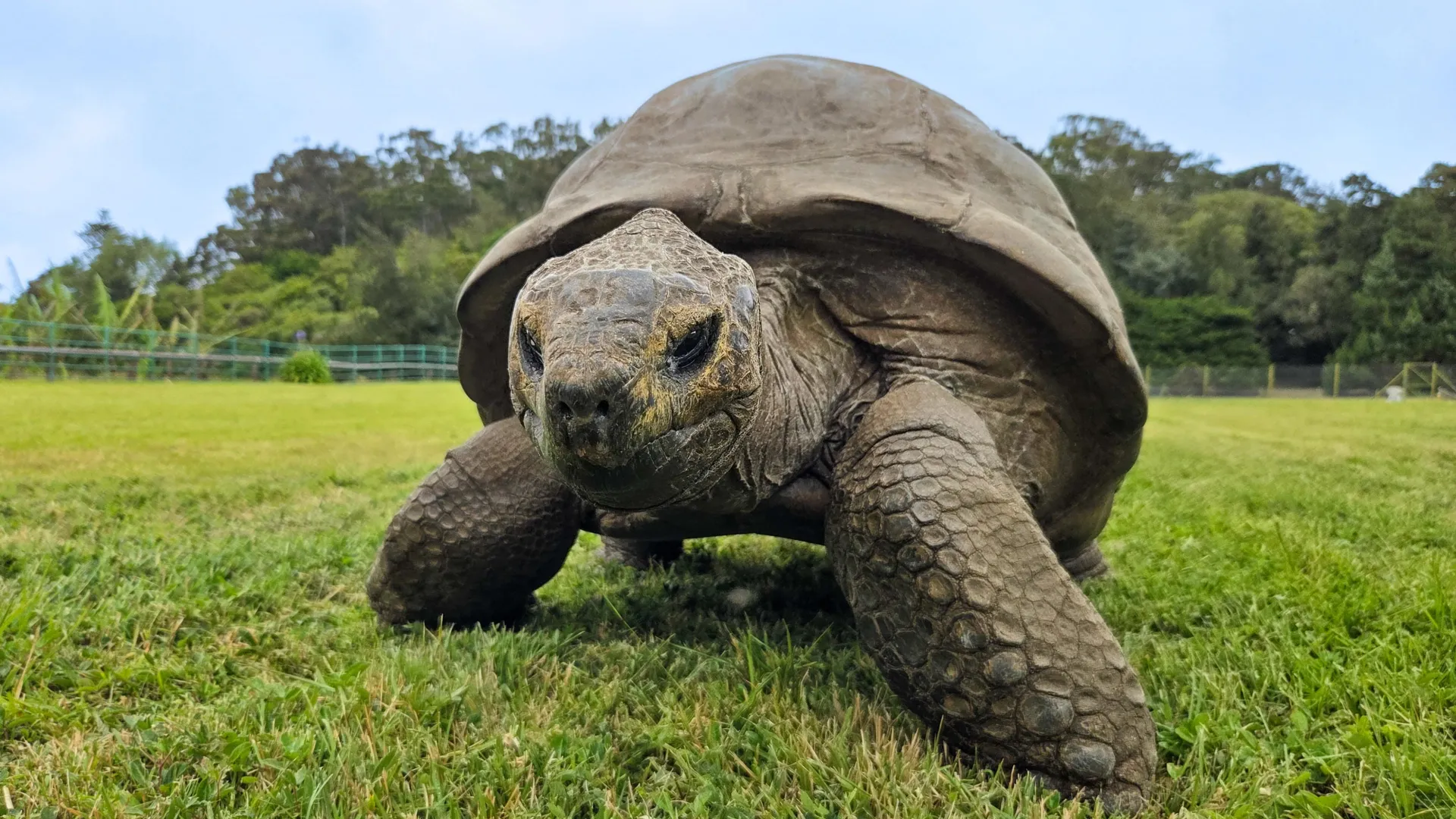
Jonathan, an Aldabra giant tortoise believed to have hatched in 1832, is offering scientists a rare opportunity to investigate one of biology’s biggest questions: why do some animals age far more slowly than others? At an estimated 194 years old, he is recognised as the oldest known living land animal. Researchers examining his genetic material have identified 287 distinctive genetic variants potentially associated with DNA repair, metabolism, inflammation regulation and cellular stability.
The findings, published in the journal Science Advances, could help scientists understand the biological mechanisms that allow certain species to maintain healthy cellular functions over exceptionally long lifespans. Researchers also examined Jonathan’s epigenome, which helps regulate how genes are switched on and off, and found signs of remarkable stability compared with younger giant tortoises of the same species.
The research has attracted interest because several of the biological processes identified are also important in human ageing. However, scientists caution that Jonathan’s genetic profile is not a ready-made formula for extending human life. The study provides potential clues, not proof that the same genetic mechanisms can be reproduced safely in people.
Key Findings From the Study of Jonathan’s DNA
- Estimated age: Jonathan is believed to have hatched in 1832 and is approximately 194 years old in 2026.
- Genetic findings: Researchers identified 287 distinctive genetic variants that may be associated with longevity and cellular resilience.
- Biological processes: The variations are linked to DNA repair, energy metabolism, inflammation regulation and insulin-related pathways.
- Epigenetic stability: Researchers observed comparatively stable epigenetic markers in Jonathan against younger giant tortoises of the same species.
- Relevance to humans: The findings could guide future ageing research, but further studies are needed before any human-health applications can be considered.
Jonathan’s Life: From the Seychelles to St Helena
Jonathan belongs to the Aldabra giant tortoise species, scientifically known as Aldabrachelys gigantea. He is believed to have hatched in 1832, making him older than many major developments in modern history. His estimated age of 194 years places him among the most extraordinary examples of animal longevity ever documented.
He lives on the grounds of Plantation House, the official residence of the governor of St Helena, a British Overseas Territory in the South Atlantic Ocean. Jonathan arrived on the island from the Seychelles in 1882 as a gift to the governor. He was already fully grown when he made the journey, meaning he had lived for several decades before reaching his present home.
His life has extended across nearly two centuries of social, scientific and technological change. While most animals experience significant physical and biological deterioration as they age, Jonathan has continued to survive far beyond the typical lifespan expected for his species.
His remarkable age has made him an important subject for longevity researchers. Rather than simply examining how long he has lived, scientists are investigating the biological processes that may have helped his cells maintain essential functions over such an extended period.
What Did Scientists Discover in Jonathan’s Genome?
The research team, led by scientists associated with the US-based longevity research organisation Kallel, examined Jonathan’s genome to identify genetic differences that might be relevant to his exceptional lifespan.
The study identified 287 genes containing distinctive genetic variants found in Jonathan. These are known as unique nonsynonymous single-nucleotide variants, or nsSNVs. Such variations can change the amino acids used to build proteins and may therefore influence how particular proteins function.
Importantly, the finding does not mean scientists discovered 287 separate genes that independently prevent ageing. Instead, the researchers identified genetic differences in genes associated with several biological pathways involved in maintaining cellular health.
Some of the most interesting findings involved:
- DNA repair: Genetic differences in genes associated with repairing damaged DNA may offer clues about how cells maintain their genetic integrity over time.
- Telomere maintenance: Variations in genes involved in telomere-related processes could help researchers investigate how cells manage chromosome protection and ageing.
- Insulin regulation: Differences in genes connected to glucose and insulin signalling may provide insight into metabolic processes associated with longevity.
- Autophagy: Genetic variations involving cellular recycling mechanisms could help explain how cells remove damaged components and maintain their internal environment.
- Cancer protection: Variations in genes associated with tumour suppression and cellular repair may offer clues about how exceptionally long-lived animals manage cancer-related risks.
The researchers used computational approaches to assess the potential functional importance of the identified genetic differences. Their analysis highlighted several genes associated with ageing research, including POT1, FOXO3, ERCC1 and TP53BP1.
These genes are connected to processes such as telomere protection, autophagy, DNA repair and the response to genetic damage. Their presence in the analysis provides potential directions for future research, but it does not establish that any single variation is responsible for Jonathan’s longevity.
Why DNA Repair Could Be Important for Living Longer
DNA carries the instructions that cells use to function, grow and reproduce. Over time, genetic material can accumulate damage from normal cellular activity and environmental factors. If that damage is not properly repaired, it can interfere with essential biological processes.
Cells have several mechanisms for detecting and repairing damaged DNA. These repair systems help preserve genetic stability and reduce the risk of mutations accumulating over time.
Scientists studying Jonathan identified distinctive genetic features involving DNA repair pathways. Some of the genes highlighted in the research, including POLQ and POLE2, were among those containing unique variants in his genome.
The researchers also examined genes associated with DNA repair in their wider comparison of giant tortoises. Their findings suggest that the genetic characteristics of exceptionally long-lived animals could help scientists understand how different species maintain cellular stability over extended periods.
However, DNA repair is only one part of the ageing process. Longevity is influenced by multiple interacting systems, including metabolism, immune responses, cellular maintenance and environmental conditions. Jonathan’s genetic profile offers clues about these systems rather than a complete explanation of why he has survived for nearly two centuries.
Jonathan’s Epigenome May Hold an Even More Important Clue
One of the most significant aspects of the research involved Jonathan’s epigenome. While the genome contains an organism’s DNA sequence, the epigenome consists of chemical modifications that influence how genes are activated or suppressed without changing the underlying genetic code.
These regulatory mechanisms help determine when particular genes are switched on or off. They are essential because different cells need to activate different sets of genes to perform their specific functions.
As organisms age, their epigenetic patterns can change. Some genes may become less active, others may become more active, and the overall organisation of gene regulation can become less stable. Such changes are associated with ageing and the gradual deterioration of cellular functions.
To investigate whether Jonathan showed unusual patterns, researchers compared his epigenome with those of four other Aldabra giant tortoises ranging from a five-year-old juvenile to older adults.
The comparison revealed distinctive DNA methylation patterns in Jonathan. DNA methylation is a chemical process in which methyl groups attach to DNA and influence gene activity. Researchers also examined methylation entropy, a measure of how organised or disordered these chemical patterns are across particular regions of the genome.
One notable finding was that regions with lower methylation entropy in Jonathan were enriched around the promoters of genes involved in the mitochondrial electron transport chain and RNA metabolism. These processes are important for cellular energy production and the accurate handling of genetic instructions.
The findings suggest that maintaining organised gene regulation in these regions could be important for exceptionally long-lived species. The researchers proposed that efficient energy production, RNA processing and DNA repair may work together to support long-term cellular stability.
How Mitochondria and Energy Production Fit Into the Research
Mitochondria are structures inside cells that play a central role in producing the energy required for biological activity. They are often described as the cell’s powerhouses because they help generate adenosine triphosphate, or ATP, which supplies energy for numerous cellular processes.
Energy production is closely connected to cellular maintenance. DNA repair, protein processing and other essential functions require energy to operate effectively. If these systems become less efficient, cells may struggle to maintain their normal activities.
The researchers’ findings concerning Jonathan’s methylation patterns suggest a possible connection between mitochondrial function and the maintenance of stable gene regulation. They proposed a model in which efficient energy production supports DNA repair and the preservation of important regulatory patterns.
This is a proposed biological explanation, not a proven mechanism. The study’s authors acknowledged that their data were not sufficient to establish direct cause and effect. Nevertheless, the relationship between energy metabolism, genetic repair and ageing provides an important direction for future investigations.
Can Jonathan’s DNA Help Scientists Slow Human Ageing?
The discovery has generated interest because many of the biological processes identified in Jonathan are also relevant to human health. DNA repair, insulin regulation, mitochondrial function, telomere maintenance and cellular recycling are all areas of active ageing research.
Scientists hope that studying species capable of surviving for exceptionally long periods could reveal biological mechanisms that are less prominent in shorter-lived animals. If researchers can understand how these mechanisms operate, they may eventually identify new approaches to protecting human cells against age-related damage.
However, translating findings from a giant tortoise into human treatments is a major scientific challenge. Humans and tortoises have different biological characteristics, lifespans, metabolic requirements and evolutionary histories. A genetic variation that appears beneficial in one species may not have the same effect in another.
There is also a difference between identifying a genetic feature associated with longevity and proving that it can be used to extend life. Scientists would need to establish how the relevant genes function, determine whether similar mechanisms exist in humans and investigate whether modifying those pathways would be safe.
The study therefore does not suggest that a particular medicine, supplement or genetic treatment can reproduce Jonathan’s lifespan in humans. Its value lies in identifying potential biological mechanisms that researchers can investigate further.
Important Limitations: What the Study Does Not Prove
Although the findings are significant for longevity research, several limitations need to be considered before drawing broad conclusions.
- Only one exceptionally old tortoise was studied: Jonathan’s genome cannot establish whether the identified genetic features are common among other long-lived Aldabra tortoises.
- Genetic associations do not prove causation: The presence of particular variants does not demonstrate that they directly caused his extraordinary lifespan.
- The comparison group was limited: Researchers examined Jonathan alongside four other Aldabra tortoises for the epigenetic analysis, leaving a relatively small sample for comparison.
- Environmental influences remain relevant: Diet, habitat, veterinary care and other conditions may also contribute to an animal’s health and survival.
- Human applications remain uncertain: The findings cannot be directly translated into treatments for people without extensive additional research.
Another important consideration is that Jonathan’s age is estimated rather than established through a precise birth record. He was already fully grown when he arrived in St Helena in 1882, and his estimated birth year of 1832 is used to calculate his current age.
These limitations do not diminish the scientific value of the research. Instead, they explain why the findings should be viewed as an important starting point for understanding extreme longevity rather than a final answer to the ageing process.
What Makes Jonathan’s Research Different From Earlier Longevity Studies?
Scientists have previously investigated exceptionally long-lived animals to understand how evolution has shaped biological ageing. Giant tortoises, bowhead whales and certain other species have attracted attention because they can survive for unusually long periods compared with animals of similar size or biological complexity.
Jonathan’s study adds a different dimension by combining genome sequencing with an examination of DNA methylation patterns. This allowed researchers to investigate not only which genetic variations he possesses but also how chemical markers regulate the activity of his genes.
The research is particularly notable because it represents the first examination of the epigenome of a giant tortoise. By comparing Jonathan with younger members of his species, scientists could explore whether some of the regulatory mechanisms associated with essential cellular functions had remained unusually stable.
The study also builds on previous research into giant tortoise genetics, including work involving Lonesome George, the last known individual of the Pinta Island tortoise subspecies. Comparing genetic information across these animals helps researchers identify biological features that may be relevant to longevity across different tortoise lineages.
Jonathan’s 194-Year Life Could Open New Questions About Ageing
Jonathan’s extraordinary lifespan is more than a remarkable biological record. It offers researchers an opportunity to examine how an animal can maintain essential cellular processes for nearly two centuries.
The identification of 287 genes containing unique genetic variants, together with the analysis of his epigenome, has highlighted several potential contributors to cellular resilience. DNA repair, mitochondrial energy production, insulin regulation, telomere maintenance and organised gene regulation have emerged as important areas for further investigation.
Stephen Clark, founder of Kallel and senior author of the study, described Jonathan’s genome as a potential blueprint for cellular resilience. The broader ambition is to use evolutionary insights to explore practical and affordable approaches to human health and longevity.
For now, the research does not reveal a single secret that explains how Jonathan reached an estimated age of 194. Instead, it suggests that exceptional longevity may involve several biological systems working together to preserve cellular function and limit age-related damage.
As scientists continue studying long-lived animals, Jonathan’s DNA could help deepen understanding of why ageing progresses differently across species. His remarkable life may not provide a direct path to a 194-year human lifespan, but it offers a valuable opportunity to investigate the biological processes that allow life to endure for so long.
For breaking news and live news updates, like us on Facebook or follow us on Twitter and Instagram. Read more on Latest Technology on thefoxdaily.com.


COMMENTS 0