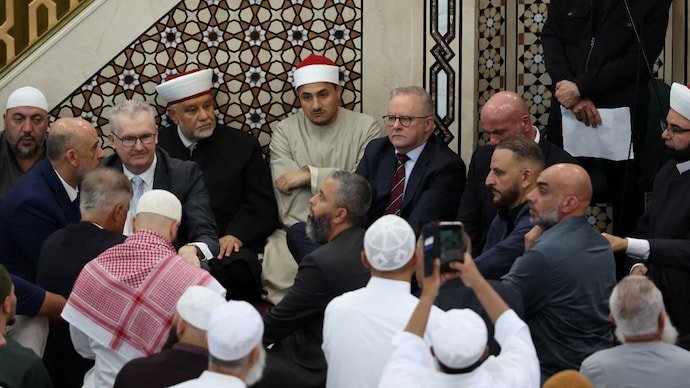
Australian Prime Minister Anthony Albanese faced protests and loud heckling during a visit to a major mosque in Sydney, highlighting growing tensions within sections of the Muslim community over the government’s stance on the ongoing Gaza conflict.
The incident took place at Lakemba Mosque, one of Australia’s largest Islamic centers, where Albanese and Home Affairs Minister Tony Burke had been invited to attend Eid-ul-Fitr prayers marking the end of Ramadan. What was intended as a gesture of outreach and community engagement quickly escalated into a politically charged confrontation.
What Happened at Lakemba Mosque?
As the leaders attended the event, a section of the crowd began chanting slogans and booing, disrupting the proceedings during a speech by a mosque official. Some attendees shouted “get out of here” and accused the Prime Minister of supporting actions in Gaza, using phrases like “genocide supporters.”
Videos circulating on Social Media captured the tense atmosphere, with chants of “Allahu Akbar” echoing across the gathering. Eyewitnesses reported that several individuals openly questioned Albanese’s presence at the religious event.
According to media reports, one protester was briefly detained by police after shouting at the Prime Minister. He was later released without charges after being issued a move-on order.
Visit Cut Short Amid Security Concerns
As the situation intensified, Albanese and his delegation left the venue earlier than planned. The Prime Minister was seen navigating through a crowd gathered near the mosque’s entrance while facing continued jeers.
Despite the disruption, officials indicated that the visit was conducted under tight security, and no major incidents of violence were reported.
| Key Detail | Information |
|---|---|
| Location | Lakemba Mosque, Sydney |
| Event | Eid-ul-Fitr prayers (end of Ramadan) |
| Key Figures | Prime Minister Anthony Albanese, Minister Tony Burke |
| Nature of Protest | Booing, slogans, accusations over Gaza conflict |
| Police Action | One protester detained, later released without charges |
Community Reaction and Mosque’s Response
The Lebanese Muslim Association, which manages the mosque, defended its decision to invite the Prime Minister, emphasizing the importance of engaging with elected leaders rather than isolating them.
In an official statement, the association clarified that inviting political figures does not equate to endorsing their policies. Instead, it argued that such interactions provide an opportunity for the community to directly voice concerns.
“Engagement is how communities make themselves heard,” the statement noted, stressing that dialogue is essential for meaningful representation.
Political Context: Gaza War and Domestic Tensions
The protests come amid heightened emotions within Australia’s Muslim population over the government’s response to the Gaza war. Many community members have expressed frustration over perceived policy positions and have also raised concerns about rising Islamophobia domestically.
At the same time, Australia has seen an increase in reports of both antisemitism and anti-Muslim sentiment, reflecting broader global polarization linked to the conflict.
Albanese’s Response
Speaking to the media after the incident, Albanese downplayed the scale of the protests, stating that the majority of the estimated 30,000 attendees were welcoming.
“Overwhelmingly, the reception was incredibly positive,” he said, suggesting that the disruption came from a small group rather than representing the broader community.
He also indicated that the protests may be linked to recent government actions, including efforts to ban extremist organizations such as Hizb ut-Tahrir under new legislation.
Broader Security Concerns in Australia
The incident unfolds against a backdrop of heightened security awareness in Australia. The government has recently taken stronger measures against extremist ideologies following a deadly attack at Bondi Beach last year, which intensified national debates around security, radicalization, and social cohesion.
Authorities remain cautious as they attempt to balance national security concerns with maintaining harmony in a multicultural society.
A Reflection of Growing Polarization
The confrontation at Lakemba Mosque underscores how international conflicts are increasingly influencing domestic Politics and community relations. What was intended as a symbolic gesture of unity instead exposed deep divisions and frustrations.
As global tensions continue to reverberate locally, such incidents highlight the challenges governments face in addressing foreign policy concerns while maintaining trust and cohesion at home.
For breaking news and live news updates, like us on Facebook or follow us on Twitter and Instagram. Read more on Latest World on thefoxdaily.com.



COMMENTS 0