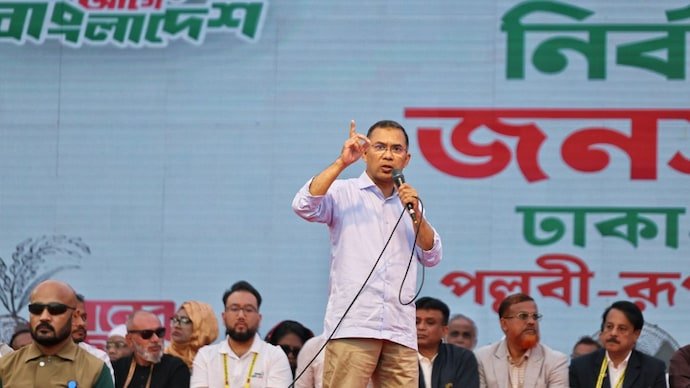
The Bangladesh Nationalist Party (BNP) is on course to form the next government after crossing the simple majority mark in the 13th general elections, marking its return to power after nearly two decades. Early counting trends show the party comfortably surpassing the 151-seat threshold required to form a government in the 300-member Jatiya Sangsad.
With results continuing to emerge from constituencies nationwide, overall patterns suggest little likelihood of a dramatic shift in the final tally. The decisive mandate represents a major political turnaround for Bangladesh, particularly following years of political turbulence and the 2024 uprising.
BNP’s Return Under Tarique Rahman’s Leadership
The BNP, which last formed the government in 2001, declared victory as counting trends pointed to a landslide under the leadership of Tarique Rahman. Party leaders described the result as a strong endorsement of their campaign platform and reform promises.
According to local media reports, the BNP-led coalition secured 209 seats in early morning tallies, well above the majority mark. The party’s performance positions it firmly to lead the next administration once final results are officially confirmed by the Bangladesh Election Commission (EC).
Meanwhile, Jamaat-e-Islami faced a significant setback, with results indicating it would remain in double digits. By around 4 a.m., the party had reportedly secured 56 seats.
Strong Backing for July Charter Reforms
Unofficial results also indicate robust public support for the July Charter — a reform manifesto that emerged from the 2024 uprising and proposes sweeping constitutional changes.
According to reports cited by The Daily Star, approximately 72.9 percent of votes cast favored adopting the charter, while 27.1 percent opposed it. However, the Bangladesh Election Commission has yet to formally announce the official referendum results.
Election-Day Unrest Injures Dozens
Although authorities initially described the polls as largely peaceful, incidents of violence were reported in several regions. Local media stated that more than 70 people were injured in election-related clashes.
The Daily Star reported that at least 72 individuals were injured across 14 separate incidents, many occurring in or near polling stations. Police confirmed that at least nine people were arrested in connection with the disturbances.
The most serious violence occurred in Hatiya in Noakhali district, where 31 people were injured in clashes between supporters of the BNP and the National Citizen Party.
Voting Process and Turnout
Voting proceeded for nine hours, beginning at 7:30 a.m. Citizens cast two separate ballots — one for the parliamentary election and another for the referendum — which were deposited in transparent ballot boxes at 42,659 polling centers across the country.
Of the country’s 300 constituencies, elections were held in 299. The Sherpur-3 seat was postponed following the death of a parliamentary candidate.
According to the Bangladesh Election Commission, nationwide voter turnout stood at 60.69 percent. Of the votes cast, 70.25 percent were declared valid, while 80.11 percent of mail-in ballots were accepted. Many voters described the election as one of the most peaceful and orderly since the 2008 parliamentary polls.
Security Measures and Monitoring
Security was significantly heightened during the voting process. Police patrols were visible in major cities, and Army personnel were deployed at numerous polling centers to maintain order.
Most voting centers were equipped with CCTV cameras, including areas near ballot booths, though some polling compartments reportedly lacked internal surveillance. Election officials stated that the enhanced security presence boosted voter confidence.
Authorities confirmed that no fatalities related to election violence were reported. Approximately one million members of the police, Border Guard Bangladesh, and armed forces were deployed nationwide to ensure a secure voting environment.
Political Landscape Shifts
This election marked the first national vote since the political unrest of 2024 and the first in three decades without the Awami League appearing on the ballot. The absence of the long-dominant party significantly reshaped the electoral contest and contributed to a new political alignment.
As results continue to be finalized, Jamaat-e-Islami leader Shafiqur Rahman stated that his party would avoid engaging in “politics of opposition” for its own sake.
“We will do positive politics,” he told reporters as counting progressed.
With the BNP poised to form the next government, Bangladesh now stands at a pivotal juncture, as voters appear to have endorsed both a change in leadership and a reform-driven political agenda.
For breaking news and live news updates, like us on Facebook or follow us on Twitter and Instagram. Read more on Latest World on thefoxdaily.com.


COMMENTS 0