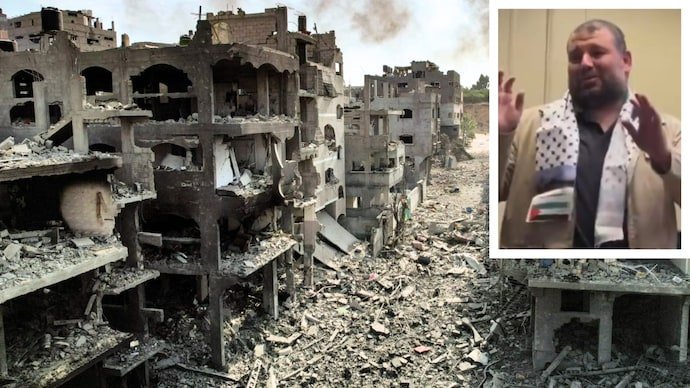
As Pakistan faces mounting pressure from the United States over a potential troop deployment to Gaza, new revelations suggest that Hamas’ footprint has already extended into Pakistani territory. Reports indicate that Naji Zaheer, described as a special envoy of Hamas leader Khaled Mashal, was recently photographed in Pakistan, raising alarms across security and diplomatic circles.
According to multiple reports, Zaheer was invited as a chief guest to an event held at a Lashkar-e-Taiba (LeT) terror camp in Gujranwala, Punjab. The alleged visit has reignited concerns about the deepening nexus between Hamas and Pakistan-based terrorist organizations, particularly at a time when Islamabad is under global scrutiny for its regional role.
Notably, this is not Zaheer’s first reported presence in Pakistan. His activities in the country are said to have intensified following Hamas’ October 7, 2023, attack on Israel—an assault that led to the group being further isolated by Western nations and designated as a major global security threat.
A September 2025 report by the Middle East Media Research Institute (MEMRI) revealed that Zaheer had previously shared platforms with leaders of other designated terrorist organizations, including Pakistan-based Jaish-e-Muhammad (JeM). These interactions, analysts say, point to an expanding ideological and operational overlap among extremist groups operating in the region.
Zaheer also reportedly made a public appearance at the Islamabad High Court Bar Association in April 2024, a visit that went largely unnoticed at the time but has now drawn renewed attention in light of the latest videos.
In the most recent footage circulating online, supporters inside a hall can be heard chanting “Naara-e-Takbeer!” followed by “Allahu Akbar!” as Zaheer is introduced by a moderator and walks onto the dais. The visuals have since gone viral, amplifying concerns over radical messaging and public endorsement.
Intelligence reports further allege that Hamas operatives are being covertly trained by Pakistan’s Inter-Services Intelligence (ISI). While Western nations have moved aggressively to isolate Hamas after the October 7 attacks, Pakistan is accused of offering the group funding, military know-how, and safe havens—an alleged collaboration that poses security risks for both Israel and India.
These concerns are not new. Days before the Pahalgam incident last year, a video surfaced showing Lashkar commander Abu Musa drawing parallels between Gaza and Kashmir, declaring “jihad as the only solution.” In the recording, he stated, “We want freedom, not charity. Our enemies are those who oppose Palestine and Kashmir. When we bring Israel to its knees, we’ll do the same in Kashmir.”
The United States Pressures Pakistan on Gaza Troop Deployment
The emergence of Zaheer’s alleged visit coincides with reports that Washington is urging Islamabad to contribute troops to a Gaza stabilization force. The proposed role would not be limited to security alone but would also involve supporting economic recovery and post-war reconstruction in the conflict-ravaged Palestinian territory.
A December Reuters report noted that Pakistan Army Chief Asim Munir is expected to visit Washington in the coming weeks to meet US President Donald Trump. This would mark their third meeting in six months, with the Gaza stabilization force likely to feature prominently in discussions. Reuters cited a senior figure involved in Munir’s economic diplomacy as confirming the agenda.
Trump’s reported 20-point plan for Gaza includes the complete demilitarization of Hamas and the establishment of an international force to manage a transitional phase, highlighting Washington’s intent to prevent Hamas from regaining military control.
Pakistan Fears Domestic Backlash Over Any Gaza Role
Despite US pressure, Pakistan’s civilian and military leadership appears cautious. Officials fear that deploying troops to Gaza could entangle the country in a prolonged conflict and trigger widespread domestic backlash from pro-Palestinian groups.
The hybrid leadership of Prime Minister Shehbaz Sharif and Army chief Asim Munir faces significant political risks. Any decision to send troops abroad could inflame internal dissent and complicate Pakistan’s already fragile political landscape.
Pakistan’s Foreign Minister Ishaq Dar stated in November that “disarming Hamas is not our responsibility,” though he added that Islamabad would consider participating in peacekeeping missions under specific circumstances.
Pakistan, notably, maintains a battle-hardened military and is the only Muslim-majority nation with nuclear weapons, despite not having won a conventional war—factors that add complexity to its potential role in Gaza.
Is Pakistan’s Gaza Role Complicated by the Hamas Leader’s Visit?
Analysts argue that Islamabad’s hesitation is further reinforced by the reported presence of Hamas leader Naji Zaheer in Pakistan. His alleged ties to Lashkar-e-Taiba and other regional terror groups could complicate any international peacekeeping role Pakistan might seek to assume.
Retired Lieutenant General D.P. Pandey reacted sharply to the videos, stating, “What can Hamas teach Pakistan and its proxies—how to destroy and kill their own people? According to Pakistan’s DG ISPR, Pakistan has already mastered that skill.”
Senior Supreme Court advocate Mahesh Jethmalani echoed similar sentiments on social media platform X. “So much for grand talks of ‘Pakistan Army boots on the ground’ in Gaza,” he wrote. “Instead, the terrorists have arrived in Pakistan. Hamas terrorist Naji Zaheer is the chief guest at a Lashkar-e-Taiba terror camp in Gujranwala. The question answers itself: why deploy boots abroad when Pakistan has long been a hospitality lounge for jihad?”
In effect, while Pakistan continues to debate whether its soldiers should travel to Gaza, the alleged presence of a senior Hamas figure at a Lashkar-e-Taiba camp has intensified scrutiny. The episode underscores the contradictions Islamabad faces—caught between international expectations and longstanding allegations of tolerance toward extremist networks.
For breaking news and live news updates, like us on Facebook or follow us on Twitter and Instagram. Read more on Latest World on thefoxdaily.com.



COMMENTS 0