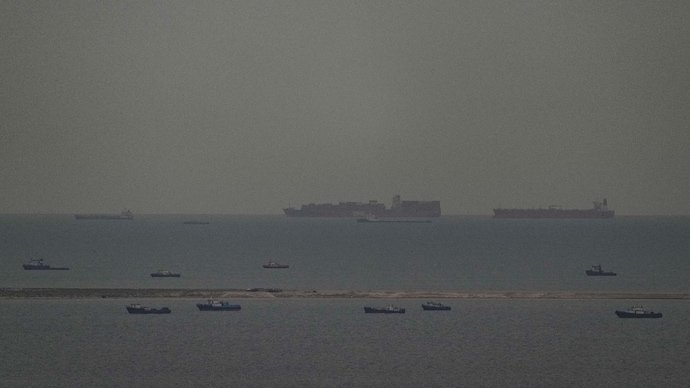
- What Is Choke Point Warfare?
- The Strait of Hormuz: Ground Zero of the Strategy
- Trump’s Strategic Shift: A Calculated Retreat?
- How Iran Built Its Choke Point Strategy
- Historical Roots: Lessons from Past Conflicts
- Expansion Beyond Hormuz: A Multi-Choke Strategy
- Global Choke Points at Risk
- Analysis: Why This Strategy Works
- Implications for the United States and Allies
- Insight: The Future of Naval Warfare
- Conclusion: A Strategy That Changed the Equation
Iran’s blockade of the Strait of Hormuz has emerged as one of the most consequential developments in the ongoing conflict, exposing a powerful yet often underestimated military strategy: choke point warfare. As global oil prices surge and supply chains strain, US President Donald Trump has signaled a surprising shift—suggesting the United States may not immediately use military force to reopen the world’s most critical energy corridor.
In his April 2 address, Trump stated that “we have all the oil we need” and predicted that “the Strait will open up naturally,” marking a notable departure from earlier threats of military escalation. The statement comes even as nearly 20 percent of the world’s oil and gas supply remains disrupted, underscoring the high stakes of Iran’s maritime strategy.
What Is Choke Point Warfare?
Choke point warfare refers to the strategic control or disruption of narrow, critical maritime routes through which large volumes of global trade and energy supplies pass. These routes—such as the Strait of Hormuz, the Suez Canal, and the Strait of Malacca—are vital arteries of the Global Economy.
By targeting these narrow passages, a nation can exert outsized influence without directly confronting a superior military force. It is a classic example of asymmetric warfare—where the goal is not to defeat the enemy outright, but to impose economic and strategic costs.
In simple terms: why fight the entire navy when you can block the doorway it needs to pass through?
The Strait of Hormuz: Ground Zero of the Strategy
The Strait of Hormuz, located between Iran and Oman, is the most critical energy choke point in the world. Roughly one-fifth of global oil and gas flows through this narrow waterway. Iran’s decision to block it following the escalation of conflict on February 28 has had immediate and far-reaching consequences.
Shipping traffic has slowed dramatically, insurance costs have surged, and oil prices have spiked by nearly 60 percent. The ripple effects are being felt across industries—from semiconductors to fertilizers—demonstrating how a localized disruption can trigger a global economic shock.
Despite extensive US and allied Airstrikes targeting over 16,000 Iranian sites, the blockade remains in place, highlighting the difficulty of countering such a strategy.
Trump’s Strategic Shift: A Calculated Retreat?
President Trump’s recent remarks suggest a possible recalibration of US strategy. Rather than forcibly reopening the strait, the US appears to be exploring alternative approaches, including pressuring allies to negotiate directly with Iran or increasing reliance on domestic energy production.
This marks a significant shift from earlier threats to target Iranian oil infrastructure and power grids. It may also indicate recognition that direct military action could escalate the conflict without guaranteeing success.
In essence, the world’s most powerful military is confronting the limits of its power—not on land or in the air, but in narrow stretches of water.
How Iran Built Its Choke Point Strategy
Iran’s approach to choke point warfare is not new—it is the result of decades of planning and adaptation. Following the US invasion of Iraq in 2003, Tehran began investing heavily in asymmetric capabilities designed to counter superior conventional forces.
These include:
- Naval mines capable of disrupting shipping lanes
- Unmanned surface vessels (USVs) for targeted attacks
- Anti-Ship Ballistic Missiles (AShBMs) to strike vessels from long distances
- Drones like the Shahed-136, providing low-cost precision strike capability
By combining these tools, Iran has created a layered defense system that can impose significant costs on any attempt to reopen blocked waterways.
Historical Roots: Lessons from Past Conflicts
The concept of targeting maritime trade routes is not new. During the Iran-Iraq War (1980–88), both sides attacked oil tankers in what became known as the “Tanker Wars.” The conflict escalated to the point where the United States intervened directly.
In Operation Praying Mantis in 1988, US forces destroyed a significant portion of Iran’s navy in a single day. Ironically, this escalation contributed to the eventual end of the war.
Even earlier, during the 1973 oil crisis, Arab nations demonstrated how control over energy supply could be used as a geopolitical weapon. Iran’s current strategy echoes these lessons but updates them with modern technology.
Expansion Beyond Hormuz: A Multi-Choke Strategy
What makes Iran’s approach particularly concerning is its potential to expand beyond the Strait of Hormuz. Iranian-backed groups, such as the Houthis in Yemen, have already demonstrated similar tactics in the Red Sea.
Using missiles, drones, and maritime surveillance, these groups have targeted commercial shipping, selectively disrupting vessels linked to adversaries. This suggests that choke point warfare is no longer confined to a single location—it is becoming a distributed strategy.
There is also growing concern about the Suez Canal, another critical global trade route. While Iran has not directly targeted it, analysts note that its missile capabilities could theoretically reach the canal, raising the stakes even further.
Global Choke Points at Risk
| Choke Point | Location | Strategic Importance |
|---|---|---|
| Strait of Hormuz | Middle East | 20% of global oil supply |
| Suez Canal | Egypt | Major Europe-Asia trade route |
| Strait of Malacca | Southeast Asia | Key shipping route for Asia |
| Panama Canal | Central America | Connects Atlantic and Pacific Oceans |
| Danish Straits | Europe | Access to Baltic Sea |
| Turkish Straits | Turkey | Black Sea access |
Iran’s ability to influence even a subset of these routes gives it significant leverage in global Geopolitics.
Analysis: Why This Strategy Works
Choke point warfare is effective because it exploits structural vulnerabilities in the global economy. Modern supply chains rely on efficiency and predictability—both of which are disrupted when key routes are blocked.
Unlike traditional warfare, which focuses on territorial control, choke point warfare targets economic lifelines. This makes it harder to counter, as military solutions may not address the underlying economic impact.
Moreover, the relatively low cost of drones and missiles compared to advanced naval fleets creates an imbalance that favors the defender.
“A ship’s a fool to fight a fort,” as the old naval adage goes—an observation that feels increasingly relevant in today’s missile-dominated maritime battlespace.
Implications for the United States and Allies
The current situation raises important questions for US military strategy. If the United States struggles to counter Iran’s relatively modest capabilities in the Strait of Hormuz, how would it להתמודד more advanced systems elsewhere?
china, for example, has developed extensive Anti-Access/Area Denial (A2AD) capabilities, including long-range missiles and drones designed to target naval forces. These systems are far more advanced and widespread than Iran’s.
The implications are clear: choke point warfare is not just a regional tactic—it is a global challenge that could redefine future conflicts.
Insight: The Future of Naval Warfare
The rise of choke point warfare signals a shift in how wars are fought at sea. Traditional naval dominance, based on aircraft carriers and large fleets, is being challenged by smaller, more agile, and technologically advanced systems.
This does not mean that navies are becoming obsolete, but it does suggest that they must adapt to new realities. Flexibility, resilience, and the ability to operate in contested environments will be key.
In many ways, the battlefield has narrowed—from vast oceans to strategic bottlenecks where every move carries global consequences.
Conclusion: A Strategy That Changed the Equation
Iran’s use of choke point warfare has already achieved significant short-term success, forcing a rethink in US strategy and highlighting vulnerabilities in the global economic system. Whether this approach can be sustained over the long term remains uncertain, but its impact is undeniable.
As the conflict continues, the world is witnessing a new form of warfare—one where control over narrow waterways can shape global outcomes. For policymakers, military planners, and businesses alike, the lesson is clear: in an interconnected world, even the smallest choke point can become the biggest battlefield.
For breaking news and live news updates, like us on Facebook or follow us on Twitter and Instagram. Read more on Latest World on thefoxdaily.com.






COMMENTS 0