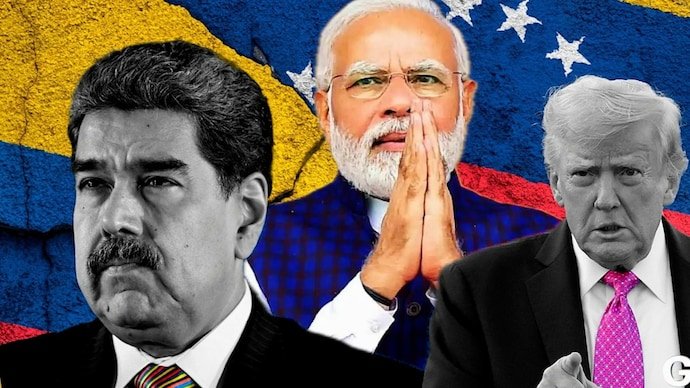
From a military, political, and economic perspective, the United States has effectively assumed control over Venezuela. Multiple reports indicate that US forces are operating on Venezuelan soil, President Nicolás Maduro is in American custody, and former US President Donald Trump has openly declared that Washington will “run the country” until a political transition is completed. For India, this moment presents a sharp strategic contradiction; for much of the world, it represents a geopolitical earthquake with far-reaching consequences.
The developments in Venezuela mark a turning point not just for Latin America, but for global energy politics. A nation that once positioned itself as a symbol of resistance to US influence now finds itself under Washington’s direct control. For New Delhi, which has traditionally advocated sovereignty and non-interference, the situation poses uncomfortable questions—yet also opens the door to unprecedented economic opportunity.
Officially, India has expressed “deep concern” over the unfolding events. However, beyond public statements, Indian energy heavyweights such as ONGC Videsh and Reliance Industries may be closely evaluating the situation for potential gains. Venezuela’s political reset could unlock a billion-dollar opportunity for Indian firms that have been constrained for years by sanctions, instability, and operational paralysis.
The Indian government’s stance has been notably measured. Without directly condemning the United States or invoking international law, the Ministry of External Affairs has adopted a neutral tone, emphasizing regional stability and the safety of Indian nationals. This restraint appears intentional. Having already faced steep tariffs and penalties for importing Russian oil, India remains wary of provoking further economic retaliation while simultaneously negotiating sensitive trade arrangements with Washington.
The stakes could not be higher. Venezuela holds the world’s largest proven oil reserves—exceeding 300 billion barrels. Yet due to years of sanctions, mismanagement, equipment shortages, and decaying infrastructure, much of this potential has remained untapped. Indian investments have been particularly affected. ONGC Videsh owns a 40% stake in the San Cristóbal onshore oilfield, which has been operating far below capacity. In addition, hundreds of millions of dollars in dividends owed to India have remained frozen since 2014.
Under a US-supervised administration, sanctions are expected to be selectively eased. This could allow ONGC Videsh to redeploy drilling rigs, revive stranded assets, and finally unlock substantial cash flows. Industry estimates suggest that San Cristóbal alone could produce between 80,000 and 100,000 barrels per day if operations are fully restored. Similarly, projects in the Orinoco Belt—where Indian firms are part of multinational consortia—could be reactivated, offering India long-term strategic supply security.
Reliance Industries also stands to benefit significantly. The company operates some of the world’s most complex refineries, optimized to process heavy crude like Venezuela’s. Reliance already holds a long-term contract—spanning 15 years—to purchase Venezuelan oil. A revival of Venezuelan exports under US oversight could provide India with competitively priced and reliable crude, reduce dependence on Middle Eastern and Russian supplies, and enhance New Delhi’s bargaining power in global energy markets.
Yet India’s path forward is fraught with geopolitical risk. Remaining silent could invite accusations of opportunism, while openly endorsing a US-led takeover might damage India’s credibility across the Global South, where sovereignty and non-alignment remain core values. Major global players such as china and Russia are watching closely, aware that a US-managed Venezuelan oil sector could dilute their influence in Latin America.
If handled with diplomatic precision, however, the changing landscape could work in India’s favor. A recalibrated Venezuelan oil industry may weaken China’s foothold in the region while offering India strategic leverage and energy diversification. The challenge lies in extracting economic benefit without compromising long-standing foreign policy principles.
This tightrope walk is clearly reflected in India’s official messaging—carefully worded, non-confrontational, and focused on stability rather than legality. It buys time while billion-dollar possibilities slowly take shape. Trump’s intervention has irreversibly altered Venezuela’s political reality, and if India proceeds with caution, experience, and strategic foresight, it could emerge as one of the few nations to convert global turmoil into lasting energy security and geopolitical advantage.
For breaking news and live news updates, like us on Facebook or follow us on Twitter and Instagram. Read more on Latest World on thefoxdaily.com.






COMMENTS 0