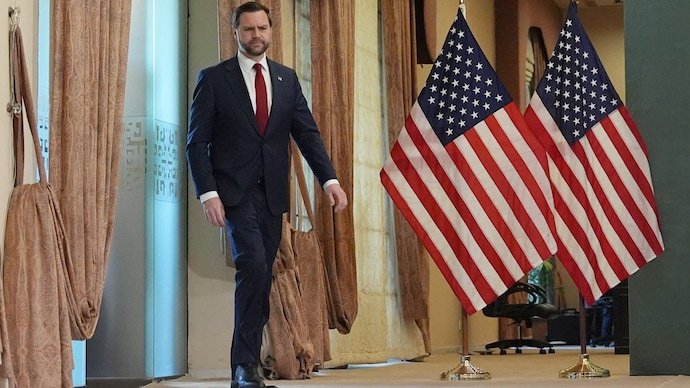
- A Mission Built on Urgency, Not Preparation
- Inside the 16-Hour Talks: Confusion and Contradictions
- Pakistan’s Role: Optics vs Outcomes
- Trump’s Messaging vs Diplomatic Reality
- The Outcome: No Deal, More Questions
- Why the Talks Failed: Key Factors
- A Defining Moment for JD Vance
- Broader Implications: Escalation Risks Grow
- Conclusion: Lessons from a Failed Diplomatic Gamble
A high-stakes diplomatic mission led by US Vice President JD Vance to Pakistan ended without a breakthrough, exposing the limits of last-minute negotiations in a rapidly escalating geopolitical crisis. The 21-hour visit, intended to revive fragile US-Iran talks and stabilise tensions in the Strait of Hormuz, concluded with no agreement, no clear commitments, and mounting uncertainty.
For Vance—widely viewed as a leading anti-war voice within President Donald Trump’s administration—the failed mission marks a significant diplomatic setback at a critical moment in global politics.
A Mission Built on Urgency, Not Preparation
The Islamabad talks were conceived as a last-ditch effort to salvage negotiations with Iran. However, unlike traditional diplomatic engagements that involve weeks of preparation, this mission was assembled in a matter of days.
This lack of groundwork proved costly. Officials reportedly struggled to align positions, while communication gaps within the US team further complicated negotiations.
Even as discussions continued behind closed doors, policymakers in Washington were said to be seeking real-time updates—an indication of the absence of a clear, coordinated strategy.
Inside the 16-Hour Talks: Confusion and Contradictions
Shifting Demands from Both Sides
The negotiations, which stretched over nearly 16 hours, were marked by inconsistent messaging and competing priorities.
Iranian officials introduced preconditions publicly, including demands such as the unfreezing of overseas assets. These statements complicated the negotiation environment before formal agreements could even be explored.
Meanwhile, US officials resisted these demands, reinforcing a sense of mistrust that lingered throughout the talks.
Lack of Clarity Within the US Camp
Perhaps more damaging was the lack of internal alignment within the American delegation. Without a unified negotiating framework, the US side struggled to present a coherent position.
This inconsistency weakened its bargaining power and made it difficult to build momentum toward a deal.
Pakistan’s Role: Optics vs Outcomes
Pakistan positioned itself as a mediator, hosting the high-level talks under tight security conditions. Islamabad saw the engagement as an opportunity to elevate its diplomatic profile on the global stage.
Security arrangements were extensive:
- Major roads were cleared and sealed
- Movements were tightly controlled
- Talks were conducted entirely behind closed doors
However, despite the strong optics, there was little evidence of tangible progress. The gap between expectations and outcomes became increasingly apparent as the talks unfolded.
Trump’s Messaging vs Diplomatic Reality
While Vance was engaged in negotiations, President Donald Trump projected a contrasting tone publicly. He downplayed the urgency of reaching a deal and emphasized US strength and leverage.
This divergence in messaging may have undermined the переговорation process. Diplomacy often relies on consistent signals, and mixed narratives can weaken credibility and trust.
For Iranian negotiators, such contradictions likely reinforced skepticism about US intentions.
The Outcome: No Deal, More Questions
Vance’s Acknowledgment of Failure
By the end of the visit, the tone had shifted significantly. JD Vance, appearing visibly fatigued, acknowledged that the talks had fallen short of expectations.
He admitted “shortcomings” and confirmed that the US had failed to secure key commitments, particularly on Iran’s nuclear programme.
He provided limited details, took few questions, and departed quickly—leaving critical issues unresolved.
Key Uncertainties Remain
- Future of the ceasefire remains unclear
- Status of Iran’s nuclear commitments unresolved
- Security of the Strait of Hormuz still uncertain
These unresolved issues continue to fuel global concern.
Why the Talks Failed: Key Factors
| Factor | Impact |
|---|---|
| Rushed Planning | Limited preparation weakened negotiation strategy |
| Mixed Messaging | Contradictory signals reduced credibility |
| Mistrust | Preconditions and pushback deepened divides |
| Lack of Coordination | Internal misalignment hindered progress |
A Defining Moment for JD Vance
The failed mission represents a critical moment in JD Vance’s political and diplomatic trajectory. Known for his skepticism toward military intervention, he was seen as a potential bridge-builder capable of easing tensions.
Instead, the outcome has tied him to a high-profile diplomatic setback.
This raises important questions about:
- His influence within the administration
- The viability of anti-war diplomacy in high-pressure scenarios
- The broader direction of US foreign policy
Broader Implications: Escalation Risks Grow
The collapse of talks comes at a time of rising tensions in the region, particularly around the Strait of Hormuz. Without a diplomatic breakthrough, the likelihood of further escalation increases.
Global stakeholders—including major energy importers and international allies—are closely watching developments, as any disruption could have significant economic and security consequences.
Conclusion: Lessons from a Failed Diplomatic Gamble
JD Vance’s 21-hour visit to Pakistan underscores the challenges of crisis diplomacy in a fast-moving geopolitical landscape. While the mission aimed to achieve a breakthrough, it ultimately highlighted the importance of preparation, coordination, and consistent messaging.
The failure to secure an Iran deal leaves the region in a precarious position, with tensions unresolved and risks escalating.
Looking ahead, the focus will shift to whether diplomatic channels can be rebuilt—or whether the current trajectory leads to deeper confrontation. In either case, the Islamabad talks will be remembered as a moment where urgency overtook strategy, and opportunity slipped away.
For breaking news and live news updates, like us on Facebook or follow us on Twitter and Instagram. Read more on Latest World on thefoxdaily.com.






COMMENTS 0