A rare public crisis between two of the Gulf’s most powerful allies deepened on Tuesday after the United Arab Emirates announced it would withdraw its remaining personnel from Yemen. The move came just hours after Saudi Arabia reportedly backed a request for Emirati troops to leave the country within 24 hours, underscoring a sharp deterioration in relations between the longtime partners.
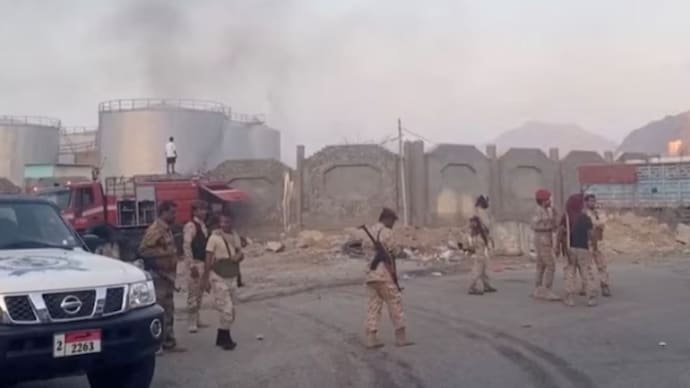
The UAE’s announcement followed a dramatic Saudi-led coalition airstrike on the southern Yemeni port city of Mukalla. Riyadh said the strike targeted a weapons shipment allegedly linked to the UAE, a claim that Abu Dhabi has firmly denied. The incident represents the most serious escalation yet in the growing rift between Saudi Arabia and the UAE, once closely aligned in the Yemen conflict.
Saudi Airstrike Raises Stakes in Gulf Dispute
Coalition aircraft under Saudi command struck the port of Mukalla just hours before Abu Dhabi declared the end of its mission in Yemen. Saudi officials said the attack was aimed at preventing the distribution of weapons and ammunition allegedly destined for various parts of Yemen’s Hadramout province, calling it a necessary step to protect Saudi national security.
The strike highlighted how far tensions have escalated between the two kingdoms, long regarded as twin pillars of Gulf and regional security. While Saudi Arabia described the shipment as a direct threat, the UAE rejected the accusation outright.
Abu Dhabi insisted that the shipment was not a weapons consignment but supplies meant for its own personnel operating in Yemen. The UAE’s Ministry Of Defence, quoted by state news agency WAM, said it was “surprised by the airstrike” and stressed the need for a solution that would “prevent escalation, based on reliable facts and existing coordination mechanisms.”
Washington Steps In as Diplomatic Pressure Mounts
Amid the escalating tensions, the United States moved quickly to contain the fallout. The US State Department said Secretary of State marco rubio held separate discussions with the foreign ministers of Saudi Arabia and the United Arab Emirates in Washington, focusing on regional security concerns and the deteriorating situation in Yemen.
Several other Gulf nations, including Bahrain and Kuwait, voiced support for enhanced dialogue and diplomatic engagement to defuse the crisis. Qatar also weighed in, emphasizing that the security of Saudi Arabia and other Gulf states is inseparable from its own, reflecting broader regional unease over the dispute.
UAE Declares Mission in Yemen Over
In its formal statement, the UAE’s Ministry of Defence said it had decided to voluntarily end the mission of its remaining counterterrorism forces in Yemen. Abu Dhabi had already significantly scaled back its military presence in the country in 2019, shifting its focus away from frontline combat operations.
The ministry said recent developments prompted a comprehensive review of its involvement. “Our remaining mission was limited to specialized personnel as part of counterterrorism efforts, carried out in coordination with relevant international partners,” the statement said, adding that the mission had now concluded.
Saudi Arabia and UAE: Diverging Interests in Yemen
According to reports, Saudi Arabia has accused the UAE of backing Yemen’s Southern Transitional Council (STC), a separatist group seeking autonomy or independence for the south. Riyadh has alleged that STC forces, with Emirati support, have advanced in ways that threaten Saudi security—something the kingdom has described as a clear “red line.”
While Saudi Arabia and the UAE initially fought side by side against the Iran-aligned Houthi movement, their strategies gradually diverged. The UAE cultivated strong ties with southern separatist groups, while Saudi Arabia continued to support Yemen’s internationally recognized government.
Rashad al-Alimi, head of Yemen’s Saudi-backed presidential council, accused Abu Dhabi of directing the STC to undermine state authority. Yemeni official media reported that Alimi gave Emirati forces 24 hours to leave the country, alleging that the UAE had encouraged military escalation.
“It has been definitively confirmed that the United Arab Emirates pressured and directed the STC to rebel through military escalation,” Alimi said in a televised address.
Oil Markets and Regional Stability at Risk
The dispute has also rattled financial markets, with tensions between Saudi Arabia and the UAE raising concerns about coordination between the two major OPEC members. Any prolonged disagreement could complicate oil production policy at a time of global economic uncertainty.
Saudi Arabia and the UAE are among eight OPEC+ countries scheduled to hold a virtual meeting on Sunday, where markets expect an extension of current production levels. The uncertainty surrounding their relationship has already contributed to declines in major Gulf stock indexes.
While the UAE’s withdrawal from Yemen could ease immediate tensions on the ground, analysts say it remains unclear whether Abu Dhabi will continue to offer political or financial support to the Southern Transitional Council. The long-term implications for Yemen’s fragile stability—and for Gulf unity—remain uncertain.
For breaking news and live news updates, like us on Facebook or follow us on Twitter and Instagram. Read more on Latest World on thefoxdaily.com.





COMMENTS 0