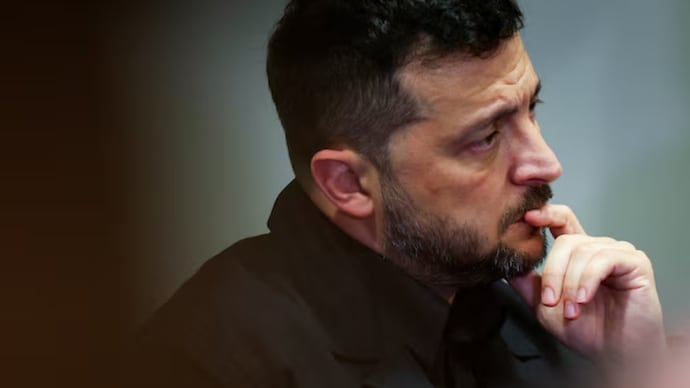
As fresh diplomatic efforts to resolve the war with Russia began in Berlin on Sunday, Ukrainian President Volodymyr Zelenskyy announced that Kyiv is prepared to step back from its long-held goal of NATO membership in exchange for strong, legally enforceable security guarantees from Western partners.
Zelenskyy’s announcement came as he arrived in the German capital for in-person discussions with senior US figures, including presidential adviser Jared Kushner and Steve Witkoff, former US President Donald Trump’s special envoy. The meetings signal a renewed push by global powers to explore a negotiated settlement to the conflict.
Additional European leaders are expected to arrive in Berlin on Monday for further talks, underscoring the growing international focus on ending what has become the deadliest conflict in Europe since World War II.
Since Russia’s full-scale invasion in 2022, Ukraine’s drive to join the Western military alliance has been a central pillar of its National Security strategy. NATO membership was widely seen in Kyiv as the most reliable deterrent against future Russian aggression.
THE CORE CONCESSION AIMED AT BREAKING THE DEADLOCK
Ahead of the Berlin negotiations, Zelenskyy made clear that comprehensive security guarantees from the United States, European nations, and other allied countries could serve as an alternative to NATO membership.
“From the very beginning, Ukraine’s desire was to join NATO, because these are real security guarantees. However, some partners in the US and Europe did not support this direction,” Zelenskyy said while responding to questions from reporters in a WhatsApp briefing.
He explained that Ukraine is now seeking bilateral and multilateral guarantees, including NATO Article 5–style commitments from Washington, alongside security assurances from European partners and other allies such as Canada and Japan.
“These guarantees would be an opportunity to prevent another Russian invasion,” Zelenskyy said, adding that Ukraine’s willingness to compromise on NATO membership already represents a significant concession.
The Ukrainian president stressed that any such guarantees must be legally binding and enforceable, warning that vague political assurances would not be sufficient to protect the country’s long-term security.
BERLIN TALKS MOVE FORWARD
According to Reuters, German Chancellor Friedrich Merz, who is hosting the talks, delivered brief opening remarks before allowing US and Ukrainian representatives to proceed with closed-door negotiations.
Zelenskyy said that Ukraine, the United States, and European allies are currently reviewing a proposed 20-point framework that could pave the way for a ceasefire. He clarified that, at this stage, there are no direct negotiations taking place between Kyiv and Moscow.
“A ceasefire along the current front lines would be a fair option,” Zelenskyy stated, suggesting that freezing the conflict could serve as a first step toward a broader political settlement.
RUSSIA’S LONG-STANDING DEMANDS
Moscow has consistently demanded that Ukraine abandon its NATO aspirations and adopt a neutral status. Russian President Vladimir putin has also insisted that NATO forces must not be deployed on Ukrainian territory.
In addition, the Kremlin has called on Kyiv to withdraw its troops from parts of the Donbas region that remain under Ukrainian control, conditions that Ukraine has repeatedly rejected as unacceptable.
Zelenskyy has previously emphasized that any peace agreement must ensure a “dignified” outcome for Ukraine and include firm guarantees that Russia will not launch another invasion in the future.
The United States has increased pressure on Kyiv in recent months to engage seriously in diplomatic efforts. At the same time, Zelenskyy has accused Russia of deliberately prolonging the war through sustained missile and drone attacks on Ukrainian cities and critical infrastructure, including power and water systems.
Earlier US-backed proposals that reportedly included territorial concessions by Ukraine, the abandonment of NATO ambitions, and limits on Ukraine’s armed forces were later reshaped by Britain, France, and Germany. European leaders have described those initial terms as unacceptable and potentially dangerous for long-term regional stability.
As talks continue in Berlin, Ukraine’s decision to trade NATO aspirations for binding security guarantees marks a pivotal moment in the search for a negotiated end to the war—one that could redefine the country’s future security architecture and its relationship with the West.
For breaking news and live news updates, like us on Facebook or follow us on Twitter and Instagram. Read more on Latest World on thefoxdaily.com.





COMMENTS 0