Fresh reports indicate that the United States military is preparing contingency plans for sustained, weeks-long military operations against Iran if President Donald Trump authorizes action. According to two US officials who spoke to Reuters on condition of anonymity due to the sensitivity of the matter, the scale of preparation points to a potentially far more serious confrontation than previously witnessed between Washington and Tehran.
The disclosure comes at a critical diplomatic juncture, just ahead of scheduled talks in Geneva where Omani diplomats are set to mediate discussions between Iranian representatives and US envoys Steve Witkoff and Jared Kushner. The timing of the report has intensified speculation over whether diplomacy or military escalation will define the next phase of US-Iran Relations.
Diplomacy Under Pressure as Military Presence Expands
Despite President Trump’s stated interest in securing a deal with Tehran, senior US officials have publicly acknowledged the complexity of the negotiations. Secretary of State Marco Rubio recently remarked that reaching an agreement would be “very hard to do,” underscoring the deep mistrust between the two nations.
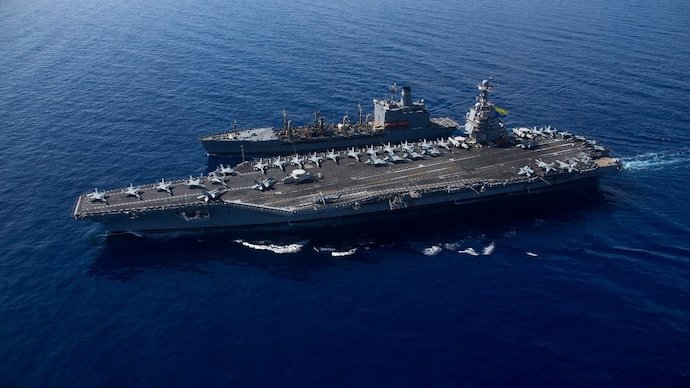
Simultaneously, the Pentagon has bolstered its military posture in the Middle East. US authorities confirmed that an additional aircraft carrier strike group is being deployed to the region. The reinforcement includes thousands of troops, advanced fighter aircraft, guided-missile destroyers, and other strategic assets capable of both offensive strikes and defensive operations.
Such deployments signal preparedness for rapid escalation while maintaining deterrence against potential Iranian retaliation.
Trump Raises Possibility of Regime Change
President Trump further heightened tensions during remarks at Fort Bragg in North Carolina, where he publicly raised the possibility of regime change in Iran. He suggested that such an outcome “seems like that would be the best thing that could happen,” though he declined to identify any preferred successor leadership.
“For 47 years, they’ve been talking and talking and talking,” Trump stated, referencing longstanding tensions since the 1979 Islamic Revolution.
While Trump has previously expressed reluctance to deploy large-scale ground forces — noting last year that “the last thing you want to do is ground forces” — analysts observe that current US military positioning emphasizes airpower, naval capabilities, and precision strike assets rather than a full-scale invasion.
White House: ‘All Options on the Table’
Responding to inquiries about preparations for a prolonged campaign, White House spokesperson Anna Kelly stated that “President Trump has all options on the table with regard to Iran.”
She added that while the president listens to diverse viewpoints on national security issues, he ultimately makes decisions based on what he believes is best for the United States and its strategic interests.
The Pentagon has declined to provide further comment on operational specifics.
From Limited Strikes to Broader Campaign?
The United States previously conducted targeted strikes on Iranian nuclear facilities, including the June “Midnight Hammer” operation involving US-based stealth aircraft. That action was widely characterized as a limited, one-time strike. Iran responded with a relatively restrained retaliation against a US base in Qatar.
However, officials now indicate that current planning is significantly more complex. According to one source, a sustained campaign could target not only nuclear infrastructure but also Iranian state and security installations. The official did not disclose operational details.
Experts warn that any prolonged conflict would expose US forces to heightened risk, given Iran’s extensive missile arsenal and network of allied militias across the region.
Regional Risks and Strategic Calculations
American military installations across Jordan, Kuwait, Saudi Arabia, Qatar, Bahrain, the United Arab Emirates, and Turkey could become potential targets in the event of Iranian retaliation. Iran’s Revolutionary Guard has warned that any attack on Iranian soil would trigger responses against US bases in the region.
One US official acknowledged that Washington anticipates retaliatory action, potentially resulting in a cycle of strikes and counter-strikes that could destabilize the broader Middle East.
President Trump has repeatedly cited Iran’s nuclear ambitions, ballistic missile development, and suppression of domestic dissent as justification for maintaining a hardline stance. He warned recently that the alternative to diplomacy would be “very traumatic.”
Israel and Opposition Voices Weigh In
During a recent meeting in Washington, Israeli Prime Minister Benjamin Netanyahu emphasized that any agreement with Iran must address security elements vital to Israel. Tehran, for its part, has denied that its missile program is subject to negotiation but has indicated willingness to discuss curbs on its nuclear activities in exchange for sanctions relief.
Meanwhile, Iranian opposition figure Reza Pahlavi — the exiled son of the overthrown shah — argued that US military action could accelerate political change inside Iran. In remarks to Reuters, he suggested that an external strike might weaken the ruling establishment and empower domestic dissent.
Pahlavi, who has lived in exile since before the 1979 revolution, claimed there are signs of internal instability and urged Washington not to prolong nuclear negotiations if they fail to yield meaningful concessions.
Diplomacy or Escalation: A Defining Moment
As Geneva talks approach, the dual-track strategy of military readiness and diplomatic engagement places US-Iran relations at a critical crossroads. The coming days may determine whether tensions de-escalate through negotiation or evolve into a sustained regional confrontation with far-reaching consequences.
With forces mobilized, rhetoric sharpened, and regional actors closely watching, the geopolitical stakes have rarely been higher.
For breaking news and live news updates, like us on Facebook or follow us on Twitter and Instagram. Read more on Latest World on thefoxdaily.com.






COMMENTS 0